UniteBoston

Bridging Divides Across Christians for the Flourishing of the City

  • Home
  • Events
    • Submit Event
  • Join In
    • Beloved Community Lab
    • Migrant Care and Solidarity
    • The Church and Civic Engagement
    • The ATTIC
    • Kingdom Conversations
    • Worship & Pray
    • Boston Flourish
  • About
    • UB Board, Staff & Volunteers
    • Cohorts
    • Missional Letter
    • Annual Reports
    • History
    • Christian Unity
  • Forums
  • Blog
  • Give
  • Contact
  • Search

Aug 15 2024

Examining What Lies Beneath

In the blog below, UniteBoston’s Executive Director Rev. Kelly Fassett shares a transparent reflection on her heart posture in recent events, including the near assassination of former President Trump, and what this revealed within her.

In our polarized climate, violence in thought and action can show up in surprising places – It is vital that we pastor the instincts in our own hearts in order to follow Jesus as the Prince of Peace. Rev. Kelly calls followers of Jesus to do the hard work of uncovering what lies beneath to discover where we might be holding enmity and offers a spiritual practice to do just this. 


What was your first reaction to hearing about the near assassination of former President Trump?

I have to admit, my initial reaction isn’t one that I am proud of. 

I was on a brunch date with my husband and we were talking about this situation, and out of my mouth came the statement, “I almost wish that the bullet hadn’t missed.”

Friends, even writing this today, I feel a little vulnerable about being so public about my sins. I am registered an Independent voter and find myself in the middle of many social issues. Plus, I had a lot of reasons for justifying my beliefs: I am a person that highly values integrity in leadership and for me, how President Trump seems to see himself as being above the law rubs me the wrong way. I also have been disturbed by how he treats other people, such as the language that he uses to disparage minority groups, and how he seems to exercise power in an authoritarian manner that demands unquestioning obedience.

When I said that I almost wished the bullet hadn’t missed, it surprised me. There are a lot of Republicans in my life that I have a lot of respect for and love dearly, yet I realized that this came from an underlying belief that at some level that if President Trump wasn’t around, life in America might be a bit better for everyone. My husband responded, “I think you have a little soul searching to do.” And he was right.

I can believe all of these things, yet willing the destruction of another person is never OK, especially for those who are following Jesus. Here’s why.

We must distinguish whether our innermost posture is an opponent to disagree with or an enemy to be destroyed. If our instantaneous reaction is anger, rage, or destruction, we must examine where that is coming from. I’ve found that anger is often protecting something that is dear to us, driven by a sense of justice to fight for what is right and good and true. Jesus himself was angry at times (Mt 21:12-13), but wanting the worst for another person is not of God. Even if I disagree with former President Trump on many aspects of his leadership and treatment of others, he is still a child of God, made in God’s image, and beloved. This has to be the beginning and end of how I treat him, in posture and action

Our cohorts are currently unpacking the biggest barriers hindering Christian unity, and one of them we have identified is “righteous hubris.” Righteous hubris is identity by hostility – we know who we are because we know who we are against. Often we know that we are holding righteous hubris when we have a sense of vengeful glee inside ourselves at the sight of an “enemy” failing or being defeated, or we make plans to destroy the “other side” and undermine their credibility. While I myself would not be the one to inflict violence on former President Trump, I was OK with someone else doing it. 

And yet, Jesus calls us to a higher place: we are not just called to love those most like us, but to love our enemies (Mt 5:44). Jesus describes, “If you love those who love you, what reward will you get? Are not even the tax collectors doing that? And if you greet only your own people, what are you doing more than others? Do not even pagans do that?” (Mt 5:46-47). Jesus is calling his followers to embody an unlikely love: a love for those on the “other side.” This is a supernatural love, as social science points to the reality that being with people who are different than you is cognitively taxing. Yet at a time when so many are carrying enmity and pointing fingers rather than looking at our darkness within, I believe that Christians who are carrying Christ’s humble, authentic, enemy-embracing love can shine brightly. 

Here is a working diagram on the spectrum of disunity that Devlin and I have been drafting this week as we’ve been thinking about this. It moves from:

  • Diversity, which is to be understood, honored, celebrated, and valued
  • To Disagreement, which are areas we grieve where followers of Jesus who are earnestly seeking to follow Jesus land in different places
  • To Division, which is an inward posture of hostility, contempt, and vengeance against those on the other side
  • To Destruction, which are violent actions taken to undermine someone’s credibility, such as slander, or hate crimes. 
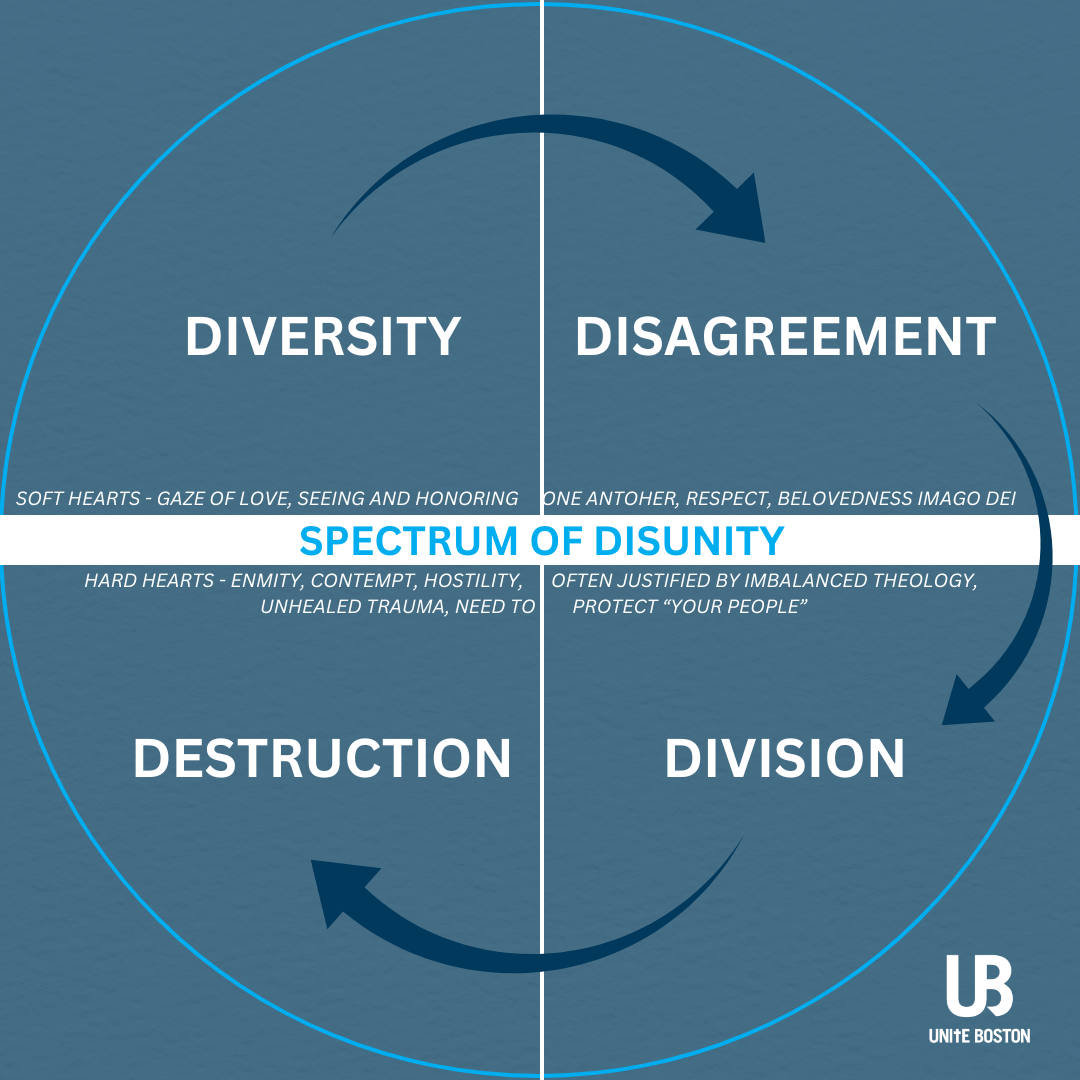
As you do this inward examination, are you above the line, with a soft heart that sees and honors the inherent imago dei, or are you below the line, holding inward postures of enmity, hate or even destruction? We know we have crossed the line from living in the way of Jesus when we sense the visceral reactions “below the line” within us. 

There are a lot of people who are acting in the name of Jesus, and this doesn’t make everything right and good and true. I’ve found it important to distinguish ideologies from the people who hold those ideologies. Our “struggle is not against flesh and blood, but against the rulers, against the authorities, against the powers of this dark world and against the spiritual forces of evil in the heavenly realms” (Ephesians 6:12). We can call out the evil in systems and structures that value some over others; and simultaneously love people, seeking the best for everyone we meet, “clothing ourselves with compassion, kindness, humility, gentleness and patience” (Colossians 3:12-13).

I shared this story in our Christian unity working group, and it opened up an incredible time of confession where others shared moments where they also had held ill will or sought destruction of others in various ways. And if we are honest, this is true about all of us at some times. For you, maybe it’s not former President Trump you feel such ill will towards – maybe Joe Biden, Kamala Harris, or some other political figure. Or a neighbor, colleague, or even family member you have a strained relationship with over politics.

I want to invite you: When a situation occurs and you have a visceral emotional reaction, pause and consider:

  • Get curious about yourself: Where is this feeling coming from? Why am I feeling threatened? What does it bring up for me? 
  • Get curious about the other person: Put yourself in the other person’s world and understand where they might be coming from. What is God’s truth for this person and situation? How might I need to shift my perspective and heart posture to see this person as beloved and made in God’s image? 
  • What changes might I need to make in my own life to ensure I can see the world and all of God’s children rightly? Where might repair be needed, within me or within the broken system that this situation reveals?

Photo Credit: Daiga Ellaby

We must do the hard work of pastoring the underlying postures of righteous hubris, of enmity and hostility that show up in our hearts, so that it doesn’t evolve into destruction or violence, the fourth component of this diagram. I grieve the situation that occured a few weeks ago where five LGBTQ+ affirming churches in the area were desecrated. Unfortunately, those that committed these acts left signs that they were Christians doing this in the name of Jesus Christ.

The UniteBoston Board and staff released a statement standing with the Massachusetts Council of Churches condemning this desecration: “While there is much diversity on the perspectives of marriage and sexuality, how we hold our beliefs and treat one another matters. Our savior Jesus Christ calls us to be one and violence is never the answer to resolving our differences. We are called to love our neighbor as ourself (Mk 12:31) and Jesus implores us to hold a love even for one’s enemy (Mt 5:44). We pray that Christians in our area would be known for upholding love and respecting the imago dei of all of our neighbors across typical lines of division, as a public witness to the reconciling love of Jesus.”

So, dear friends, when we see the darkness in our hearts, join me in doing the hard work of uncovering what lies beneath. In a world that is characterized by so much dissension, enmity, and finger-pointing, may we do the inner work so we can be a different kind of people: following the Prince of Peace to transform our “acts of the flesh,” including hatred, discord, rage, selfish ambition, dissensions, and factions, to the “fruit of the Spirit”: love, joy, peace, forbearance, kindness, goodness, faithfulness, gentleness and self-control (Galatians 5:19-21). This type of transformation needed so we can humbly and authentically witness to the way of Jesus, for the glory of God and the good of the city. 

– Rev. Kelly

P.S. The views mentioned are Rev. Kelly’s personal thoughts and opinions, not the views of UniteBoston. UniteBoston’s community encompasses Christians of many different backgrounds, convictions, and opinions and we encourage individuals to have honest, courageous conversations of listening, learning and story-sharing with those they may disagree with to grow in our embodiment of Christian unity. Feel free to reach out to me with any thoughts that this article brought up for you – I’d love to hear from you!

P.P.S. The UniteBoston board and staff believe this is a kairos moment for the Church. In the coming UniteBoston newsletters, we will be featuring resources on how Christians can engage well civically in this political climate, including a featured series with various articles, curriculums and spiritual practices. UniteBoston will also be hosting an event this fall for Christian pastors and leaders to experience a space of deep listening and connection about living and leading throughout this election year and to be a public witness to our churches and our city that the way of Jesus is to reconcile divides and to love our neighbor through intentional, curious, respectful conversation. If this is something you’d like to be part of please reach out to us. 

Further Resources:

  • REFLECT: On how we are to imitate the role of Jesus as a peacemaker with these resources from Common Ground USA.
  • REFLECT: Dr. Alison Cook has a powerful model for pastoring our instincts with her tool “Taking A You-Turn.”
  • READ: How to Have an Enemy: Righteous Anger and the Work of Peace by Melissa Florer-Bixler. This is a fabulous book describing what the Bible says about enemies, sharing “a theology that allows us to name our enemies as a form of truth-telling about ourselves, our communities, and the histories in which our lives are embedded.” 
  • LEARN: ​The After Party – This is a “free six-part video course designed to provide churches, small groups, and individuals with an on-the-ground, biblically based approach to navigating today’s challenging political environment.” The study can be used for individuals or as a small group curriculum, offering participants opportunities to examine their own political identities, consider the “how vs. the “what” of politics, and explore what the Bible has to say about it all.
  • LISTEN: Kingdom of Jesus by The Porter’s Gate, Jon Guerra, and Sandra McCracken. I’ve been listening nonstop to this song; it reminds me of the humble, upside-down ways of Jesus, our Prince of Peace: “His Kingdom is not one of slander or rage but one that is ruled by the Lamb who was slain, And is worthy of wisdom and honor and glory and strength…Oh say can’t you see, we have one allegiance. It’s to the Kingdom of Jesus.”

Written by uniteboston · Categorized: Blog, FROM THE UB LEADERSHIP, RESOURCES, Unity & Reconciliation · Tagged: christian unity, lent, transformation, uniteboston, unity

Jul 09 2024

God has a province for you to oversee

Apply for the next Boston Fellows cohort!  Sept 2024 to May 2025
Boston Fellows is a nine-month program that helps early- to mid-career professionals cultivate the insights and spiritual habits necessary for meaningful vocation, in a cohort of peers, spiritual leaders, and professional mentors. Read what recent alumni are saying about the program here.   Application deadline: August 1.
For more info and to apply visit bostonfellows.com or contact communications@bostonfellows.com

Written by Andrew Walker · Tagged: boston fellows, transformation, work

Dec 01 2023

Advent Resources: Waiting, Longing and Yearning for God Together

“In Advent we are ushered into a time of waiting where we are connected again with our desire, our longing, and our yearning for God.”

This Sunday is the first Sunday of Advent, where Christians throughout the world are anticipating Jesus’ arrival and contemplating what it means for the God of the universe to be present with us. Katie Oxley, former director of the Young Adults Ministry at the Paulist Center (a Catholic community in downtown Boston) offers these resources and practices for all Christians to ready our hearts for the coming of Christ.

(This article was originally posted in 2018 and has been updated)


With Thanksgiving suddenly behind us, we are launched full-force into the Christmas season. Stores are all playing Christmas music, Starbucks has brought out their red cups, and Christmas Tree lots are popping up on every abandoned roadside corner.

Yet amidst the inevitable hustle and bustle of this time of year (this “getting ready” for Christmas), we often neglect the most important preparation we need to be doing–readying our hearts and lives for the coming of Christ. This is why remembering the season of Advent is important. In Advent we are ushered into a time of waiting where we are connected again with our desire, our longing, and our yearning for God. Joan Chittister, in the book The Liturgical Year, comments: “The year opens with Advent, the season that teaches us to wait for what is beyond the obvious. It trains us to see what is behind the apparent. Advent makes us look for God in all those places we have, until now, ignored.”

Advent is a time when we, too, are invited to sink deeply into ourselves and re-orient ourselves to the world and to God. It is a humble time of recognizing one’s need, and yearning for God’s powerful presence to break into the world.

The waiting we are called to do during Advent is not the busy, numbing, frenetic kind of waiting, but the stilling, germinating kind that connects you deeply with the present and your true self. We await the celebration of the human arrival of Jesus and we anticipate the eventual Second coming of Christ, but more profoundly, we open ourselves up to await the in-breaking of God into our own personal lives and communities here in the present. It is a time to connect with our hope and our desire.

Desire is more than wanting; it is longing, yearning, a deep-seated hope that has the power to burn into being a multitude of things. Theologian Wendy Farley, author of The Wounding and Healing of Desire, wrote, “Desire is the absurdity that holds open the infinity of possibility.” From experience, many of us have learned that desire itself often feels foolish. We are all familiar with the devastation of disappointment and have, in turn, used it to disown, numb, and shrink our desire.

Advent is a season for us to settle down deeply into ourselves–to hear our heart cry, to find that spark of life and hope deep within the darkness of unknowing. Desires unfulfilled. Hope unmet. Longing unsatisfied. It is a time of discernment, of waiting, of being present. It is an active waiting. Because of this, it seems appropriate that in the northern hemisphere, this is the darkest time of year.  I’ve heard that that is one of the reasons why the celebration of Christmas was set for end of December. Because in a very real way, it is the Christ child that ushers in the light.

Just as in the Jewish tradition, each day begins at sunset, begins with darkness, so it seems appropriate that the beginning of the church calendar would likewise begin in stillness and the dark, with us facing our deepest fears and desires, cultivating our hope for the light. In the silence and the darkness, we hear our own heart’s cry, our own flame of desire, our own longing for God.

During the season of Advent I invite you to not get caught up in the frenetic chaos of holiday preparation, but do the work of preparing your soul, of reconnecting with yourself and your desire.

Practices

For Waiting:

–Advent Calendar: Whether it’s a common chocolate-filled one from the grocery store, or something you make yourself, have an Advent Calendar is a great way to mark the days of Advent and slow your pace in preparation for Christmas. This daily reminder of the season invites us to show up each day to reveal what lies hidden and trust that there is goodness even in darkness.

–Slow Decorating:  Although the stores are already filled with Christmas lights and decorations, consider taking a slower approach in your own home. As tempting as it is to jump right into all the Christmas cheer, carve out space and time for Advent -intentional preparation. Consider waiting to listen to Christmas Music, or decorate your home with Advent decor instead of Christmas lights. One nice practice is to get a tree, but to slowly decorate it -one ornament a day to let to the preparation for Christmas be a slow build. And to remind us of the process of preparing.

-Scripture: (From Park Street Church) How would you define hope? Did you know that the word doesn’t appear in the Bible until Ruth 1:12, when Naomi uses it? After that, it occurs 184 times. Interestingly it is often translated “wait”!
See if these verses help you come up with a definition of hope. Notice how they incorporate both the saving and judging nature of God’s two comings.

  • Job 13:15-16
  • Psalm 25:3,6,7
  • Psalm 42:5
  • Lamentations 3:19-25
  • Rom. 5:1-6
  • 1 Thessalonians 1:2, 3
  • Hebrews 6:17-20
  • 1 Peter 1:13

Also, meditate on (i.e. savor, chew slowly, ponder, repeat, reflect upon) Romans 8:22-25:

We know that the whole creation has been groaning as in the pains of childbirth right up to the present time. Not only so, but we ourselves, who have the firstfruits of the Spirit, groan inwardly as we wait eagerly for our adoption as sons, the redemption of our bodies. For in this hope we were saved. But hope that is seen is no hope at all. Who hopes for what he already has? But if we hope for what we do not yet have, we wait for it patiently.

– Reflection: Last, this one page PDF from Leadership Transformations invites you to consider God’s invitation to watch and wait this Advent season. Download it here and spend some slow and spacious time in prayerful reflection.

For Remembering:

-The Jesse Tree: This ancient practice is a great way to prepare for Christmas through Storytelling. A Jesse tree is typically a bunch of bare branches collected in a jar or vase, and then hung with different items or ornaments throughout Advent. Each of these ornaments is a symbol of a particular Bible story or Character. (like an Apple for Adam, or some wheat for Ruth) Each day as you hang the ornament reflect on that story, part of the Genealogy of Christ, and part of our own spiritual ancestry.

–Nativity Scene Journey: Sink into the story of Christ’s birth slowly by allowing your nativity scene to play out the story across your living room. Start with the Angel and Mary for the annunciation, then the journey to Bethlehem. The wise men can be traveling from the bedroom or some other location. Move each set along every few days throughout Advent and until Epiphany (when the Wise Men arrive).

For Preparing:

-Make an Advent Wreath: This is a practice often done in community at your local Parish, but can just as easily be done at home too. One of the best ways to do it is by going on a walk near your home and gathering items to make your own wreath –Fallen greens, berries, pine cones, etc. Once it’s made, set 4 candles (safely) in it and light one each week as you read the Scriptures for the week. Or as a way to intentionally reflect on the 4 markers of Advent: Hope, Peace, Joy, Love.

-Lectio Divina: Also called “sacred reading” Lectio divina is the process of sitting with a text and allowing God to speak to you through it. This is a great way to come into connection with God and to prepare you heart during the Advent Season. Try doing Lectio Divina during Advent with the O Antiphons or with the verses of O Come O Come Emmanuel.

Feast days/practices

-St. Nicholas -December 6th (Gifts in Stockings and Cookies)

–Immaculate Conception -December 8th (Song of Mary)

-St Lucy’s Day -December 13th (Make a Special Breakfast)

Thoughtful Blog posts, articles, and videos:

Check out the Zeteo Resource Guide for Advent to find links to a number of different Advent series ideas, including worship liturgies, prayer guides, sermons, candle series, and more.

Collection of art and reflections for the 4 weeks of Advent

http://adventdoor.com/

Blogposts, podcasts, and resources

https://www.asacredjourney.net/advent-practices-resources/

Small video description of Advent

http://bustedhalo.com/video/watch-advent-two-minutes

A digital Advent Calendar with new reflections and resources each day

https://advent.bustedhalo.com/

Great collection of resources: videos, reading material, and practices:

http://bustedhalo.com/?s=Advent

Another digital Advent Calendar with new reflections and resources each day

http://grottonetwork.com/advent-calendar/

Collection of resources: videos, reading material, and practices:

https://godinallthings.com/?s=advent

Great collection of resources: videos, reading material, and practices:

https://www.ignatianspirituality.com/?s=Advent

Collection of Essays/posts about Advent

https://theseattleschool.edu/?s=Advent&submit=Search

Collection of resources: videos, reading material, and practices:

http://www.missioalliance.org/search/Advent/

Practice ideas: including food & music & options for kids

http://www.carrotsformichaelmas.com/2017/11/30/liturgical-living-at-a-glance-december-2017/

Reading Material:

Preparing for Christmas -Richard Rohr

To Dance with God -Gertrude Mueller Nelson

The Liturgical Year -Joan Chittister

Written by uniteboston · Categorized: Advent, Blog, RESOURCES, SPIRITUAL FORMATION & EVANGELISM · Tagged: community, jesus, peace, transformation, unity

Nov 27 2023

The Dark Hours of Advent

The Dark Hours of Advent

A song cycle based on Rainer Maria Rilke’s Book of Hours
Composed by Christopher Greco, piano and vocals

With guest musicians Cliff Chuang, Pierson Wetzel, and Andy Young

English translations of poems by Anita Barrows and Joanna Macy
English translation of Rilke’s letters by Stephen Mitchell

This program will include excerpts of advent hymns and readings.
Sunday, December 10, 6:30 p.m.
Reservoir Church, The Chapel
15 Notre Dame Avenue
Cambridge, MA 02140
“Pay what you can” donation at the door

Written by Andrew Walker · Tagged: advent, art, christian, collaboration, music, transformation, trauma, worship and prayer

May 31 2023

New Book Alert! A Woman’s Journey With God

As women, we know the importance of self-discipline for achieving our goals in life, be it career, fitness or relationships. But what about our spiritual life? Spiritual disciplines exist for the sole purpose of building character conducive to Christ’s teachings, but we must be willing to make the journey.

-Rev. Moreen Hughes

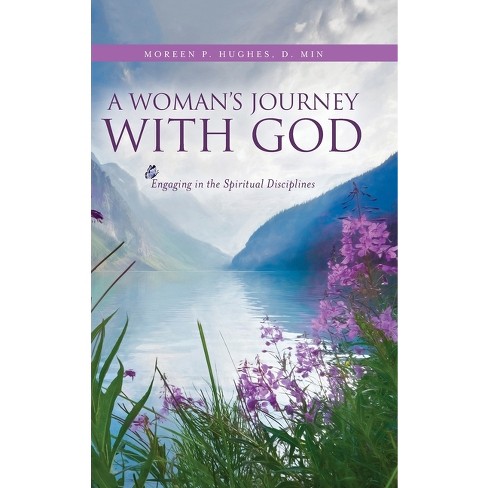
Today, we want to share about a new book that was just released by local Pastor Rev. Moreen Hughes, entitled “A Woman’s Journey with God: Engaging in the Spiritual Disciplines.” As an associate pastor and women’s minister at Concord Baptist Church of Boston in Milton, Pastor Moreen is passionate about helping women become the best that God has created them to be. In her new book, she presents a set of spiritual disciplines to help women develop Christlike character and become the best version of themselves.

Click below to read an excerpt from her book. You can purchase her book here!


“Practices such as reading Scripture and praying are important – not because they prove how spiritual we are – but because God can use them to lead us into life.”

John Ortberg, The life you’ve always wanted: Spiritual disciplines for Ordinary People

In today’s culture, we are seeing a renewed interest in the spiritual disciplines. People are looking for the connectedness into those things that are meaningful and can bring them into greater relationship with God. 

Having developed a personal interest in topics of ‘Christian spirituality’ and ‘Christian spiritual formation,’ I have researched and studied the impact of the spiritual disciplines in the lives of women specifically. These results, done in correlation with my doctoral academic studies, strongly suggest that those who regularly engage in practice of the disciplines have more of a spiritual consciousness and connectedness to Christ, than those who do not, including the formation of their character, spiritually and morally. The practicing of the spiritual disciplines has the potential to aid in the practice of God’s redemptive interactions within each of us.

It is my belief that for the inner self to be spiritually shaped and formed, and the mind to be renewed and transformed, it takes more than a casual knowledge of the Word of God, or an occasional engagement with the disciplines. These practices must become common place in the everyday lives of each of us. There must be a commitment to intentionally setting aside time and developing a lifestyle, which includes interaction with the Word, earnest daily prayer, engaging in the disciplines and an external demonstration of faith that will make one worthy of being called a ‘Christian’ – a disciple of Christ. 

If change and spiritual formation is to be experienced on this Christian journey – It is not about saying so, but knowing so, and doing so. 

Paul said in Philippians 3:10, that knowing Christ is the most important thing he could have ever done in all his life regardless of social standings or interactions, educational attainment, economical resources, or familial ties. We too have access to the principles for knowing Christ, but we must daily set aside the necessary time daily from our over-crowded schedules in order to do so. Refraining from always saying ‘yes’ to others and saying ‘no’ at times, allows us the time to say ‘yes’ to engage in the disciplines and gain a greater understanding of who God is. 

Embarking on a spiritual journey is no easy task. It is an intentional pursuit that requires the individual to purposefully engage in those things that allows for the attainment of such. There is the preparatory stage. Preparing the heart, mind, and soul for the journey.  Being on this Christian spiritual journey requires intentionally learning how to seek after the things of Christ.  

Walking with Christ and engaging in the practice of the spiritual disciplines helps believers in all seasons and stages of life, including times of uncertainty and times of confidence. They revolve around our love for God and help produce Hope, Strength, Trust, Humility, Joy, and Compassion. They produce the ability to see and interact with others in ways God intends in loving our neighbor as self. 

The practice of the disciplines produces desirable qualities necessary to emulate positive interactions with others, self and God. My belief is that when we are obedient and allow the Holy Spirit to work in us, we become more like Christ. When we are more like him, we become closer to God feeling whole and connected. 

Having a daily quiet time, praying regularly, fasting, and studying God’s Word are not things that people do naturally, they are not an automatic part of us, but they automatically come as a result of our spiritual maturity and when done with consistency. 

In an era where instant gratification is the way that people often approach life, the very idea of discipline does not seem appealing to many. Yet, God invites us on a journey with him that involves discipline. This spiritual journey helps us to find out who we are in life and in Christ. The purpose is not to become mystical or find profound and theological answers, rather, it helps in an individual’s transformational process, moving them toward spiritual development, while journeying on a quest to consciously deepen their spiritual insights. 

We are living in stressful times and there is concern that many persons including followers of Christ, are feeling the effects that are being manifested in the form of depression, anxiety, stress, and discouragement. These debilitating defects can be devastating and have the potential to lead a Christian out of the work ministry and away from the church. However, there is a school of thought that the spiritual disciplines can be beneficial and serve as an aid in helping to manage one’s emotions as well as serve as a deterrent in to helping persons to deal with the uncertainty of times. 

When the focus is shifted away from self, maintaining that connection with God, family and the church can be achieved. I believe that when practiced correctly, spiritual disciplines can be useful as we strive to maintain focus and balance in our lives. 

May our wills be lost in the will of God, as we seek to draw closer to him.

In ways that bring us into his presence – engaging in – the spiritual disciplines.

Written by uniteboston · Categorized: Blog · Tagged: boston, christian, city, prayer, transformation

  • « Previous Page
  • 1
  • …
  • 3
  • 4
  • 5
  • 6
  • 7
  • …
  • 10
  • Next Page »


Give to Further Christian Unity

DONATE!

  • Email
  • Facebook
  • Instagram
  • YouTube

Copyright © 2026 · UniteBoston · Built on WordPress