UniteBoston

Bridging Divides Across Christians for the Flourishing of the City

  • Home
  • Events
    • Submit Event
  • Join In
    • Beloved Community Lab
    • Migrant Care and Solidarity
    • The Church and Civic Engagement
    • The ATTIC
    • Kingdom Conversations
    • Worship & Pray
    • Boston Flourish
  • About
    • UB Board, Staff & Volunteers
    • Cohorts
    • Missional Letter
    • Annual Reports
    • History
    • Christian Unity
  • Forums
  • Blog
  • Give to UniteBoston
  • Contact
  • Search

Jul 27 2017

Small New England Church?

This week’s guest blogger is Ellen Bass, Director of the Boston Capacity Institute at the Black Ministerial Alliance. Ellen is a member of River of Life Church and began an initiative last year which encouraged church members to visit other congregations’ worship services on Sunday mornings. Read below to hear church members’ insights and key learnings about the kingdom of God in Boston through worship and fellowship  across historic barriers.


With about 60 members, River of Life Church in Jamaica Plain, Boston, is the typical size for a small New England church.[1]

You might be surprised to learn that a year ago, its leadership decided to send 10% of its members to visit other churches once a month. The little church wanted to experience worship and fellowship in different contexts from its own dually affiliated denominations of Christian & Missionary Alliance and American Baptist, as well as its own primarily white culture. The church’s leaders and members set out to connect with the rich diversity and unity of the broader Body of Christ in Boston.

A total of 17 different people visited the following churches over the course of the year:

  • People’s Baptist Church
  • Arabic Evangelical Baptist Church
  • Congregacion Leon de Juda
  • Bethel AME Church
  • First Baptist Church JP
  • Boston Chinatown Evangelical Church
  • Eternal Covenant
  • Roxbury Presbyterian Church
  • Holy Resurrection Orthodox Church
  • Community of St. Egidio at Mission Church
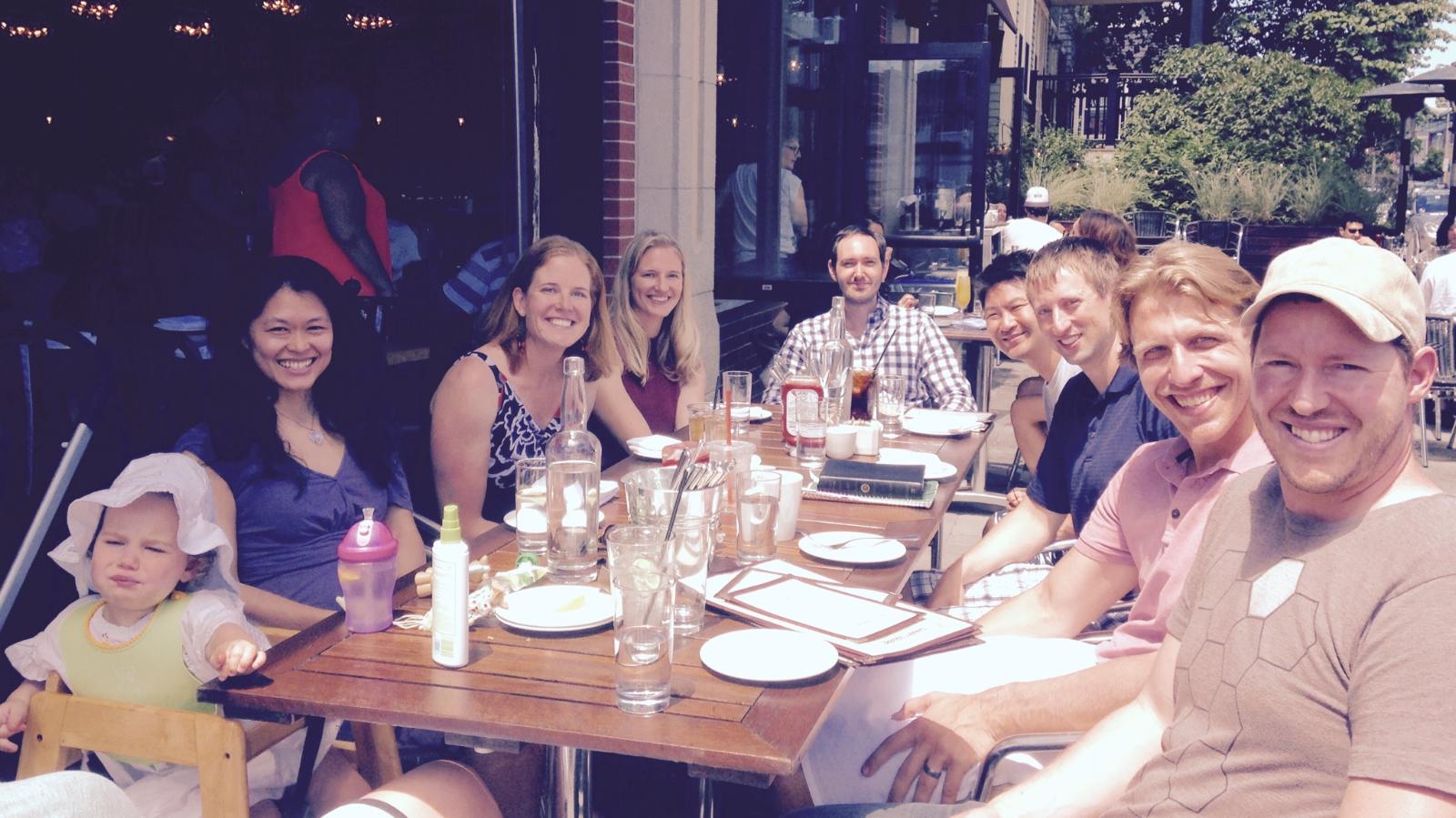
River of Life Church members eating lunch together at a neighborhood cafe

After each worship service, a small group from both churches often shared a meal together to get better acquainted. Anyone from our church was invited and encouraged to sign up to visit the churches they wanted to get to know better. Although it took some planning to get us to the right place at the right time, we learned a lot together!=

  • We loved the hospitality of People’s Baptist Church; they spend five minutes every Sunday during the worship service with everyone in the congregation vigorously greeting everyone else in the room!
  • The Orthodox Church had a beautiful family feel, with lots of people caring for all the children in the middle of the worship service, and plenty of acceptance for children’s noises and behaviors!
  • We experienced how a shared culture makes fellowship very deep and close in these churches: Bulgarian Orthodox, Arabic, Black, and Latino. We found Middle-Eastern culture to be especially hospitable.
  • Immigrant communities spoke about the challenges of language and culture, especially for their youth. These churches wanted to maintain an authentic culture within families across generations, but clearly the younger generations spoke a different language and had a different culture from the older generations. How do we all reach our youth effectively with the gospel?

Some people reflected on how being a minority was a new experience, and how valuable it would be to worship with co-ethnics if they were in the minority all week long. However, we were surprised by how easily and deeply we bonded with people we were so different from. There was a shared desire to maintain a close connection with many of these churches and continue building friendships.

Our plans for next year are still taking shape, but monthly visits are likely! We hope to focus our visits on other churches in its neighborhood of Jamaica Plain, to connect more deeply with our local churches and support what God is doing in our community.

River of Life Church is now confident that its small size isn’t a hindrance to connecting with the rich cultural and denominational diversity displayed in worship services across Boston on Sunday morning. What does your church want to learn and experience in the broader Body of Christ in Boston?

[1] Median US church size is 75. National Congregations Study, Duke University, 2007, p. 2, http://www.soc.duke.edu/natcong/Docs/NCSII_report_final.pdf
Written by uniteboston · Categorized: Blog · Tagged: community, lent, neighborhood, unity, university

Mar 24 2017

Coming More Alive This Lent

This week, we feature a guest blogger, Fr. Tom Ryan, CSP, who directs the Paulist North American Office for Ecumenical and Interfaith Relations in Boston.

Father Tom recently held a day of reflection entitled “What Will Bring Me More Fully to Life This Lent?” His words are important for us in this period where we are reflecting and considering our relationship with Christ.


CC-BY-2.0/ Susanne Nilsson Via Flickr

If you were to take that approach to Lent this year, you might ask: “What would bring me more alive?”

Keep your eye on the sun in this season. It will give you the primary cue as to what this period we call Lent is all about. In our northern hemisphere, Lent coincides with the turning of the earth towards the sun, the springing forth of life from the apparent death of winter’s frigid grasp.

The very word “Lent” comes from the Anglo-saxon “lencthen,” originally referring to the lengthening of the light. From this original meaning, confirmed in the movement from winter’s darkness to spring’s increasing vitality, we are invited to move out of our own personal lethargy to vitality, from ashes to the paschal feast. Lent, in short, is about coming to life in new ways. It is about growth.

Its spirit is better captured by the pouring of water at Easter baptisms than by the burning of palms on Ash Wednesday. The history of Christian worship reminds us that Lent exists as a time to prepare candidates for baptism and to invite all the baptized to renew their baptismal consecration at Easter. Once again, the emphasis is on new life.

If you were to take that approach to Lent this year, you might ask: “What would bring me more alive?” The practices of physical and spiritual disciplines you choose would be in light of Jesus’ words, “I came that you might have life and have it to the full!” (John 10:10). Yes, you might settle on a practice or two that has some “bite” in it, but it would be undertaken in the spirit of pruning a rose bush, of cutting back the branches that have grown too wild, in order to cultivate more blossoms that give glory to God.

If you approached your life in terms of a holistic spirituality, looking at your physical, mental, emotional and spiritual well-being to see where things have fallen out of balance, have grown wild, and need some pruning or fertilizer or watering, you might ask yourself some questions like these:

How is the balance between my active and contemplative life? Do I spend much more time “conjugating” the verbs doing, wanting, having than the verb being? What forms of prayer might help me restore some contemplative space to my living to allow my soul to breathe?

What is the balance between mind and body in my day? If the scale tips heavily towards major engagement of the mind but minor involvement for the body, what kind of physical exercise might I enjoy that would have the benefit of renewing my energy, enabling me to sleep better, and bring a more relaxed presence to those with whom I live and work?

Is there rough equilibrium between time invested in taking care of myself and time dedicated to taking care of others? If I cannot identify a clear service dimension somewhere in the deployment of my time and energy, what opportunities are there in my locale to assist the homeless, the hungry, the sick or the aged?

Is my relational life blossoming, or dying on the vine? Maybe laying in an evening a week to spend with spouse or friends would be like watering dry soil and bring alive your affectivity with laughter and tears.

What’s the balance between passive watching (as in television) and active reading (as in a good book that nourishes the soul)? Could Lenten fasting take the form of fewer sitcoms watched but more chapters read?

And what’s the ratio between the time my functional activities get and the time made available to nurture my creative energies? Maybe a good Lenten resolution would be to get out at least once a week to an art gallery or a museum, or to an inspiring play or movie.

Whatever you settle on in this season of a springtime for the spirit, keep your eye on the sun and imitate the earth in turning more fully towards the light. Do what will bring you and others more fully to life. There could be no better preparation for the Easter feast of water and light, no better offering to make at the altar, than a heart and spirit renewed and grateful to God for the gift of life both human and divine.


Note: This article was originally published in the Boston Pilot; republished with permission.

Written by uniteboston · Categorized: Blog · Tagged: boston, ecumenical, home, jesus, lent

Feb 16 2017

Keep the Fire Burning: An Article from Koinonia Magazine

Tom Ryan, CSP

Some people have said that the Christian unity movement has been in an “ecumenical winter.” However, Father Tom Ryan, who directs the Paulist North American Office for Ecumenical and Interfaith Relations in Boston, contends that “the signs are there that the Holy Spirit is alive and active, lighting the fire in our hearts for more visible communion with one another as followers of Jesus.” Father Tom was one of the most consistent attendees during UniteBoston’s Week of Prayer for Christian Unity and in this article, he describes how encouraged he is about the movement he sees in Boston of Christians coming together to receive their calling as ambassadors for unity.

Originally posted here, republished with permission.


Keep the Fire Burning

by Thomas Ryan, CSP
February 6, 2017

The ecumenical movement spread through Christian churches like a wildfire in the late 1960s, through the 70s, and into the 80s, fanned significantly by the entrance of the Roman Catholic church after the Second Vatican Council into the work for Christian unity.

Around the turn of the millennium, there was a substantive reshaping of relationship among a significant number of churches. In 1997 the Evangelical Lutheran Church in America and the U.S. Episcopalian Church judged that their process of growth in agreement had reached sufficient maturity to enter into full communion with one another.

The Reformed Church in America, the United Church of Christ, the Presbyterian Church USA, and the Evangelical Lutheran Church in America also entered into full communion with each other with mutual recognition of ministries, sacraments, exchangeability of ministers and members.

And in 1999 the Roman Catholic Church and the Lutheran World Federation signed a Common Declaration on Justification by Faith, burying the hatchet on one of the core issues of the Reformation and creating a new context on the road to full communion between the Reformation Churches and the Roman Catholic Church.

Fire Dying Down
Prayer Service for Christian Unity

Prayer Service for Christian Unity

But in the first decade of the new millennium, one began hearing references to the “fire dying down” or to the “winter of ecumenism”. A variety of factors contributed to this shift in temperature: Diminishing congregational numbers resulting in increasing denominational self-focus and self-definition for the sake of survival. The increasing religious pluralism of the country with its call to interreligious encounter and engagement. The emergence from the culture wars of new church-dividing questions like the nature of sexuality and marriage, and who can be ordained?

Workshop on Christian Unity

Workshop on Christian Unity

What is needed in our time are reminders that the Church’s mission for unity has not been and cannot be shelved. The thematic scriptural passage for the January Week of Prayer for Christian Unity provided that reminder: “God reconciled us to himself through Christ and has given us the ministry of reconciliation.” (2 Cor 5: 18,).

In other words, the Church is the community of those who, because of Christ, are no longer separated. It is a contradiction in terms to speak of “separated Christians”, for reconciliation, unity, is the very nature of the Church of Christ. To be in communion of life with one another as Christians and bring that message of reconciliation to others is our baptismal vocation. In short, the Church we are called to be is the community of those who-–because of Christ—are no longer separated.

Energizing Reminders
coptic-choir
Coptic Orthodox choir

Do we need energizing reminders in these turbulent times that this call to unity, this vocation, is more real and needed than ever? Yes, we do. And the signs are there that the Holy Spirit is alive and active, lighting the fire in our hearts for more visible communion with one another as followers of Jesus.

Such signs were manifest in Boston during the January 18-25 Week of Prayer for Christian Unity. There was a prayer gathering in a different denominational church each night of the week. On the opening evening, Wednesday, Christians from around the city gathered in an Evangelical church. On Thursday evening, people came together in an Eastern Orthodox church. And on Friday evening there was an energizing service of song and prayer in a Pentecostal church.

Co-Presiders at prayer service

Then, on Saturday afternoon, over 800 people from a broad spectrum of denominations came to a Catholic church to meet and talk over lunch, share faith in workshop discussions,  join their hearts and voices in a prayer service, and after, to participate in a mission and volunteering fair in the church hall. The variety of music served as a symbol of the richness of gifts within the Christian family, led in turn by a Pentecostal worship team, an Orthodox Byzantine choir, a Coptic Orthodox choir, a Taizé chant group, along with regular Catholic/Protestant hymnody. The service was co-presided by eight church leaders, and in his homily Cardinal Sean O’Malley reminded those present that we are all members of the one body of Christ through our common baptism, and that “our divisions are an impediment to our announcing the gospel and prevent people from accepting the good news.”

Cardinal Sean O'Malley
Cardinal Sean O’Malley

On Sunday evening, students at the Massachusetts Institute of Technology led an evening of sung prayer in the style of the ecumenical community of Taizé. On Monday evening, Asian Evangelicals hosted a prayer gathering. On Tuesday evening, Catholics and Lutherans co-hosted a service in the Paulist Center chapel commemorating the 500th Anniversary of the Protestant Reformation. And Episcopalians brought the week to a close in their church with an Evensong service for all. Each evening, after the service, there was a reception with refreshments, and those present were encouraged to go and meet some fellow Christians they’d never met before and learn something about each other’s church communities.

Scott Brill, Bishop Arthur Kennedy, Vito Nicastro

We need to hear good news like this and draw inspiration from such events to keep the fire for Christian unity alive and well in our own towns and cities. All these events were stimulated and overseen by two new local ecumenical networks founded in 2012 by individuals in whose hearts the fire for unity burns: UniteBoston (Kelly Steinhaus), and the Ecumenical Institute (Vito Nicastro and Scott Brill).

“God reconciled us to himself through Christ and has given us the ministry of reconciliation…. We are ambassadors for Christ, since God is making his appeal through us” (2 Cor 5: 18,20).  When we accept our role as ambassadors for unity, the Holy Spirit will use us in ways unimagined to keep the fire burning.

What might you do?


Fr. Thomas Ryan, CSP, directs the Paulist North American Office for Ecumenical and Interfaith Relations in Boston. 

Written by uniteboston · Categorized: Blog · Tagged: christian unity, lent, reconciliation, uniteboston, unity

Sep 11 2016

Preparing for the Reformation Commemoration: Conversation Groups

image credit: http://www.empowermissions.org/
Photo and Graphics: Empower MissionsDigna Reklambyrå

Last fall, Bishop Jim Hazelwood and Cardinal Sean O’Malley announced preparations for a mutual observance of the 500th anniversary of the Reformation. This participates in the worldwide observance, to be initiated October 31, 2016 by Pope Francis and Bishop Munib Younan, President of the Lutheran World Federation. Locally, along with worship and service projects, Cardinal Sean and Bishop Jim encouraged us to participate in ecumenical discussion groups, saying:

…We seek to witness together to the world. One aspect of this witness is in caring for God’s good creation. Pope Francis’ encyclical On Care for Our Common Home provides a timely opportunity for Lutherans, Roman Catholics, and all our ecumenical partners to gather in small groups to read and discuss it together in an atmosphere of prayer and common faith. We encourage all to do so. Such a time of study, prayer, and ecumenical fellowship will serve as a worthy preparation for our mutual observance of the 500th anniversary of the Reformation in 2017.

Over the next year and a half, the commemoration planning team would like to encourage and support congregations in forming such groups not only in the Boston Archdiocese but all across New England. Some congregations, such as St. John Lutheran in Sudbury, MA, have already studied the Pope’s encyclical. Others are beginning to plan for next year’s programs and may choose a different document to study. Whatever approach is chosen, these discussion groups can be a starting point for joint activities including shared acts of service and, in the fall of 2017, a culminating worship experience.

If you would like to join the conversation, here are some ways to get started:

  • Contact leaders of nearby congregations, share the bishops’ letter, and invite them to co-lead a study group with you.
  • Choose the location. Will one congregation host? Or is there a public setting available, such as a coffee shop, library or pub? Perhaps a non-church setting will make the group feel more balanced and welcoming even to people not from our congregations.
  • Set dates. Joint study such as this could make for a wonderful Lenten activity for 2017!
  • Select a text to read together. Suggested options include:

On Care for our Common Home. Pope Francis’ encyclical will certainly be an engaging option with which Christians of all kinds will find common ground.

The Joint Declaration of the Doctrine of Justification (JDDJ). This document from 1999 presents a shared consensus between Lutherans and Roman Catholics on the central issue of the reformation.

From Conflict to Communion. This book explores the themes and history of the reformation and explores the work of recent decades in reconciling our two churches.

(All three resources are available for free online and for purchase at Amazon.com and other retailers. Additional resources are listed below.)

  • Invite and advertise! Depending on your setting and the text you choose, don’t forget to include other ecumenical partners and the non-church neighbors in your community!
  • Share what you are doing! Besides using social media, please also share your plans and stories with our planning team so that we can celebrate this as a region-wide, mutual observance. (You can share your plans by sending them to Pastor Andrew Heisen at pastor_mtolivet@townisp.com. He will be compiling a list of all congregations taking part.)

Hopefully, this cross-congregational opportunity will enrich all of our churches, help us discover common ground, and lead us into other aspects of our mutual observance including joint service projects and liturgical observances – so as to demonstrate our unity through baptism in Christ.

For example, please save the date for New England CityServe, which will take place on May 6, 2017. This initiative will be hosted by UniteBoston, where churches all across the region will be coming together to identify shared missional goals to serve their neighborhoods. The committee is also planning a joint liturgical gathering in Boston for Fall 2017 along with materials for use in local gathering with your local neighbors.

For more information:

More information regarding this and other reformation observances in New England can be found at the website of the Institute for Christian Unity at http://www.instituteforchristianunity.org.

The Commemoration Planning Team would love to hear from you to listen to your ideas and answer questions. We can be reached through Pastor Andrew Heisen of the ELCA at pastor_mtolivet@townisp.com and Dr. Vito Nicastro, Associate Director, Office of Ecumenical and Interreligious Affairs, Archdiocese of Boston, at vito_nicastro@rcab.org.

Additional Resources for Discussion:

ELCA social statement on environment: http://www.elca.org/Faith/Faith-and-Society/Social-Statements/Caring-for-Creation?_ga=1.195392044.149268272.1454101160

ELCA Bishop’s response to encyclical: http://www.elca.org/Resources/Presiding-Bishop-Messages?_ga=1.259436810.149268272.1454101160

Declaration on the Way, From Conflict to Communion Study Guide, JDDJ and other resources: http://www.elca500.org/articles-and-publications/

“Lutherans Restoring Creation Study Guide” http://www.lutheransrestoringcreation.org/Home/highlights/laudato-si—lutheran-study-guide

Study Guide from Archdiocese of Washington: http://adw.org/wp-content/uploads/2015/06/Laudato-Si-Study-Guide.pdf


Written by uniteboston · Categorized: Blog · Tagged: christian unity, christianunity, lent, uniteboston, unity

Aug 10 2016

UniteBoston was featured in the Koinonia Newsletter!

We have big news – we were just featured on the Paulist Fathers “Koinonia” newsletter! The text is posted below, or you can check it out by clicking on the link here


UniteBoston: Recognizing the Family of God

UniteBoston Reps Team

By Kelly Steinhaus

August 2, 2016
Kelly Steinhaus
Kelly Steinhaus

“These are my brothers and sisters!”

I hear this sentiment expressed repeatedly from individuals attending events affiliated with our up-and-coming ecumenical organization in Boston called UniteBoston. UniteBoston’s mission is to build relational connections throughout the diversity of Boston’s Christian community. There are many differences separating Christians, but with UniteBoston we focus on the shared faith practices that bring us together: worship, prayer, and missional service to the city.

While we are a large network now, with strong relationships in the Catholic, Evangelical, Mainline Protestant, and Orthodox communities, starting a non-profit organization was never our intent. Rather, a group of young people and I noticed that there were so many great things happening around churches in the city, but little infrastructure to connect the events that were taking place with the people that might be interested in attending.

To address this, in September 2010, we started sending out weekly “UniteBoston” email newsletters with information about the various Christian events taking place in the city. Within a couple of months, over 1,000 people had added themselves to the newsletter! Additionally, a lot of local interest was emerging, and a leadership team began to form. Soon, the newsletter became overloaded with information submitted from the community, so we raised funds and built a website.

UniteBoston Fall meeting on Boston Common

UniteBoston Fall meeting on Boston Common

Over the next few years, UniteBoston continued to grow, eventually becoming a 501c3 non-profit in July 2012. In addition to our weekly Christian events newsletter, UniteBoston hosts monthly “meetup” events to build community and encourage people to go beyond their denominational walls to discover all that God is doing in Boston. During Lent last year, we coordinated a “Holy Week Pilgrimage,” which highlighted various worship services that were already taking place in the city. Two young men attended an Orthodox service for the first time on Good Friday, and were astounded by how they resonated with the liturgy.

Additionally, UniteBoston loves to see Christians come together to serve the city. We have a team of “UniteBoston Reps” who are working to build relationships with pastors and city leaders within specific neighborhoods in Boston. The UB Reps meet monthly as a collaborative “think tank” of God’s work in the city, and they mobilize churches together to discern a collaborative shared missional project for their neighborhood communities. We had our first BostonServe day last October, and we’re gearing up for a CityServe day on May 6, 2017 in conjunction with Catholics and Lutherans throughout New England who are coming together to commemorate the 500thanniversary of the Reformation. Truly, God is up to great things in Boston!

Throughout these initial years of our ministry, I have begun to discover something significant about ecumenism: While the Internet can be a powerful tool to bring Christians together, the real work of Christian unity comes down to relationships, which cultivate agape love between brothers and sisters in Christ. It was not until I sat down with brothers and sisters from other denominations and ethnic groups that God began to reveal my underlying biases and partiality towards my own tradition’s worship practices. Through my new friendships, God began to break down my boxes of how I understood Christ’s Church and God’s work in the world. This continues to be true for our leaders and participants in UniteBoston’s events – we’re discovering that Christ’s family is much bigger than we initially imagined!

In coming together across our differences, God does an incredible work in our hearts. We begin to identify ourselves primarily not as Catholic or Lutheran, for example, but as pilgrims on a journey following Jesus Christ. Our denominational distinctions matter, and they matter profoundly – but our differences come to be understood not as barriers for others to enter into my one “right” understanding of God, but rather as beautiful displays of the multifaceted heart of God. I am beginning to see that unity is a process by which the church is brought to maturity (Eph 4:13).

In light of the recent racially-charged events plaguing our nation, I lament with the families that have been affected with this violence and the reality of racial discrimination and injustice within our communities. Jesus models loving those who are difficult to love, and Jesus’ call to love our neighbor must be stronger than our innate tendency to fear and hate those who are different than us.

People in the world are searching for a vision of hope and transcendence beyond what they see. What they are looking for is found in the Church, as Christ’s work on the cross has fully destroyed the dividing walls of hostility (Eph 2:14.) Indeed, we are called to embody this ministry of reconciliation (2 Cor 5:19). However, if people look at the Church and only see us in tension with one another, then how can they believe that our message is about love? Ultimately, it’s as we embody Christ’s message of reconciliation that we will regain our ability to act in healing ways in situations that the world is wrestling with.

In addition to directing UniteBoston, Kelly Steinhaus is also studying urban ministry at Boston’s campus of Gordon-Conwell Theological Seminary. She lives in Brookline and enjoys outdoor activities such as hiking and bicycling.

Written by uniteboston · Categorized: Blog · Tagged: christian unity, lent, reconciliation, uniteboston, unity

  • « Previous Page
  • 1
  • …
  • 14
  • 15
  • 16
  • 17
  • Next Page »


Give to Further Christian Unity

DONATE!

  • Email
  • Facebook
  • Instagram
  • YouTube

Copyright © 2026 · UniteBoston · Built on WordPress