UniteBoston

Bridging Divides Across Christians for the Flourishing of the City

  • Home
  • Events
    • Submit Event
  • Join In
    • Beloved Community Lab
    • Migrant Care and Solidarity
    • The Church and Civic Engagement
    • The ATTIC
    • Kingdom Conversations
    • Worship & Pray
    • Boston Flourish
  • About
    • UB Board, Staff & Volunteers
    • Cohorts
    • Missional Letter
    • Annual Reports
    • History
    • Christian Unity
  • Forums
  • Blog
  • Give
  • Contact
  • Search

May 06 2016

Christ is Risen!

photoUHZ6HESHOur blogger this week is Steven Hardy, who is a UniteBoston Rep in the Cambridge/Harvard Square area. Steven attends St. Paul’s Parish and is a self-described  “arm chair theologian and historian.” Below, Steven presents some great insights on the unity of the church after attending his first Orthodox liturgy service.

—————

For the first time this year, I decided to attend the Pascha (Easter) celebrations at an Orthodox church. A group of us from UniteBoston had participated in the Good Friday service of Lamentations the previous evening, and I felt as though it would be incomplete to lament the crucifixion and burial of Christ with this community, and not celebrate his joyful resurrection with them. Being a Western Christian, I had already undergone the Lenten fast and the Feast of the Resurrection, but one can never mark this great mystery enough, right?

Image Credit: holycrossbookstore.com

Going into the service, I fully expected the many differences in the Eastern liturgy to stand out. I was eager to experience these differences and ready to make note of them. Basically, I suspected that I would be more of an observer than a participant. However, what drew my attention was the many things I saw that were in common with my own liturgical background. Many of the prayers, verses and responses, and even the placement in the liturgy were the same or very similar to my own background. Some of them were in the very same translations that I’ve known my whole life. As is often the case, my expectations were utterly off base when it comes to the work of God, through the Holy Spirit.

Another thing that I was very conscious of, being at an Antiochian Orthodox Church, was the current strife taking place in Syria. I noticed that, though many were not of Syrian decent, those who are, were at least one generation removed from their immigrant forerunners. The blood of Christian martyrs is being spilled there far too frequently. These Christians martyrs are not just Orthodox, but a mix of denominations. They are being persecuted and murdered due to their shared faith in Christ, causing the blood of Catholic, Orthodox, and Protestant martyrs to be mingled together in union. As Pope Francis told Catholicos Karekin II of Etchmiadzin, the Patriarch of the Armenian Apostolic Church, “Just as in the ancient church the blood of the martyrs became the seed of new Christians, so in our day the blood of many Christians has become the seed of unity.” The Pope was referring to both the Arminian Genocide that took place under the Ottoman Empire 101 years ago, as well as the current state of affairs.

We often use the term brother and sister when referring to Christians of other denominations. I suspect, however, that we often mean something more akin to cousin, or friend. As I witnessed the many things in common with the Orthodox in Cambridge, as I was made to feel welcome at their festive post- liturgy celebrations, and as I thought on the witness of the martyrs, I can’t help but to feel a much closer bond to these people who are indeed my brothers and sisters in Christ.

One day I hope that we can finally remove the things that stand in the way of full union with one another. We have a rich diversity in Christian faith traditions right here in the Greater Boston Area. We share in one Baptism into the living body of Christ on Earth. We all proclaim Christ crucified and risen. I would very much like to celebrate this shared faith together, in full communion so that we can reply with one voice, “truly He is Risen!”
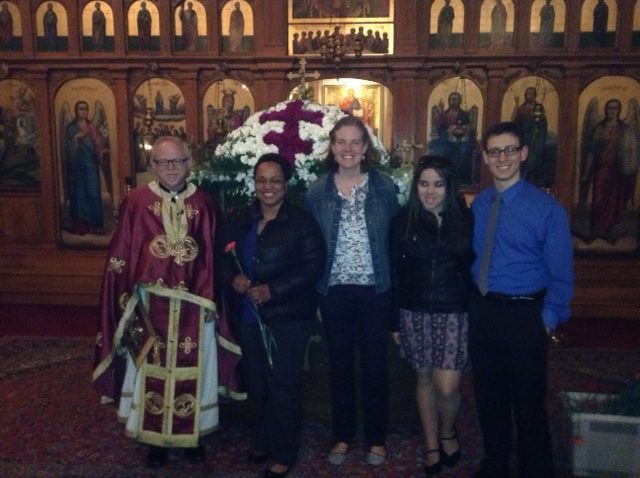
Photo from UniteBoston Meetup at Orthodox Good Friday Service

Written by uniteboston · Categorized: Blog · Tagged: community, harvard square, lent, uniteboston, unity

Dec 13 2015

Guest Blog: God Is Not Served By Human Hands

Kelsey Karys, UniteBoston Rep and previous intern with Cru campus ministry, is passionate about Christian unity. She shares her reflections after attending the Taize Prayer service at MIT during UniteBoston’s 10 Days Boston event.
—-

I remember helping my dad build our swing set when I was a child. He handed me a hammer, and showed me how to pound, pound, pound a nail into a piece of wood while he looked on, guiding my hand when I needed, and always giving the finishing pound, burying the nail into the wood. I eventually reached an age where I realized that what took me thirty pint-sized pounds, my dad could have done with one, but his affection towards me was so great that it didn’t matter.

CALLED OUT

As I take a step back from college ministry for a season, I am having one of those moments again, where I realize first, how great an architect my Daddy is, and second, how much love and patience He has for me, fumbling around in this grown-up world.

I worked in campus ministry for two years, with the goal of seeing a house of prayer rise up on every campus in Boston. So when God called me out of the campus scene so quickly, in my me-centric world I asked Him, “How is there supposed to be a revival in Boston if I’m not on campuses starting houses of prayer?!” I thought my fears were validated when I heard the news that the MIT House of Prayer would not be continuing this school year.

I heard a familiar voice saying, though, “Hey Kelsey, answer me one thing. Where were you when I laid the foundation of the earth?” (Job 1:4)

A NEW THING

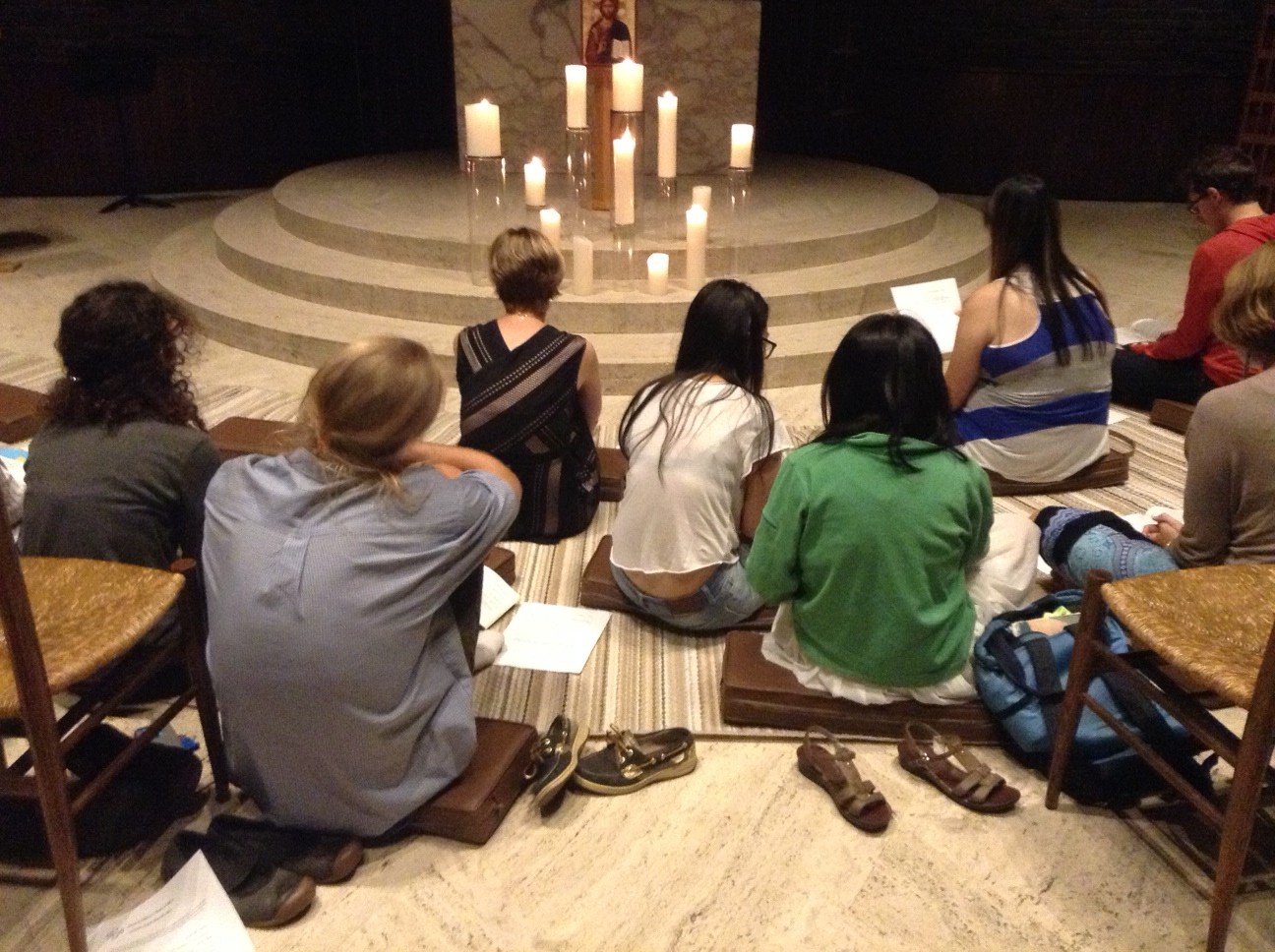
photo 1-2I was seated in MIT’s dimly lit chapel before an icon of Jesus, surrounded by flickering candles. I knelt on a prayer rug with about 30 others, and while they chanted in Latin, I just listened. I tried to listen beyond the haunting echoes off the tall stone walls, past the frustration that I didn’t know the language, and beyond the discomfort of having to sit still, so different from the charismatic worship gatherings that I so easily box God into.

As I listened, I asked, “God, what are you doing here? Where are you?”

Sitting next to me was Sabrina, a new Catholic missionary at MIT with a heart to bring together the different fellowships in prayer and worship. Kelly, a close friend who leads a movement called Unite Boston, bringing together churches and denominations around the city to pray and worship Jesus together, chanted on my other side. In front of me was Erik, one of my former Cru students with a heart for unreached people groups. Behind me was a large group from the Lutheran-Episcopal Ministry, who in all my time at MIT I had never seen gather with the larger Christian population. A girl from Intervarsity sat nearby, and a professor stood in the shadows in the back.

In the stillness of this Taize gathering, God whispered back, “I am doing a new thing”.

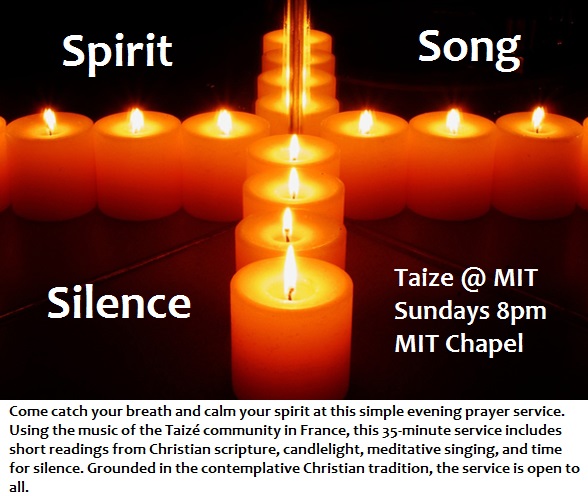
Taize prayer is a contemplative ecumenical prayer style started by a protestant monastic community in Switzerland in 1940. There is no one leader, and much of the gathering is silent, but at a few points different people read scripture in their own tongue, and the songs, which are more like chants, are often sung in Latin. 

At the end of the gathering, one of the Lutheran campus ministers stood and announced that a Taize prayer gathering would be happening once a week in the MIT chapel for the remainder of the year.

MY DREAMS ARE TOO SMALL

I have dreamed and prayed for weekly prayer gatherings in the MIT chapel for years, but my dream was too small because it was just that — my dream, shaped by mycomforts, my prejudices, and my ambitions. Just as King David wasn’t allowed to build God a house, it was never going to be my job to build God a house at MIT. I may have placed a few nails and pounded them a few times with my hammer, but God won’t be limited by the ceiling of the dreams I’ve built. Instead, He lets me dream with Him, just big enough to require faith, and even shows me the fulfillment of some of those dreams.

This year, the MIT chapel is finally becoming a house of prayer — Taize-style prayer that is. For me, it stands as a reminder that “the God who made the world and everything in it, being Lord of heaven and earth, does not live in temples made by man, nor is He served by human hands, as though He needed anything, since He Himself gives to all mankind life and breath and everything,” (Acts 17:24-25). 

*Note: Taize services take place on Sunday evenings at 8:00pm in the MIT Chapel. Come and join for a rich contemplative time of worship and prayer.

*Originally published on campusrenewal.org; republished with permission

Written by uniteboston · Categorized: Blog · Tagged: 10 days boston, christian unity, lent, uniteboston, worship and prayer

Feb 27 2015

This Lent Thing…

This week, Elizabeth Grady-Harper from the Boston Faith and Justice Network shares with us about the recent shift in her perspective of Lent.

——

Growing up the daughter of a born again evangelical and a disenchanted former Catholic I didn’t really get a clear picture of what Lent was meant to be until I was an
adult. From my evangelical side I got nothing on Lent. Not even a mention. I knew the Catholic side of my
family did things like give up meat on Fridays and went to church a few extra times
during the lead up to Easter. There was
also this ash on the foreheads thing at the beginning that I did not get at
all. Then at some point I was introduced
to the idea that people gave up something. Things like chocolate or coffee or for
the hardcore maybe TV. This resonated
with me as a believer even though I most definitely fell in the evangelical
camp. I decided to jump on board usually
trying to give up soda (not always succeeding).
Sometimes I’d try for sweets or Facebook (this was usually even less
successful than soda even with the Sunday pass). I always felt a little better about myself at
the end of the forty days (you know for trying and all) and I always gorged on
whatever I had fasted when Easter rolled around.

Pretty sure I was
missing the point.

I did not have the
full story of Lent, its meaning, its history and its purpose.

Lent is not mandated
by scripture. You can’t find it in the Bible.
Its inception dates back to around 325 AD. It was established as a preparation for holy
week and Easter itself. The forty days
are meant to mirror Jesus’ period of fasting as told to us in the gospel of
Matthew. (see this interesting CT article
with some history or this Huffington
Article
) The practice today varies
widely through denominations and individuals but often involves some of the following:

No meat on Fridays

Fasting on Ash
Wednesday and Good Friday

Sacrificing of
something throughout the Lenten period (with some people making an exception on
Sundays)

But why?

How did our spiritual
forefathers and mothers intend this forty day period to prepare us to celebrate
both the death and gloriously world changing resurrection of our Lord and Savior? Because I have this thing about tradition. If
continues for its own sake I hate it. However;
if it was created and continues to exist for a purpose, like drawing us closer
to Jesus, and it can do that then I don’t care if it’s almost two thousand
years old – I’m in. And I think if we do
Lent the right way it can lead us in to Holy week prepared to truly celebrate
the beauty, love and power that is Easter Sunday.

In my research
I found this quote from sister Joan Chittister that explains what Lent can be,
what it is meant to be better than I can:

Lent is the opportunity to change what we ought to
change but have not…Lent is about becoming, doing and changing whatever it is
that is blocking the fullness of life in us right now… Lent is a summons to
live anew…Lent is the time to let life in again, to rebuild the worlds we’ve
allowed to go sterile, to “fast and weep and mourn” for the goods
we’ve foregone. If our own lives are not to die from lack of nourishment, we
must sacrifice the pride or the sloth or the listlessness that blocks us from
beginning again. Then, as Joel (2:12-18) promises, God will have pity on us and
pour into our hearts the life we know down deep that we are lacking.

Yes, please.

One idea a friend
introduced me to several years ago that I have incorporated into my Lenten
discipline was not to simply (or maybe at all) take something away from my
routine (like soda or social media) but to add something positive. Because fasting certainly has value but so
too can working toward a good. So my Lenten commitment could be – saying something
kind every day, studying a new topic or learning about an injustice.

But whether it is
the giving up or the taking on I don’t think it really matters. It is the mind and heart with which we do it that
matters. Can we take these forty days
(or really forty six because somehow Sundays aren’t counted) and give over some
part of ourselves to the Lord that we have held back that we might “begin anew”
and when Easter Sunday dawns can we be ready like never before to celebrate the
fact that we are truly saved and truly called to new life filled with hope,
purpose and meaning?

I want that.

Written by jasonjclement · Categorized: Blog · Tagged: @justiceboston, lent

  • « Previous Page
  • 1
  • …
  • 15
  • 16
  • 17


Give to Further Christian Unity

DONATE!

  • Email
  • Facebook
  • Instagram
  • YouTube

Copyright © 2026 · UniteBoston · Built on WordPress