UniteBoston

Bridging Divides Across Christians for the Flourishing of the City

  • Home
  • Events
    • Submit Event
  • Join In
    • Beloved Community Lab
    • Migrant Care and Solidarity
    • The Church and Civic Engagement
    • The ATTIC
    • Kingdom Conversations
    • Worship & Pray
    • Boston Flourish
  • About
    • UB Board, Staff & Volunteers
    • Cohorts
    • Missional Letter
    • Annual Reports
    • History
    • Christian Unity
  • Forums
  • Blog
  • Give
  • Contact
  • Search

May 16 2026

“That They May Be One” Film Release

In theaters May 19th and 20th only!

“That They May Be One” – A Docudrama on Unity in Christ
On the night before His crucifixion, Jesus prayed a prayer that still echoes across the Church today: “That they may all be one.” (John 17)

Featuring Francis Chan and Christian leaders from across denominations, That They May Be One is a powerful docudrama exploring how the Holy Spirit has been quietly working across generations to answer that prayer.

The film uncovers a remarkable story of God’s providence unfolding for more than a century. From the urgent prayers of St. Elena Guerra, which inspired Pope Leo XIII to consecrate the twentieth century to the Holy Spirit, to the dramatic outpouring of the Spirit in Topeka, the historic revival at Azusa Street, and the surprising awakening among Catholics at Duquesne University in 1967, a powerful thread emerges.

Through compelling testimony, historical insight, and dramatic reenactments of Pentecost and Jesus’ prayer in John 17, the film reveals the Holy Spirit’s work across denominational lines – calling the Church to renewal, awakening, and unity.

That They May Be One is more than a documentary – it’s an invitation to rediscover the Spirit who is still moving today.

Learn More 

Ticket Information Here – Playing in Danvers, Bellingham, Marlborough, Methuen, and more!

Written by uniteboston · Tagged: jesus, john 17, testimony, unity, university

Mar 20 2026

Five Choirs, One God: United Gospel Experience Tour Creates Christian Community Through Music

The tour brings collegiate gospel choirs together to perform praise songs for audiences across New England.

A powerful new movement is emerging in our region as five New England collegiate choirs join forces, proclaiming the message of freedom and hope we have in Jesus Christ. Read the full story by Boston College student journalist Ella Chang to go behind the scenes before our final Gospel Experience tour stop at Morningstar Baptist on April 18!

P.S. Please help us spread the word by spreading the word to local pastors and congregations through our invite letter! 


By Ella Chang

UMass Lowell’s New Purpose Gospel Choir performs at the third stop of UGET.

UMass Lowell’s New Purpose Gospel Choir shuffles onstage in an orderly line. They’re met with polite applause…and pounding footsteps.

Two college-aged women appear in the shadowy recesses of the auditorium. They charge awkwardly down the aisle, one valiantly battling a long, flowy dress that’s doing its best to trip her. Miraculously, they arrive at the front of the room unscathed, skidding to a stop mere feet from the stage.

As New Purpose sings, the women explode into a head-bobbing, hip-swinging frenzy. They clap along to an upbeat rendition of Joshua’s Troop’s “Everybody Clap Your Hands”. For Ricky Dillard’s “Amazing” – a soulful ballad – they plop down in front row seats, rocking side to side.

These women are members of the University of Hartford Gospel Choir, one of three guest choirs at tonight’s concert. Their group came to support New Purpose at the Lowell stop of the 2025-26 United Gospel Experience Tour (UGET).

UGET is an annual concert series featuring choirs from five schools: Providence College, Gordon College, the University of Hartford, UMass Lowell, and Trinity College (who couldn’t make it to the UMass Lowell show). Together, the choirs perform gospel music at locations across New England.

UGET’s goal is simple: unite collegiate gospel choirs to spread the faith and hope of Jesus Christ through music.

“It’s not just about going on tour,” Angel Nooks, UGET’s executive assistant, said, “but helping to bring unity across campuses; helping to bring unity within the body of Christ.”

Historically, gospel music has been a powerful source of unity in the Black church. It began as a means of encouragement and resistance for enslaved Africans. Centuries later, it served as the soundtrack of the Civil Rights Movement.

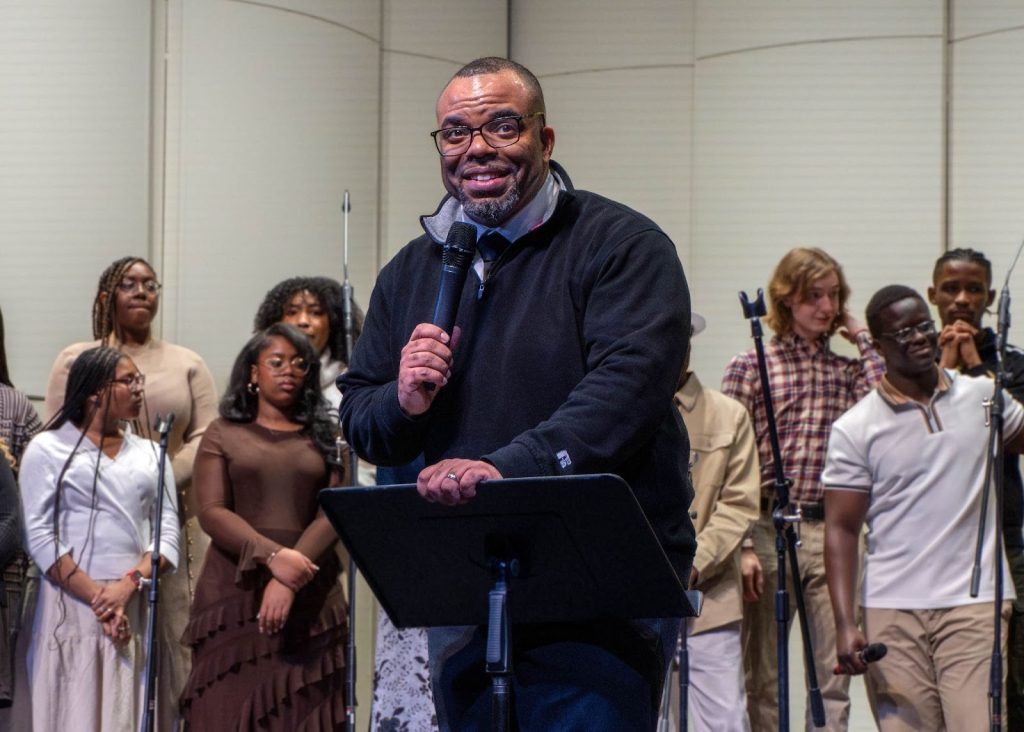
Dr. Craig Ramsey addresses the crowd.

Today, the gospel genre remains rooted in community. For Dr. Craig Ramsey, UGET’s tour director, church gospel choirs provided a way to connect with other Christians from a young age.

“It was about giving kids opportunities to work together, to come together, to serve together, to worship together,” he said.

But in his 14 years as a collegiate choir director, Ramsey noticed that, unlike the choirs of his childhood, collegiate gospel groups seemed isolated. They rarely collaborated with other choirs and mostly stayed within their own campuses. This meant they faced various challenges – from leadership turnover to lack of funding – alone.

“I saw that these gospel choirs were not being encouraged,” Ramsey said. Gradually, an idea formed: “What if we went on tour, and we just supported one another?”

Initially, a collegiate gospel tour was a pie-in-the-sky dream. Then UniteBoston – an organization dedicated to bridging divides among Christians – stepped in. They helped apply for grants and organize the tour, while Ramsey recruited choirs. In November 2024, UGET was born.

The first tour gave the choirs a taste of the intercampus community they’d been missing.

“The experience of collaborating with the other schools was really amazing,” Dyna Louis, New Purpose’s president, said, “being able to see these students in one place with one goal and one thing in mind, which is to worship Jesus Christ.”

Front right: Dyna Louis, president of New Purpose.

Now, in UGET’s second season, the students are even more excited to perform.

“You just come with greater anticipation,” Louis said. “You now come with the mindset of, ‘What is God going to do? How is God going to move?’”

Keeping the focus on God has always been UGET’s goal. It’s especially important now, Ramsey says, as Christians split along political lines rather than embracing their shared faith.

“We are allowing what’s going on in our country to divide us,” Ramsey said. “If we can get back under that umbrella of Jesus Christ, we can build from there and walk together. And I think we’ll find that there is more that brings us together than divides us.”

UGET’s second season isn’t quite finished – its last stop will be at Boston’s MorningStar Baptist Church on April 18. But already, Ramsey is looking to the future.

“We’re trying to build in the New England area and beyond,” he said. “What would it look like if every gospel choir that felt forgotten or didn’t feel like they had support came under the umbrella of the United Gospel Experience Tour?”

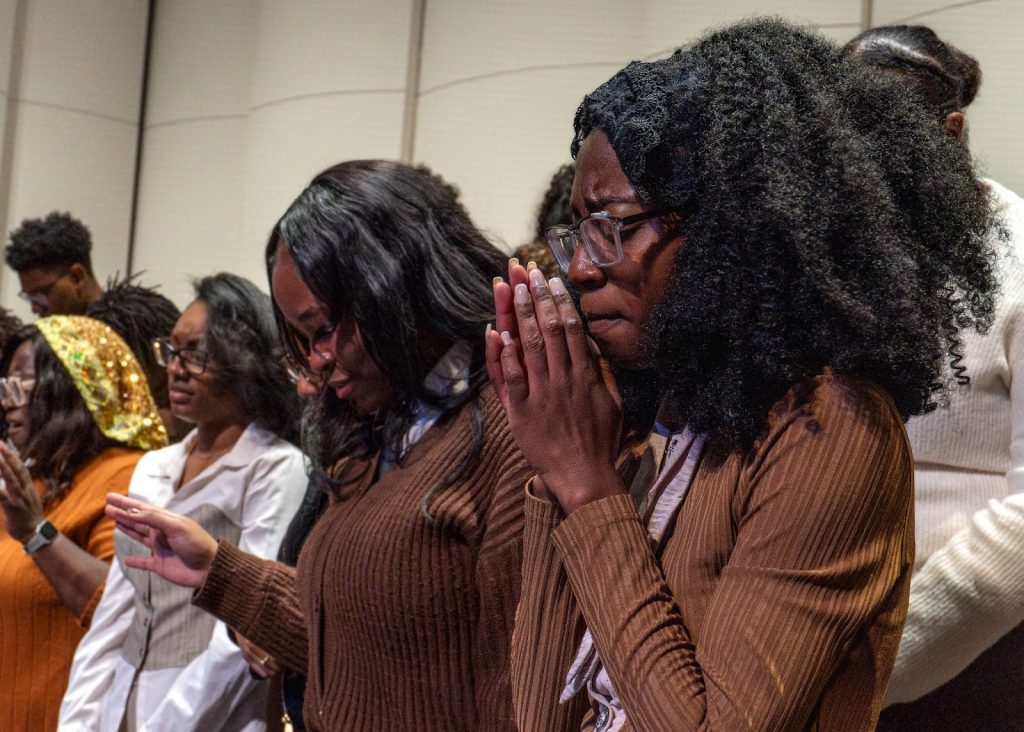
Four choirs sing together at the finale of UGET’s UMass Lowell concert.

It would probably look something like the finale of the UMass Lowell concert, where the four choirs merge together. Singers from different groups and different universities form one great whole: UMass next to UHart, Providence next to Gordon.

With infectious energy, they belt out classic hymns (“This is the Day”); traditional gospel (Malcolm Williams’ “The Blood Still Works”); and more modern tracks (Judith Christie McAllister’s “Hallelujah You’re Worthy”). They move as one unit; they sing as one triumphant voice, raising songs of victory and praise.

There’s no better symbol of UGET’s mission.

“What you do by yourself, that’s great,” Ramsey said. “What we do together is so much better.”

Written by uniteboston · Categorized: Blog · Tagged: community, jesus, uniteboston, unity, university

Feb 13 2026

Faith & Veritas 2026

Join a university-wide gathering of Harvard’s Christian alumni, students, faculty, and staff to forge new friendships and engage with thought leaders exploring the role and impact of the Christian faith in addressing contemporary challenges.

Space is limited and registration is required. Register here. More information available on the event website.

Written by Andrew Walker · Tagged: christ, christian, faith, gathering, university

Nov 10 2025

Discipleship and Community Without Judgmentalism

Today, our guest blogger is Mark D. Baker, who lives in Portland Maine and attends Rise Church. Rev. Kelly recently connected with Mark, as he wrote a book called Centered-Set Church; centered-set thinking resonates deeply with the vision of UniteBoston.

Below, Mark shares some of his personal experience, offering valuable insights on the perils of in-group and out-group thinking and how we can draw theological boundaries that faithfully uphold our convictions with compassion.


Cancel culture, us-them divisions, and line-drawing judgmentalism tear at the seams of society today. The way of Jesus offers an antidote, but before churches can offer the antidote to others, we must stop these practices ourselves. How can we leave judgmentalism behind, but still maintain a commitment to truth and biblical ethics? How can we appropriately make judgments between right and wrong without practicing self-righteous judgmentalism?

Youthful Judgmentalism

While riding home from church as a six-year-old, I looked disdainfully at people mowing their lawns; I had learned that Christians did not work on Sunday. I could draw a neat line between those who belonged to my religion and those who did not, just by looking at this one behavior. This gave me the security of knowing I was “in.” As I grew older, I continued to derive security from the lines I drew. As a teenager, I felt morally superior because, in contrast to those around me, I did not cheat on tests, steal on the job, drink, dance, swear, smoke, or do drugs. Unlike those on the other side of my lines, I was “in”––a good Christian.

The Problem is Judgmental Line Drawing, Not the Content of the Lines

At the Christian college I attended, I met some Christians who had a shorter list of rules than I did. They drank alcohol occasionally and enjoyed dancing. I faced a dilemma. My definition of Christianity told me they could not be Christians—at least, not good ones. In other ways, though, I recognized their faith to be more mature than mine. I concluded that the problem was legalism—putting too much focus on rules and strictly enforcing them. So, I became less legalistic. But had I really changed? Was I less judgmental? No, I had immediately drawn new lines. I looked down on legalistic Christians. Now they were the ones who were not “good Christians.”

Over the next several years, I embraced new expressions of Christian discipleship: a simple lifestyle, total commitment to Jesus, openness to gifts of the Spirit, and advocacy for social justice. I also continually drew new lines or added new criteria to the lines I used to define what constituted a good Christian. Just as I had disparaged those who mowed on Sunday, I now looked down on those who did not share my new perspectives. 

I thought I had progressed as a Christian, but one day, through the prodding of a friend, I recognized I was just as judgmental as I had been as a six- or sixteen-year-old. I thought that legalistic rules were the problem, but it was the judgmental use of lines. Ceasing to draw lines would appear to be the solution. Many have erased the lines, but the resulting fuzziness creates new problems.

An Alternative: Orientation to the Center

Knowing I wrestled with this issue, a friend recommended I read an article by missiologist Paul Hiebert. He borrows categories from mathematical set theory to describe how groups determine who belongs and applies it to churches. A bounded church (left diagram) creates a list of essential characteristics that form a clear boundary line that determines whether a person is part of the group or not. Anyone who meets the requirements is considered “in.” I immediately recognized that I had practiced a bounded approach to Christianity. As seen in the diagram, a fuzzy church (right diagram) is the result of addressing the problem through line removal. Hiebert gave me language and diagrams for better describing my line-drawing judgmentalism and the ambiguity of the fuzzy option. More significantly, though, he introduced me to an alternative: a centered approach. 

Bounded Set
Fuzzy Set

A centered group is created by defining a center and observing people’s relationship with the center–which in this case is Jesus. As the diagram with its arrows illustrates, instead of just judging a person by which side of a line they are on, a centered church looks at the direction the person is heading. 

Centered Set

Jesus’ parable of the Pharisee and the tax collector in Luke 18 clearly displays the difference between a bounded and centered approach. Luke informs us that Jesus told this parable “to some who were confident of their own righteousness and looked down on everyone else” (18:9). In Hiebert’s terminology, we could say that Jesus told this parable to those using a bounded-group approach.  According to a bounded approach, the Pharisee would be in—part of the group. The tax collector would be out—on the wrong side of the line. But referring to the tax collector Jesus says, “I tell you that this man, rather than the other, went home justified before God” (v. 14). How can Jesus say it is the tax collector who is justified, included, “in”? Because Jesus is looking at direction. A centered approach evaluates trajectory rather than just looking at compliance with a list of requirements. 

Note that Jesus does not state that the Pharisee’s standards are wrong, it is his attitude toward others.  Boundaries themselves are not the problem. Jesus himself draws boundaries between appropriate and inappropriate behaviors—like those listed by the Pharisee. The problem of the bounded church is using the boundaries to grasp for status and put others down. Through using boundaries to define the group, a bounded church ends up putting its identity and security in the lines drawn. A centered approach, through defining members by their orientation toward the center, naturally pulls people to put their identity and security in the center—Jesus. (See this article for a fuller explanation of the bounded, fuzzy, and centered approaches.)

A Resource: Examples of Practicing a Centered Approach

Excited by its potential to help students practice discipleship and ethics in less legalistic and judgmental ways, I introduced my seminary students to Hiebert’s work. Many students had experienced the shame of standing on the wrong side of a bounded church’s line. The possibility of an alternative excited them; some, however, felt nervousness. Does embracing a centered approach mean taking beliefs and standards less seriously? I first said, “No, that is what a fuzzy approach does.” After making the same clarification I did above—that to critique a bounded approach does not mean a rejection of boundaries—I gave the following example:

A centered approach to playing soccer would be inviting anyone who wants to play to gather at a local park on Saturday afternoon at three o’clock. In the diagram, those who show up are represented by the people whose arrows are heading toward the defined center, which is soccer. Those who do not show up to play are represented by the people whose arrows are turned away from the center. Some of those who show up may not be very good, but their lack of ability will not exclude them—their wanting to play shows their trajectory is toward the center.

I said to the students, “Suppose one of the players picks up the ball and starts running with it. What will the other players do?” A student responded, “They will say, this is not rugby, you can’t use your hands.” I asked, “What if the person does it again, and after further instruction does it a third time?” A student replied, “They will tell them they can’t play if they do not follow the rules.” I added, “Yes, because if they do not all follow the rules they will no longer be playing soccer. They will say, ‘we are playing soccer, you can come back whenever you are ready to play by the rules.’” 

Photo by Greta Schölderle Möller on Unsplash

Similarly, a centered church must lovingly confront, and at times exclude, those whose beliefs or behavior hinder the community from living out the way of Jesus (Gal. 6:1; I Cor. 5:12). By discerning trajectory, a centered church has more space than a bounded church to walk with people in messy situations, but it does not water down standards.

As students more fully understood, they become curious about application; they asked, “What is the centered approach to dealing with ______?” (many things filled that blank, e.g., disagreement with the church’s doctrinal statement, a couple living together, and poor attendance at worship team rehearsals). They asked, “What do you do about membership in a centered church?” or “Don’t some things, like recovery ministry, have to be bounded?” I had no resource to recommend to them. Eventually I decided to write the resource I wished existed. 

Before writing the book, I interviewed numerous church leaders practicing a centered approach. Their stories and insights fill the book. I invite you to read Centered-Set Church: Discipleship and Community Without Judgmentalism and join others in applying a centered approach to all aspects of ministry. 

Unity with Other Churches: A Centered Approach

An individual church practicing the centered approach must define its center. In part that means differentiating between things of primary importance and secondary things about which there can be disagreement. Churches that have Jesus as their center will define their centers differently. For instance, they will have different practices of baptism. Rather than focusing on differences, as a bounded approach might pull us to do, a centered approach fosters unity across churches by focusing on what we have in common. That unity will grow as we recognize, that in relation to that common center, we are all heading the same direction.

This is not, however, just about diagrams and using different language like “trajectory.” Fundamental to a centered approach is relationship with the center. The shift in my attitude toward others, in my church and in other churches, flows from Jesus. Resting in the security of Jesus’ loving embrace, I feel less need to gain security and status by putting others down. A centered approach facilitates that shift, but in the end it is the work of the Holy Spirit. 

Rather than being known as places of finger-pointing judgmentalism, my prayer is that we may become known for how we lovingly walk with people, toward Jesus, in their struggles and pain.


Diagrams taken from Centered-Set Church by Mark D. Baker. Copyright (c) 2021 by Mark D. Baker. Used by permission of InterVarsity Press, P.O. Box 1400, Downers Grove, IL 60515, USA. www.ivpress.com

Bio: Mark D. Baker is Professor Emeritus of Mission and Theology, Fresno Pacific Biblical Seminary. He now lives in Portland, Maine. He previously was a missionary in Honduras for ten years and a campus minister with InterVarsity Christian Fellowship at Syracuse University for three years. He has written a number of books in English and Spanish, including, Freedom From Religiosity and Judgmentalism: Studies in Paul’s Letter to the Galatians, and Ministering in Honor-Shame Cultures: Biblical Foundations and Practical Essentials.

Written by uniteboston · Categorized: Blog · Tagged: community, jesus, uniteboston, unity, university

Oct 25 2025

The Future of Sports Chaplaincy

Join us for “The Future of Sports Chaplaincy: Inclusive, Trained, and Ready” — a groundbreaking in-person event hosted by The Black Sports Ministry Network, Inc. (BSMN)

Sports are more than games—they’re spaces where identity, faith, justice, and humanity meet. As athletes and teams navigate complex challenges on and off the field, the role of the chaplain has never been more vital. We need leaders who can listen deeply, care courageously, and serve inclusively—meeting people where they are, no matter their story or background.

What does inclusive sports chaplaincy look like?

How can chaplains support athletes, coaches, support staff navigating faith, justice, gender, identity, technology, and global issues?

Who’s shaping the future of spiritual care in sports?

Come find out.

Featuring:

Jua Robinson – Former NFL Chaplain, New England Patriots

Shariah Anderson – Chaplain, Harvard Women’s Basketball Team

Michael Harris – Athletic Director, Boston College

Cynthia N. Perry – Former Athletic Trainer & Executive Director of BSMN

Moderator: Dr. Stephanie Edwards, Executive Director of the Boston Theological Interreligious Consortium

Location: Boston University’s Howard Thurman Center for Common Ground (Room 205)

Date: Monday, November 24, 2025

Time: 3:30 – 5:00 PM EST
Free & In-Person | Registration Required

Visit our website to register: https://www.thebsmn.org/events

Supported by our partners:

Eastern Bank Foundation

Boston University School of Theology

Boston Theological Interreligious Consortium

Written by Andrew Walker · Tagged: boston, faith, ministry, technology, university

  • 1
  • 2
  • 3
  • …
  • 7
  • Next Page »


Give to Further Christian Unity

DONATE!

  • Email
  • Facebook
  • Instagram
  • YouTube

Copyright © 2026 · UniteBoston · Built on WordPress