UniteBoston

Bridging Divides Across Christians for the Flourishing of the City

  • Home
  • Events
    • Submit Event
  • Join In
    • Beloved Community Lab
    • Migrant Care and Solidarity
    • The Church and Civic Engagement
    • The ATTIC
    • Kingdom Conversations
    • Worship & Pray
    • Boston Flourish
  • About
    • UB Board, Staff & Volunteers
    • Cohorts
    • Missional Letter
    • Annual Reports
    • History
    • Christian Unity
  • Forums
  • Blog
  • Give
  • Contact
  • Search

May 09 2018

Living Out Unity: Louisiana, Boston, and other Adventures

“Poking holes in one another’s theologies is easy; what is difficult is looking at someone who thinks about God in a completely different way than I do and finding a way to see its loveliness.”
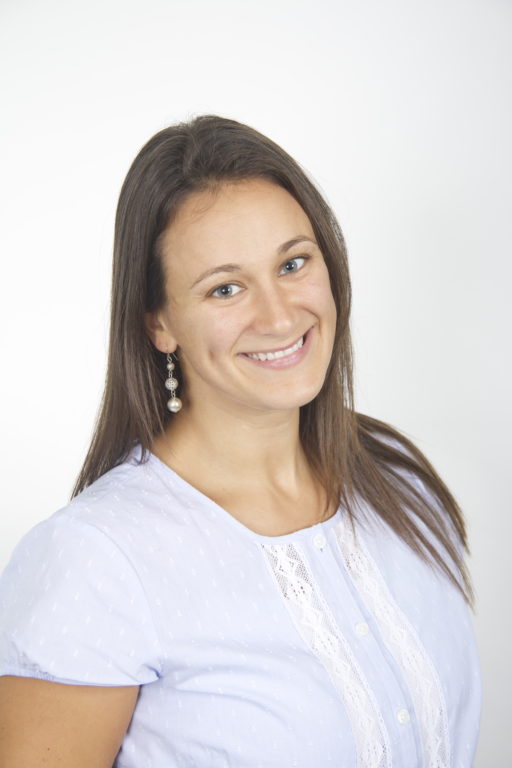
Photo Credit: Brenda DuPont

This week’s blog is written by Elizabeth M. Smith, Ph.D. Elizabeth works as a pastoral associate at Holy Family Parish in Concord and is a Catholic systematic theologian and ecumenist in the Boston area. She received her doctorate from Catholic University in 2017, and also holds a Master of Philosophy, a Master of Divinity, and a Master of Sacred Music. In this blog, she describes the journey that God has led her through in her understanding of the work towards Christian unity.


I never liked the idea of practicing theology as an exercise in calling out those who don’t get it, or emphasizing those who aren’t in the club. My experience with fellow Christians in grad school was, unfortunately, often just such an exercise. Hoping to be aspiring apologists, I believe, I witnessed many well-intentioned Christians from various denominations in the DC area try to poke holes in one another’s theology and in one another’s traditions. These discussions – most of which were outside the classroom – always seemed to leave participants frustrated and drained. If we know a tree by its fruits, I was hopeful that I could find another tree.

I’ve always felt like a peacemaker. I feel more at home finding ways to describe similarities than confronting difference. More at home highlighting ways our differences complement each other rather than ways they separate us. I’m learning that the term for this is “receptive ecumenism.”

I felt the Holy Spirit create in me a deep desire to construct conversations that ran counter to the apologetics I heard in DC. While apologetics is a praiseworthy field, the movement of the Spirit doesn’t seem to reside in apologetics the way it did in the early centuries of the Church. The days of sorting out heretical positions have yielded, in my view, to a new age in which the Spirit beckons us to stop weeding, lest we uproot the entire garden.

I moved from DC to Boston in 2014, the time I began to write my doctoral dissertation. Although my major area up until this point was theology of God (mainly Trinitarian theology), I felt a strong move within myself pulling me toward ecumenism. As much as I loved pouring over the various views that theologians asked us to consider about who and what God is, I felt the Spirit telling me, “You’ve spent so much time trying to understand me, but do you understand you?” By “you,” in this case, I felt God meant “the entire Christian Church.” I spent years of my life discussing various understandings of God with other Christians, but I realized the conclusions didn’t matter if they divided Christians rather than united them. If our Christian theology draws us further from, instead of closer to, the maxim “they’ll know we are Christians by our love,” then it may be theology, but it isn’t all that Christian.

My dissertation seemed to pour out of me when I approached it as a reconciling tool rather than yet another exercise in making distinctions that divide. After graduating, I turned much of my paper into articles and a book. The Spirit seems to be working in the hearts of so many people I’ve encountered, because I’ve been invited to speak on my topic – mainly Anglican-Lutheran dialogues and their ecumenical successes in the US, Canada, and Northern Europe – in Louisiana, Minneapolis, Boston, and hopefully more. I know that our hearts are hungry for God, and if anyone is finding something attractive in my work, it isn’t of me; rather, it’s the Spirit of love that is of God, and I’m fortunate enough to be tapping into it as an ecumenist. That’s what people are attracted to, and I find that the more I open myself to it, the more opportunities keep springing up for me to do ecumenical work.
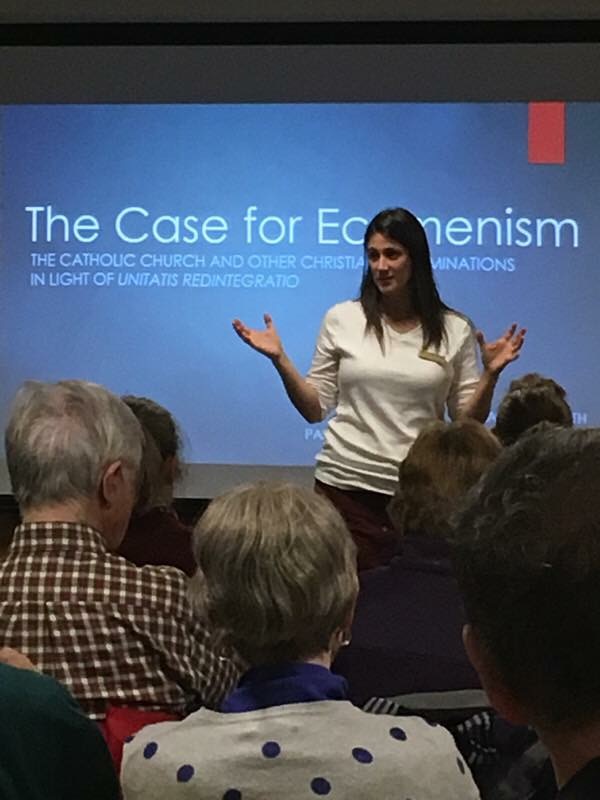
Elizabeth giving a talk at her parish (Holy Family Parish) on ecumenism

Poking holes in one another’s theologies is easy; what is difficult is looking at someone who thinks about God in a completely different way than I do and finding a way to see its loveliness. We are all unlovely in some way; yet, Christ died for all of us. What I’m learning in my work as an ecumenist is that the heart of Christian theology is to love the unlovely as Christ does, loving it into loveliness: “My song is love unknown; my saviors love to me. Love to the loveless shown, that they might lovely be.” We are all unlovely in some way, yet wholly lovable. The same is true for our theologies. This may sound like a watered down version of merely feel-good extractions from the cross of Christ; it is, in fact, the cross itself. 

I’m attempting to argue this point as a theologian and scholar. I’m continually working to adopt it as a way of life, as well. I’m thankful to those in my ecumenical cohort and to Unite Boston for helping me move towards that goal.
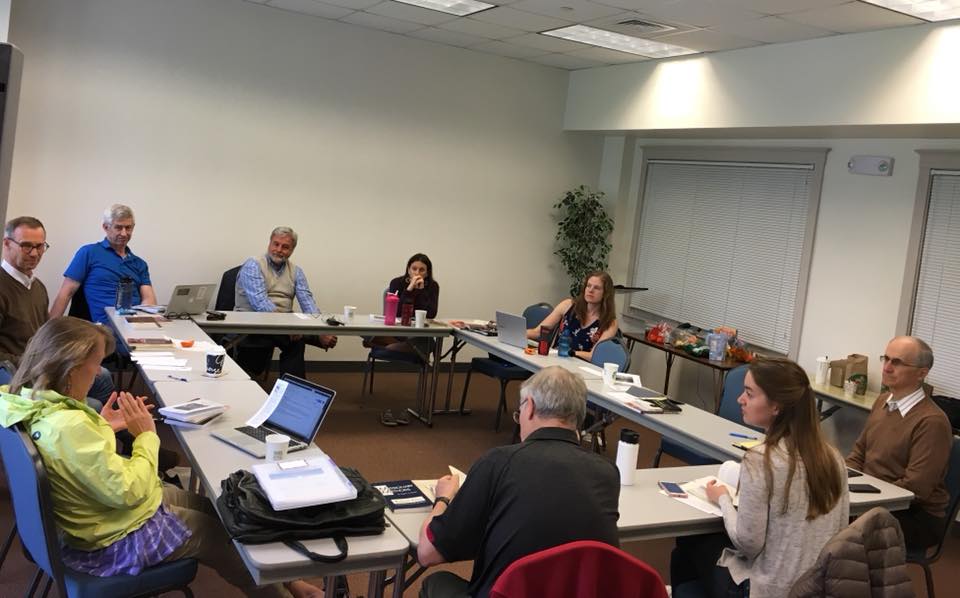
Elizabeth is participating in the ACT 3 Network Missional Ecumenism cohort here in Boston this spring, along with a number of other local clergy

Written by uniteboston · Categorized: Blog · Tagged: christian unity, home, peace, unity, university

Jul 27 2017

Small New England Church?

This week’s guest blogger is Ellen Bass, Director of the Boston Capacity Institute at the Black Ministerial Alliance. Ellen is a member of River of Life Church and began an initiative last year which encouraged church members to visit other congregations’ worship services on Sunday mornings. Read below to hear church members’ insights and key learnings about the kingdom of God in Boston through worship and fellowship  across historic barriers.

With about 60 members, River of Life Church in Jamaica Plain, Boston, is the typical size for a small New England church.[1]

You might be surprised to learn that a year ago, its leadership decided to send 10% of its members to visit other churches once a month. The little church wanted to experience worship and fellowship in different contexts from its own dually affiliated denominations of Christian & Missionary Alliance and American Baptist, as well as its own primarily white culture. The church’s leaders and members set out to connect with the rich diversity and unity of the broader Body of Christ in Boston.

A total of 17 different people visited the following churches over the course of the year:

  • People’s Baptist Church
  • Arabic Evangelical Baptist Church
  • Congregacion Leon de Juda
  • Bethel AME Church
  • First Baptist Church JP
  • Boston Chinatown Evangelical Church
  • Eternal Covenant
  • Roxbury Presbyterian Church
  • Holy Resurrection Orthodox Church
  • Community of St. Egidio at Mission Church
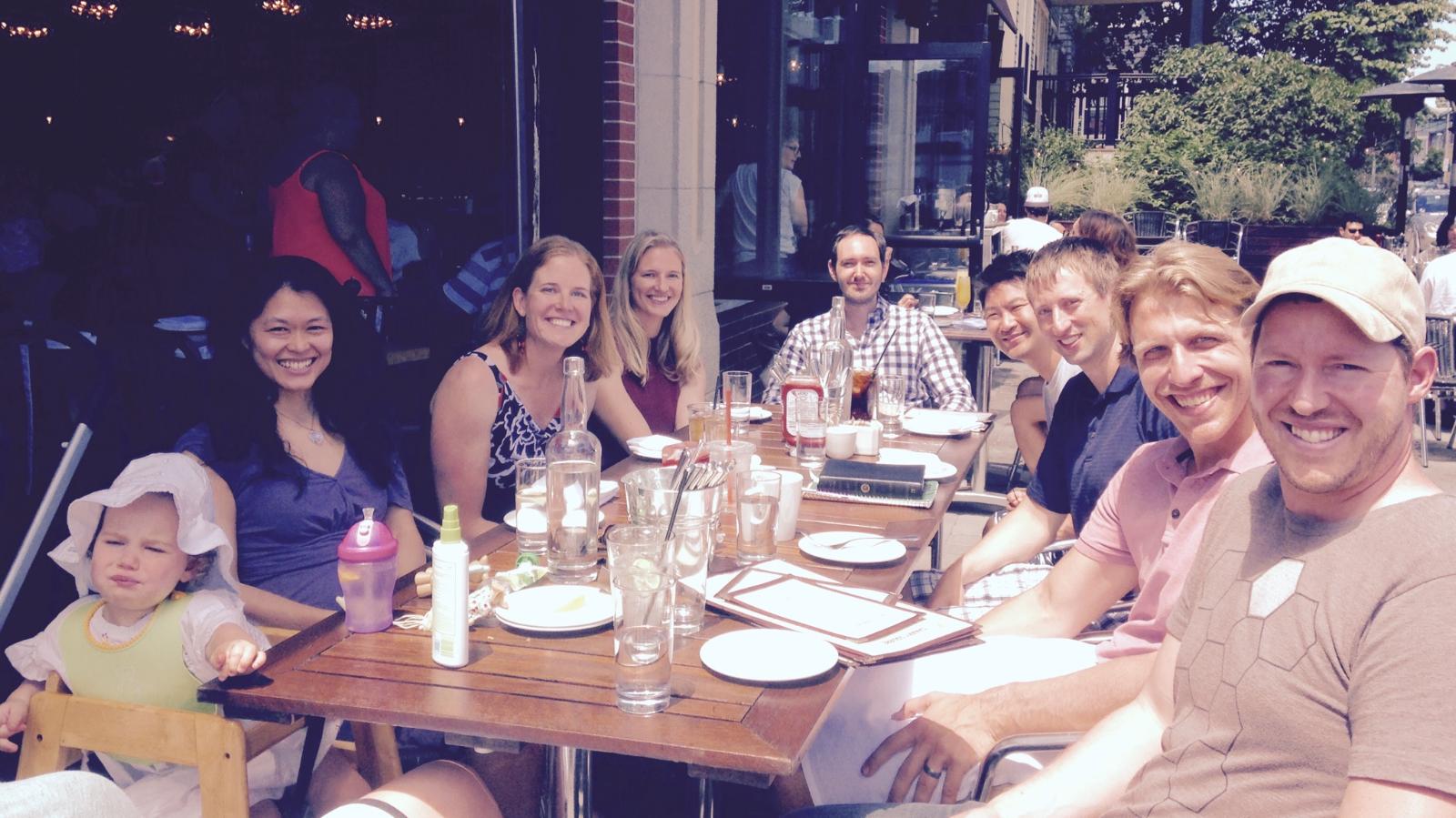
River of Life Church members eating lunch together at a neighborhood cafe

After each worship service, a small group from both churches often shared a meal together to get better acquainted. Anyone from our church was invited and encouraged to sign up to visit the churches they wanted to get to know better. Although it took some planning to get us to the right place at the right time, we learned a lot together!=

  • We loved the hospitality of People’s Baptist Church; they spend five minutes every Sunday during the worship service with everyone in the congregation vigorously greeting everyone else in the room!
  • The Orthodox Church had a beautiful family feel, with lots of people caring for all the children in the middle of the worship service, and plenty of acceptance for children’s noises and behaviors!
  • We experienced how a shared culture makes fellowship very deep and close in these churches: Bulgarian Orthodox, Arabic, Black, and Latino. We found Middle-Eastern culture to be especially hospitable.
  • Immigrant communities spoke about the challenges of language and culture, especially for their youth. These churches wanted to maintain an authentic culture within families across generations, but clearly the younger generations spoke a different language and had a different culture from the older generations. How do we all reach our youth effectively with the gospel?

Some people reflected on how being a minority was a new experience, and how valuable it would be to worship with co-ethnics if they were in the minority all week long. However, we were surprised by how easily and deeply we bonded with people we were so different from. There was a shared desire to maintain a close connection with many of these churches and continue building friendships.

Our plans for next year are still taking shape, but monthly visits are likely! We hope to focus our visits on other churches in its neighborhood of Jamaica Plain, to connect more deeply with our local churches and support what God is doing in our community.

River of Life Church is now confident that its small size isn’t a hindrance to connecting with the rich cultural and denominational diversity displayed in worship services across Boston on Sunday morning. What does your church want to learn and experience in the broader Body of Christ in Boston?

[1] Median US church size is 75. National Congregations Study, Duke University, 2007, p. 2, http://www.soc.duke.edu/natcong/Docs/NCSII_report_final.pdf

Written by uniteboston · Categorized: Blog · Tagged: community, lent, neighborhood, unity, university

Jun 17 2014

Harvard Square: There’s No Place Like Home

For the past five months, the UniteBoston Reps have been engaging in various activities to listen and learn from their communities. These next four weeks, each rep will be writing a brief blog to share their findings with the Greater Boston Christian community.

We dream of having every community in Boston connected with a UB Rep! UB Rep Cohorts begin in October and extend to May. If you’re interested in being a UB Rep in your community, email Kelly Steinhaus, kelly@uniteboston.com

——-

Harvard Square: There’s No Place Like Home

by Kelly Steinhaus

Cambridge has been my home community for almost six years now, and I’m coming to understand that in many ways, the Cambridge community is like a brick. 29% of Cambridge is enrolled in college (1), whose campuses are characterized by red brick buildings. In Cambridge, a person’s tends to be defined by the letters after their name, and, like a brick I’ve found many people in Cambridge to have a hard outer shell. Yet, I’ve also found that, once people trust you, people in Cambridge will open up and become some of the most loyal friends you could ever hope to have.

For many, a brick is also symbolic of “home,” which many people in Cambridge do not have. On one night in 2013, it was determined that 537 persons in Cambridge were homeless (2). Anyone who walks around Harvard Square will notice friends young and old who are living on the street. In fact, Tom Magliozzi said that “Harvard Square is the bum capital of the world.” (3)

Over the past few months as a UB Rep, I’ve become stirred by this issue and am seeking the answer to one question – What would it look like for the churches to come together to serve people who are experiencing homelessness?

As I began researching, I realized that what we don’t need is another soup kitchen. Lunch is served every day in three locations in Cambridge, with 12 dinner meals throughout the week – and this is only the beginning of the abundance of resources available. So what should be done?

I interviewed three people with this question, and found one common thread: What people experiencing homelessness need most is a friend. Tim & Alice Colegrove serve as friends and advocates of homeless youth in Harvard Square, emphasized that “We need a shift in our attitude from charity to mutuality. The church doesn’t need to provide services, they need to build relationships.” Similarly, Alex Grant from Hope Fellowship Church said that while we can’t eliminate homelessness, we can have a change of heart where we look at those we pass during the week and desire to help them.

I also had the opportunity to interview Stephanie Akert, Cambridge’s Director of the Multi-Service Center for the Homeless. From her perspective, one of the biggest needs is to help people transition to permanent housing. We brainstormed ideas as to how churches could alleviate the loneliness that plagues many formerly homeless people who become housed. Churches could be matched with individuals and families who become housed to provide welcome baskets and walk alongside them as friends in their new community. However, the logistics of this effort would be quite difficult due to restrictions in confidentiality and the dispersal of home placements far from Cambridge.

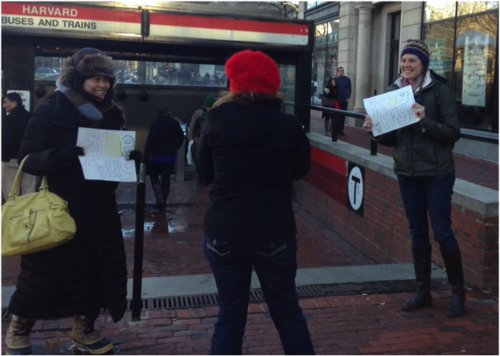
A few friends and I did an interesting experiment a few months ago – we stood in the middle of Harvard Square with signs that read, “Free Hugs.” While many were skeptical and walked by, a few brave souls came to give us a hug. They left grinning and laughing, bringing smiles to others passing by. This momentary embrace of perfect strangers celebrated our common desire for community. (Click on the image below to watch)

The UB Reps program has helped me to see Cambridge holistically. I’m coming to understand that more than a physical home, people need a spiritual place they can call home; a community where they are loved and appreciated for who they are, not just what they do. My church (Journey Church) is officially launching to the city in September with a campaign called “Helping Others Find Their Way Home.”

You see, a brick is only significant because of what it is a part of – a larger wall, placed in alignment with many other bricks. Truly, in Cambridge, there’s no place like home.

Written by jasonjclement · Categorized: Blog · Tagged: cambridge, christian unity, christian witness, community, harvard square, home, homelessness, jesus, university

  • « Previous Page
  • 1
  • …
  • 5
  • 6
  • 7


Give to Further Christian Unity

DONATE!

  • Email
  • Facebook
  • Instagram
  • YouTube

Copyright © 2026 · UniteBoston · Built on WordPress