By Revs. Devlin Scott and Kelly Fassett
Over UniteBoston’s 15 years, we have realized that Christian unity goes far deeper than a surface-level togetherness or a celebration of “unity in diversity.” The way to our unity is through our divisions, and scripture is clear that unity cannot take place alongside unaddressed injustice (Mic. 6:8, 1 Cor 11:17-26).
Through learning about the history of our city and centering the narratives of friends of color, we have come to the conviction that the sin of racism—and the history of chattel slavery, land theft, and systemic disenfranchisement—is not merely a political or social issue. It is a profound spiritual crisis that has fractured our world and wounded the witness of the Church. We lament how for centuries, the name of Christ has been used to justify actions and postures of human bondage, segregation, and economic exclusion.
Jesus came to redeem every form of brokenness and restore wholeness from all individuals and systems damaged by sin (Col. 1:19-20). As followers of Jesus, we are called to carry forward Christ’s redemptive mission as ambassadors of reconciliation through tangible restitution and active repair to foster shalom (2 Cor. 5:18-19). As civil rights leader and theologian Dr. John Perkins famously stated: “There is no reconciliation without justice. And there is no justice without restitution.”
Read more to discover the theological roots of reparations, how two distinct local Christian groups are actively answering this call for repair, and practical ways you can get involved!
*JUST RELEASED: Episcopal City Mission’s story was also just published in the Bay State Banner.*
The Biblical Foundation: Why Reparations Matter
For many Christians, the word reparations can feel politically charged. Yet, the heart of reparations is deeply rooted in historic Christian theology and scripture.
In the Old Testament, the word for righteousness (tzadeqah) is linked to mishpat (justice). Scripture consistently presents true repentance not merely as a private, individual act, but as a communal responsibility (See a great Bible Project video about this here!) Because racism exists internally, interpersonally, and systemically, repair must be collective as well. Reparations transform abstract confession into concrete, tangible restitution for those who have been harmed by these practices and their reverberating effects.
- Restitution in the Law: In Exodus 22 and Leviticus 6, God’s covenantal law required that whenever someone stole, cheated, or took advantage of someone else, repentance demanded returning what was taken, along with additional compensation to restore what was lost.
- The Example of Zacchaeus: In Luke 19, the tax collector Zacchaeus experienced the transformative grace of Jesus, and his immediate response was financial repair: “Look, Lord! Here and now I give half of my possessions to the poor, and if I have cheated anybody out of anything, I will pay back four times the amount.” Jesus responded to this by declaring, “Today, salvation has come to this house.”
- Restoring Right Relationship: The word atonement can be understood as “at-one-ment”—the active work of restoring right-relationship. Christ restored our spiritual debt on the cross, and we are called to follow God’s call to restore material debts incurred by corporate sin and institutional harm (Lev 6: 4-5).
Exploring Our Shared History: The Boston Sankofa Journey
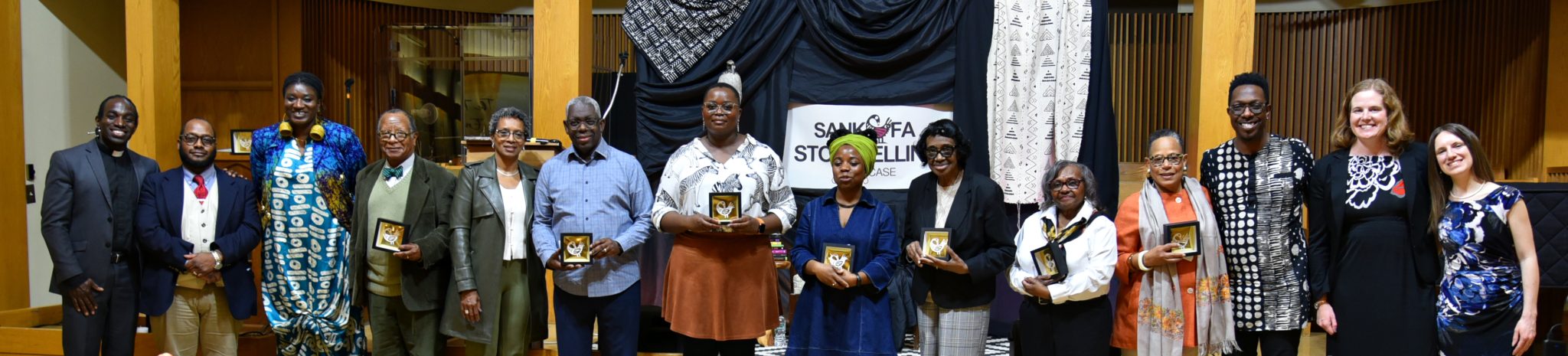
To understand why repair is necessary in Boston today, we must be willing to look back honestly. Through UniteBoston’s Sankofa Journey, we invite local Christians to participate in the concept of Sankofa—looking back to reckon with the past in order to understand our present and build a faithful future together.
Boston’s history is intertwined with both deep faith and deep complicity. The wealth, endowments, and infrastructure of many historic Boston institutions and churches were built on the backs of Black and Brown individuals. For centuries, Black Americans were enslaved, denied citizenship, excluded from homeownership, and segregated from opportunities to build capital. Similarly, indigenous peoples faced forced removal from ancestral lands, the theft of sovereign territories, suppression of their cultural and spiritual practices, and systemic disenfranchisement that stripped them of generational wealth and self-determination.
These historical injustices compound across generations, resulting in clear disparities in education, health, criminal justice, and economic stability. In fact, research shows that the median net worth for White households in Greater Boston is ~$247,500, while for Black households it is just $8. Such stark inequity exposes a profound wound in our city, a wound that left unaddressed will continue to fester, as we know that every person in our city deserves an equal opportunity to thrive and flourish.
Witnessing Repair in Action Across Greater Boston
As shown above, Scripture clearly calls Christians to participate in God’s healing, reconciling, and repairing work. This week, we celebrate two examples of how local Christian leaders and institutions are putting that call into practice.
1. Episcopal City Mission Distributes $2.75 Million
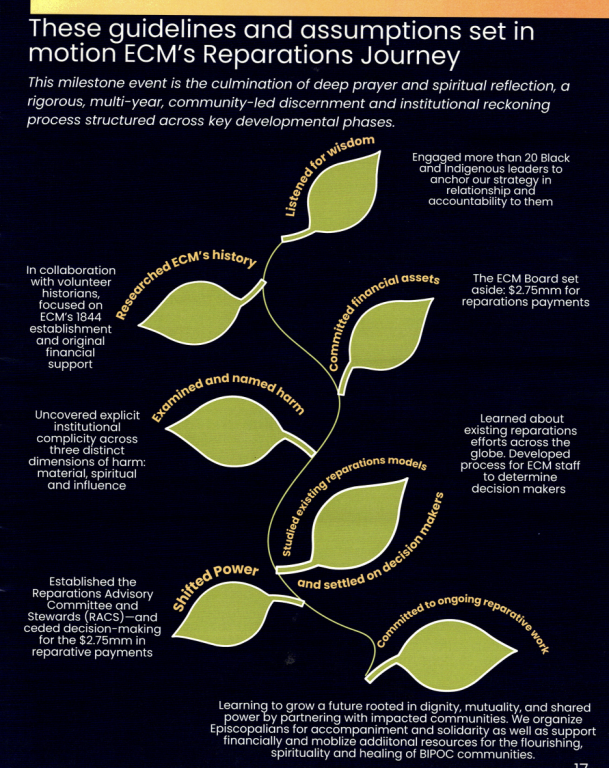
Founded in 1844, Episcopal City Mission (ECM) recently issued a formal Statement of Atonement, acknowledging its history of benefiting from wealth linked to the transatlantic slave trade, exploitative industries, and Indigenous displacement. This action was inspired by a historical audit that ECM completed the last few years, where they discovered that a foundational grant was funded by William Appleton. Appleton was a notable 19th-century white Episcopalian leader in the textile sector whose financial success relied on connections to slave labor, from maritime insurance to cotton and sugar trades in New Orleans and Cuba.
Cynthia Perry, cofounder of The Black Sports Ministry Network and lead consultant to this process, shares, “We know these insurance companies insured cargo, which were often enslaved Africans. Thus, if money given to start ECM was connected to the exploitation of Black labor it is only right to give reparations as unrestricted funds as a form of atonement, apology and attempt of repair.”
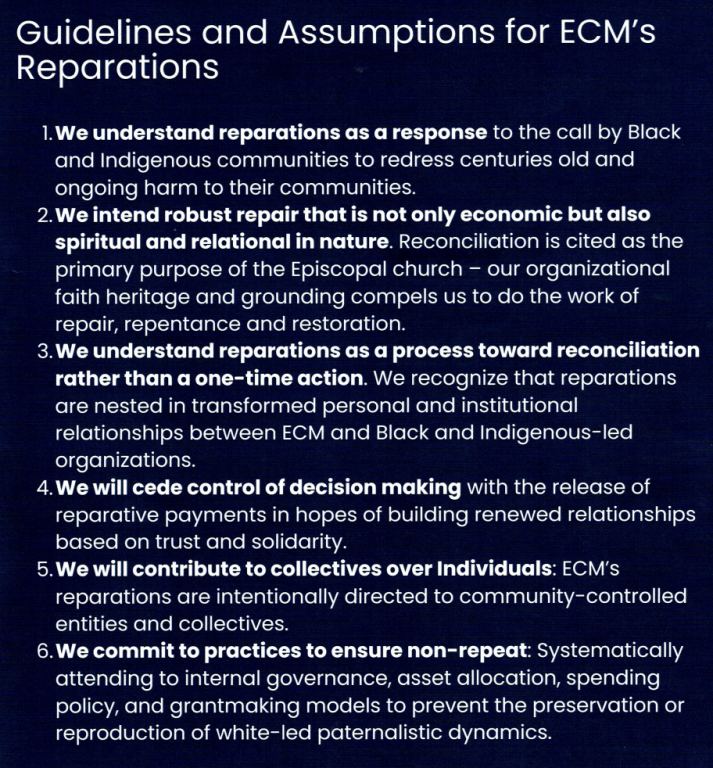
Recognizing that “acknowledgment is not enough,” this week ECM awarded $2.75 million in reparations funding to 25 Black- and Indigenous-led organizations across Massachusetts. This effort was featured in the Bay State Banner.
Guided by Lead Consultant Cynthia Perry and the Reparations Advisory Committee & Stewards (RACS), ECM intentionally ceded decision-making authority to grassroots BIPOC leaders so that the process would center relational trust rather than paternalistic charity. Read about their holistic reparations process here.
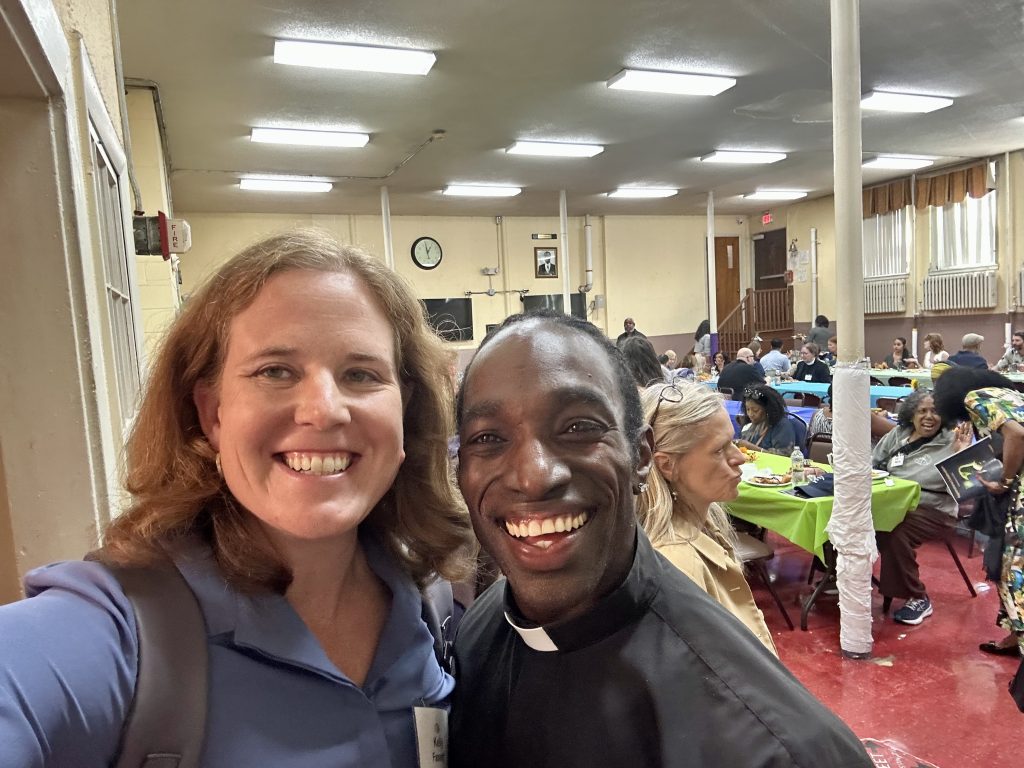
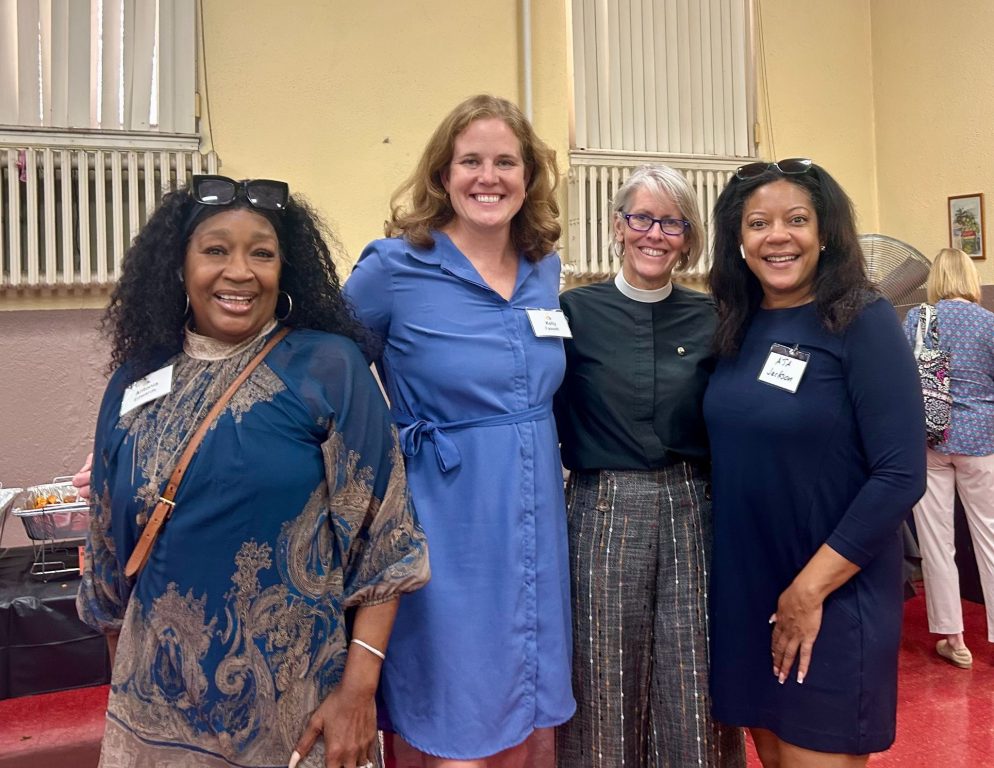
In a Reparations Celebration that took place mid-September, Episcopal City Mission’s Executive Director Rev. Arrington Chambliss said “As a Christian, we are called to confess, but confession without action is empty. It calls us to change our practices, relinquish what needs to be relinquished, and participate in repair. We have to examine patterns of power and wealth to build towards a future where all people will be free.” We commend Episcopal City Mission for demonstrating its commitment to racial reparations and justice with a transparent process and also allocating substantial financial resources—a meaningful step that can be particularly challenging for a large institution.
Recipient Organizations Include:
- Bikes Not Bombs: Advancing mobility justice and youth empowerment.
- Castle of Our Skins: Funding Black artistry and cultural preservation at Harriet Tubman House.
- Resilient Roses Respite: Strengthening infrastructure for youth and young adults with disabilities.
- Native Land Conservancy & Chappaquiddick Tribe of the Wampanoag Indian Nation: Supporting Indigenous land stewardship and sovereignty.
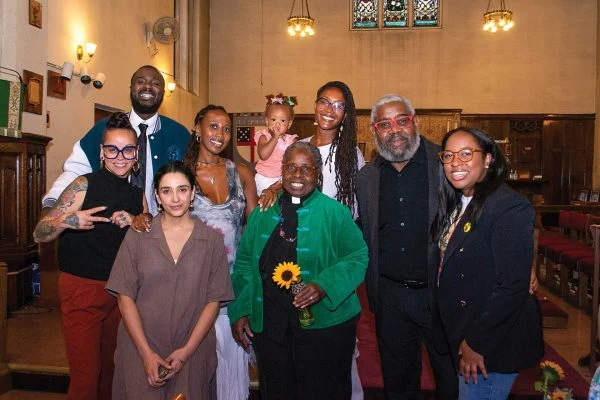
Dr. Ciyadh Wells, Executive Director, Castle of our Skins said: “We are overwhelmed, grateful, and honestly still taking in the reality of receiving reparations. We never thought we would see the day when an institution would look honestly at the harm embedded in its history and make a meaningful commitment to repair. This investment will allow us to continue creating opportunities for cultural curiosity, bringing Black artistry and edu-tainment into classrooms, concert halls, and community spaces, and reaching even more people with stories, music, and experiences that celebrate Black life and creativity.”
Additionally, Deborah Collins, president and CEO of Brookview describes, “Through our work at Brookview House, we’ve seen that many families are carrying challenges that didn’t start with them. The hurdles they face today are often shaped by generations of unequal access to opportunities, resources and support. This reparations payment is an acknowledgment that the disparities we see today did not happen by accident, and that addressing them requires intentional action.”
We celebrate other local congregations that are taking practical steps toward economic repair. The vestry of Emmanuel Church where Rev. Pam Werntz is the rector, has committed 1% of their parish’s budget to help pay down the mortgage of Jubilee House. Co-owned by New Roots AME Church and CRECHE (the Charles River Episcopal Co-Housing Endeavor), Jubilee House is an intentional, eight-bedroom community house in Dorchester, featuring a community garden and food forest. This payment will help to build long-term financial equity for Black-led ministries.

2. Boston Clergy Release Open Letter to White Churches
Also this week, Rev. Dr. Kevin C. Peterson (Boston People’s Reparations Commission / The New Democracy Coalition) and Rev. John E. Gibbons released an Open Letter to Boston’s White Churches. This builds on the The 10 Demandments to Boston’s White Churches that they authored from January 2025.
Addressing systemic economic abandonments across Boston neighborhoods, the leaders emphasized that acknowledgment without restitution is not repair. They called on white churches and faith institutions to:
- Audit Historical Ties: Uncover endowments and properties connected to the slave trade.
- Cede Decision-Making Power: Move away from top-down charity by placing decision-making authority in the hands of documented descendants of enslaved Africans and local Black reparationists.
- Commit Real Resources: Allocate meaningful wealth directly into Black-led institutions driving homeownership, healthcare, and economic development.
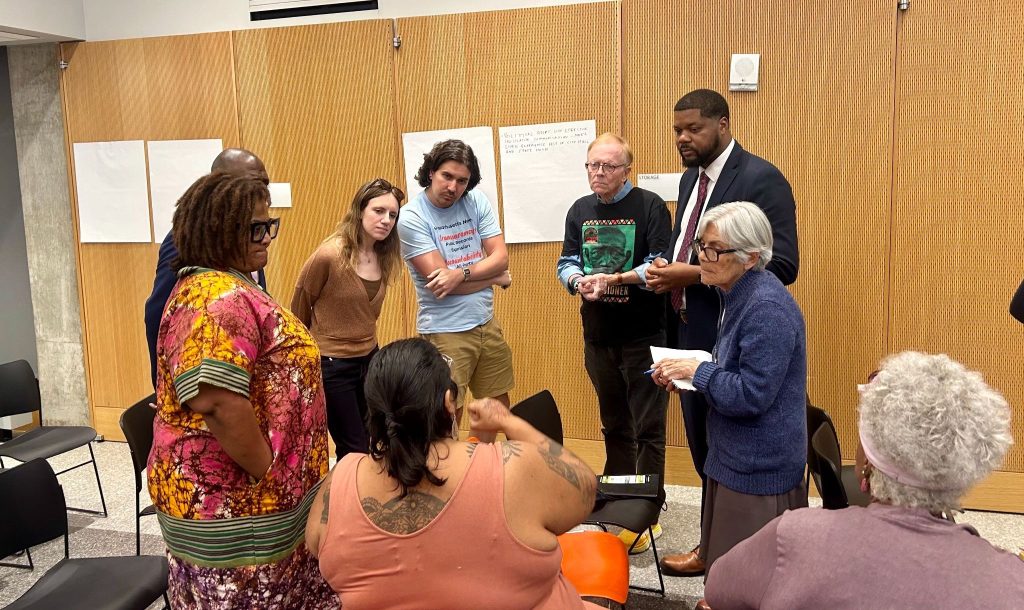
At a community “Reparations Reset” meeting this week, members highlighted grassroots efforts alongside ongoing public policy work. The meeting included community-led brainstorming on the necessary actions to define the levels of harm that have taken place and “reset” the local reparations movement. This community gathering was featured on the Boston Neighborhood Network News (4:30 to 9:35).
Reckoning with the past and defining repair cannot be a top-down endeavor; it must be driven by those most impacted. In an article he published on Medium.com, Rev. Kevin describes: “Reparations cannot be developed primarily through consultants, closed meetings, academic research, or conversations among government-appointed representatives. Research is essential, but it must be joined with sustained public participation. The lived experiences of Black Bostonians are not supplementary materials. They are central evidence.”


This call for grassroots action comes at a pivotal moment as municipal efforts face complex challenges. Established in 2022 to research Boston’s historical ties to slavery and recommend policy-level atonement, the official City of Boston Reparations Task Force recently hit a major administrative setback. The city was forced to cancel its $335,000 contract with Tufts University for the first volume of its historical study (covering 1620 to 1940) after lead researcher Kerri Greenidge left the university amid controversies over her academic citations, leaving Tufts unable to find a replacement. While the returned funds will be reallocated and a secondary report by Northeastern University (covering 1940 to 2020) remains under task force review, community advocates emphasize that municipal bureaucracy cannot be a substitute for direct action.
Rev. Mariama White-Hammond, UB Cohort alum and pastor of New Roots AME Church, leads the research subcommittee for the task force. In a report by WGBH this week, she shares frustration over the delays, yet the need to press forward. “We can actually be a city on a hill, a shining example, which we’ve been saying for hundreds of years. I think this a real opportunity still for Boston to do that, and I hope we will move forward with that as the focus.”
Cynthia Perry adds, “White business practices are often associated with perfectionism, and in trying to find a perfect model, repair and justice are delayed. It is hypocritical to say you are an example of God’s love, teach about God’s love on Sunday and then sit on resources that can have transformative systemic and institutional change. Larger faith institutions that know their wealth was built on the exploitation of Black labor and Indigenous land need to do the right thing and do it now.”
At UniteBoston, we celebrate these courageous local efforts and the vital steps being taken toward real racial repair across Greater Boston. In our Missional Letter, we share our conviction that true Christian unity requires courageously reckoning with the deeper causes of division and actively repairing what has been broken. Tending to these historical wounds is not a distraction from our unity, but the very path toward it. As we engage in active restitution and seek justice together, we offer a living public witness to Christ’s reconciling power (John 17:23). May God use our collective efforts to heal deep fractures, bridge long-standing divides, and draw us into the deep, holistic unity to which we are called.
Taking the Next Step: How You and Your Church Can Respond
Christians in Greater Boston are invited to actively step up to take part in community-led racial healing and repair. Here are some steps that you and your community can take:
- Educate: Learn about the Biblical call for Reparations in author Duke Kwon and Gregory Thompson’s book Reparations: A Christian Call for Repentance and Repair.
- Learn: Learn about the legacy of slavery in Boston through this resource list compiled by UB Sankofa Cohort Alum Megan Lietz, director of the Race & Christian Community Initiative at the Emmanuel Gospel Center
- Audit: Examine your church or organization’s history and financial legacy to find historical involvement in the slave economy.
- Here is a toolkit for institutions wanting to pursue reparations, and local Episcopal Churches who have done this work are listed here.
- The Sacred Reckonings Ecomap includes five intersecting areas for reparations: Truth-telling, Spiritual Practice, Political Solidarity, Relationship Building, and Wealth Return.
- Rev. Arrington offered to be a resource for anyone who would like to learn about their process.
- Engage the Sankofa Journey: Lift up the stories of Black Christian leaders by watching videos on our Boston Sankofa Journey Youtube Channel, and engage in your own Sankofa practice by sharing your own stories of how racial division has touched your life
- Direct Resource Allocation: Consider setting aside a permanent percentage of your family budget, church budget, or endowment to support local Black-led community organizations. Additionally, we encourage you to direct your personal and organizational purchasing power toward minority-owned businesses, restaurants, and contractors by exploring resources like the Boston Ujima Project. Emmanuel has used Sacred Reckonings’ ecomap for reparative work which includes 5 intersecting areas: Truth Telling, Spiritual Practice, Political Solidarity, Relationship Building, and Wealth Return. — Pam