UniteBoston

Bridging Divides Across Christians for the Flourishing of the City

  • Home
  • Events
    • Submit Event
  • Join In
    • Beloved Community Lab
    • Migrant Care and Solidarity
    • The Church and Civic Engagement
    • The ATTIC
    • Kingdom Conversations
    • Worship & Pray
    • Boston Flourish
  • About
    • UB Board, Staff & Volunteers
    • Cohorts
    • Missional Letter
    • Annual Reports
    • History
    • Christian Unity
  • Forums
  • Blog
  • Give
  • Contact
  • Search

Nov 19 2019

Boston Ujima Project and Faith Communities for a Solidarity Economy

We are growing a network of faith organizations as part of the Boston Ujima Project, which organizes neighbors, workers, business owners and investors to bring a community-controlled Boston-based economy to fruition.

We are on our way! And you are the most important part of the equity-equation! Whether you came to the first kick-off event in Nov 2018, or are engaging for the first time with us, or anywhere in between, we urge you to engage with us as a broader body of faith communities. We gather to encourage making commitments to the equitable distribution of decision-making power and resources in our city, and to grow and be joyful together, in pursuit of racial and economic justice. All are welcome,including but not limited to members, staff and leaders of congregations and faith organizations.

Details:

  • When: Thursday, November 21st, 6-8pm
  • Where: Jamaica Plain Cohousing, 65 Cornwall St., Boston
  • Dinner provided.
  • RSVP today via Eventbrite
  • Spread the word via Facebook to folks in your or other organizations/congregations who you want to be part of Ujima’s work!
  • Co-hosted by Kavod, a community of young adults committed to local social justice organizing and meaningful Jewish practice.
  • Feel free to reach out to Nadav at partnerships@kavodhouse.com or Seona at seonaboston@yahoo.com

What to expect: 

At this event, we will learn from and celebrate how some faith communities have been engaging with Ujima, including over $80,000 of direct investment into the Ujima Investment Fund, and over $15,000 (and counting) purchased of goods and services from the Ujima Business Alliance businesses! You did this, and we can continue to do so much more together!

If you have made purchases with Ujima’s businesses or partners, please record them on this Google Form. See our list of partners and businesses at www.UjimaBoston.com.

This will also be the space to meet some of the Ujima business owners, and familiarize and network with the other efforts within the Ujima ecosystem.

And what would be a faith communities meeting if we didn’t have a little fun and laughter together, to foster goodwill and ignite collaboration among the faith communities represented amongst us.
Written by Andrew Walker · Tagged: collaboration, community transformation, racial justice

Oct 02 2019

I Dreamed I Was Free

EVENING PERFORMANCE | Rich Swingle, actor | 7:30-9:00 p.m.
“I Dreamed I Was Free”, The story of Quaker abolitionist John Woolman
$5 donation requested at the door.

Rich Swingle is an award winning actor, who has performed and/or taught on five continents, in 37 nations and in hundreds of venues, mostly with a dozen one-man plays he has written or helped develop: I Dreamed I Was Free, Big Fish Little Worm, The Revelation, The Acts, Alien Immigration Training, Views of the Manger, Five Bells for 9/11, Journey to the Garden, Paradise Lost, God of Hope, Shepherds Reflect on the 23rd Psalm, and Beyond the Chariots, which he’s performed Off-Broadway, at the Edinburgh Fringe Festival (the largest arts festival in the world), in LA, Toronto, Hong Kong, Shangai, Transylvania, and in Beijing, Vancouver, Singapore and London while those cities hosted the Olympics. He received his master’s degree in theatre from Hunter College.

This program is made possible through a Vital Worship Grant from the Calvin Institute of Christian Worship, Grand Rapids, Michigan, with funds provided by Lilly Endowment Inc.

For more information, visit www.lca.edu

Written by Andrew Walker · Tagged: racial justice

Mar 21 2019

Spirituality & Social Justice: Abraham Joshua Heschel & Martin Luther King, Jr.

Abraham Joshua Heschel and Martin Luther King met in the early 1960’s and established a friendship based on shared values and mutual respect between their Jewish and Christian traditions. Through our study, we will pursue several key biographical, theological, and political questions:

  • How did each emerge as a public figure?
  • What were their understandings of the relationship between religion and American democracy?
  • How did they weave together ritual and ethics concerns?
  • Can we apply lessons from their interreligious, cross-cultural, and interracial efforts to oppose bigotry and hatred today?

By studying Heschel and King together, we will have the opportunity to learn by way of comparison and contrast—including the impact each had on the other—thus offering us two intriguing models of “spirituality and social justice.”

This is a 5-week interactive course; the cost is $120. Register here.

Written by Andrew Walker · Tagged: clergy, diversity, prayer, racial justice, spirituality

Mar 19 2019

Letter from Birmingham Jail: Public Reading & Reflection

All are welcome on the anniversary of Dr. King’s death for a public reading of Letter from Birmingham Jail, with times of personal and community reflection.

The Letter began in the margins of smuggled newspapers in response to criticism from moderate white clergy, and became the moral framework for the Civil Rights Movement. Today, it continues to call people of all faiths and none to pursue reconciliation in our communities.

With special guest Rev. Emmett G. Price III, Ph.D. Dean of the Chapel & Founding Executive Director of the Institute for the Study of the Black Christian Experience at Gordon-Conwell Theological Seminary.

For questions or more information email richard@nscbc.org

Written by Andrew Walker · Tagged: community, injustice, justice, peace, peacemaking, racial justice, seeking peace, unity

Jan 12 2019

Visualizing Racial Justice and Reconciliation

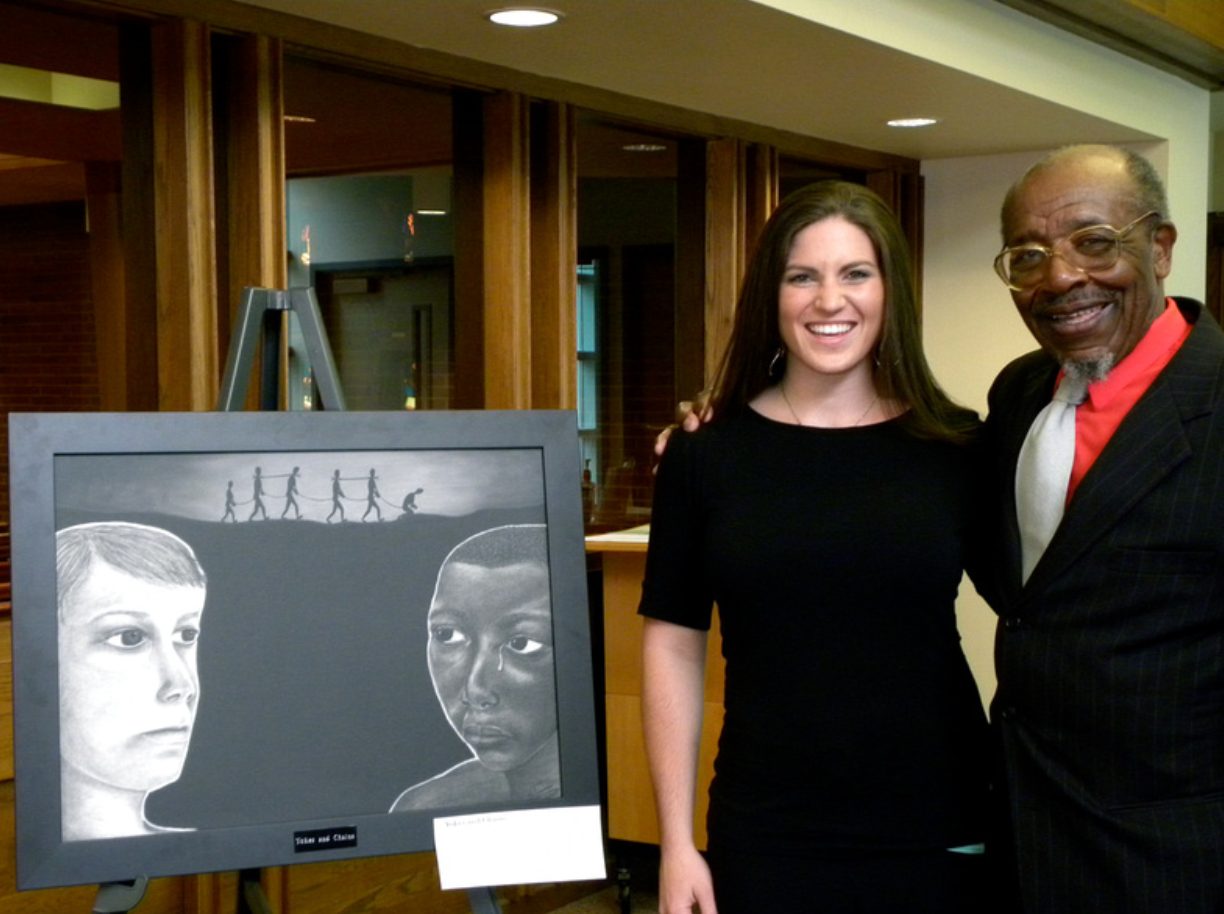
Stephanie Irwin with Civil Rights Activist John Perkins

The theme of the 2019 Week of Prayer for Christian Unity is “Justice, only justice, you shall pursue” (Deuteronomy 16:20). In light of this theme, we created this discussion guide around Stephanie Irwin’s artwork to invite local conversation around the ways in which we can contribute to God’s justice in our communities. 

Stephanie lived in the Longwood Christian Community in 2011 to 2014 while training as a physical therapist. This project was inspired by Stephanie’s experience as part of reconciliation workshops in Rwanda, Africa with members of the Tutsi and Hutu ethnic groups. It was there that she learned that healing “could only progress by facing the truth and acting upon it.” She created these art pieces seeking to share God’s call for justice and reconciliation with all those around her. Stephanie lives in Seattle now. Her artwork and photography are available at https://www.stephanielynnephoto.com/

We are planning to use the discussion guide below during some of the UniteBoston neighborhood dinners, but it could also be used within a church bible study or community group. When coming together with people from a variety of perspectives, it is always good to set expectations and guidelines for the conversation. Together, let us consider how God is inviting us to contribute to acts of justice and reconciled relationships within our lives and communities.

Note: While Stephanie’s art focuses on relationships between Black and White people, we recognize that racial justice includes people of all races. Additionally, we value Stephanie’s reflections as stated below through her own lens as a Caucasian woman, but we do not seek to universalize her experience or perspective. We felt that this was a valuable lens into one person’s understanding of the process of reconciliation, and hope that you will be inspired as well.


Jesus stood up to read, and the scroll of the prophet Isaiah was handed to him. Unrolling it, he found the place where it is written: “The Spirit of the Lord is on me, because he has anointed me to proclaim good news to the poor. He has sent me to proclaim freedom for the prisoners and recovery of sight for the blind, to set the oppressed free, to proclaim the year of the Lord’s favor.” Then he rolled up the scroll, gave it back to the attendant and sat down. The eyes of everyone in the synagogue were fastened on him. He began by saying to them, “Today this scripture is fulfilled in your hearing. (Luke 4:16-21, NIV)

“There is another thing that disturbs me to no end about the American church. You have a white church and you have a Negro church. You have allowed segregation to creep into the doors of the church. How can such a division exist in the true Body of Christ? You must face the tragic fact that when you stand at 11:00 on Sunday morning to sing “All Hail the Power of Jesus Name” and “Dear Lord and Father of all Mankind,” you stand in the most segregated hour of Christian America. They tell me that there is more integration in the entertaining world and other secular agencies than there is in the Christian church. How appalling that is.” (Paul’s Letter to American Christians, Dr. Martin Luther King, Jr., Delivered at Dexter Avenue Baptist Church, Montgomery, Alabama, on 4 November 1956)

“Injustice anywhere is a threat to justice everywhere. We are caught in an inescapable network of mutuality, tied in single garment of destiny.” (Dr. Martin Luther King, Jr., Letter from a Birmingham Jail, 1963)


Stephanie’s Artwork and Reflections

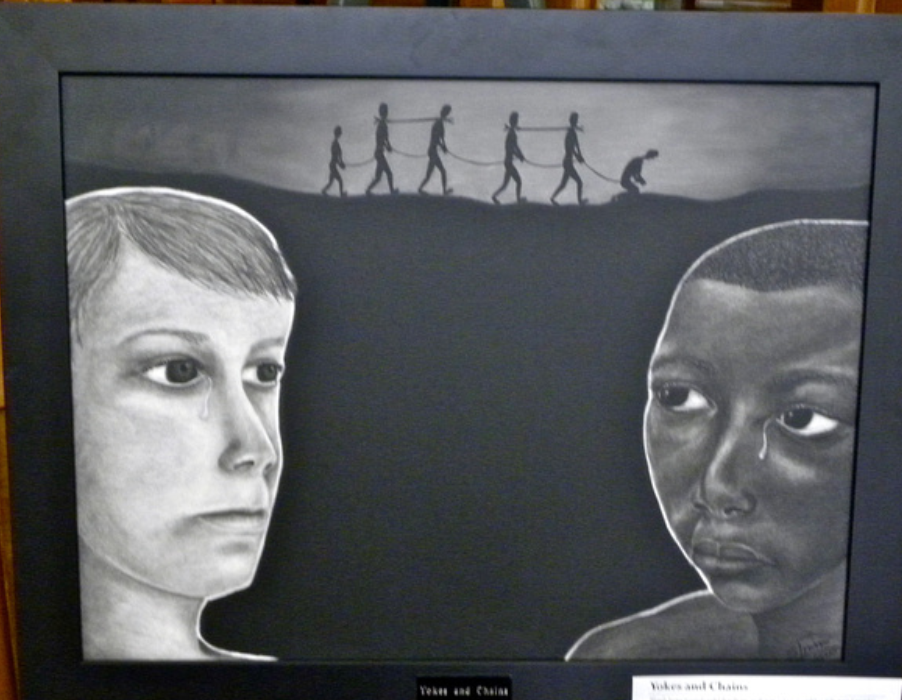
Yokes and Chains

The first piece, titled Yokes and Chains, sets the stage for both the pain of the past that continues to cause separation as well as a hope for abolition of that separation.  When considering the process of arriving at reconciliation the pain cannot be ignored but rather must be confronted. As the two children face each other they reflect on the reality and pain of slavery.  In this moment they bear witness to the fault, pain, consequence and responsibility of the transatlantic slave trade. In response, they express their pain through the shedding of tears. Both their tears reveal remorse for what transpired in the past as well as for the racism and segregation that persists even today.  Though they are separated by a darkness that is fueled by American society, their sorrow also reflects a hope for future change. By first gaining awareness of the truth rather than hiding from it, they choose to be a part of that change.


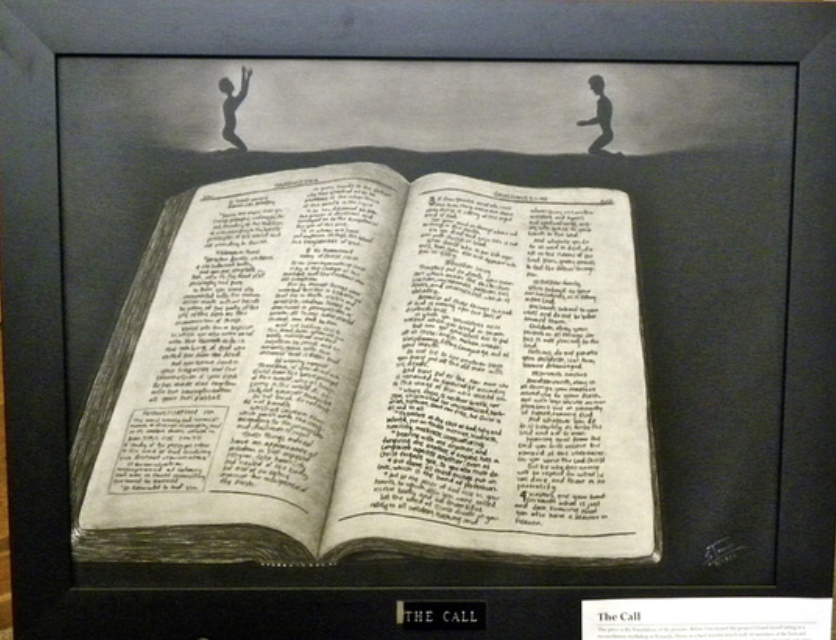
The Call

The second piece in the series is the foundation of the process.  True healing can only progress by facing the truth and acting upon it.  The Call presents this truth as the Word of God. The part of the text in focus reveals Colossians 3:11-14 which reminds us that we are called to be one, that in Christ there is no separation and that we must embrace unity through forgiveness, healing and love.  The silhouette brings to light the need to receive the truth as the two children from the first piece fall to their knees in surrender.


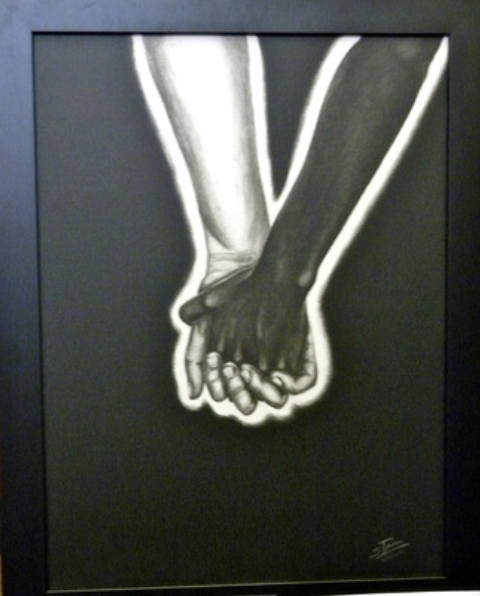
The Act

As she drew this picture, Stephanie describes, “My mind rushed back to another day in Rwanda where I saw a light emerge in the darkness through the joining of two men who expected to be lifelong enemies. A Tutsi man forgave the unforgivable of his Hutu neighbor and perpetrator from the 1994 Genocide. As I witnessed them walk hand-in-hand, I was convinced that I had never before seen a more beautiful sight. It was at this point that I acquired a renewed hope of flourishing unity between whites and blacks in America.  Similarly, the two children who were separated by darkness in the first piece are now joined here to create a light as they respond to their call. With fingers interlocked they move forward together determined to never be divided.”


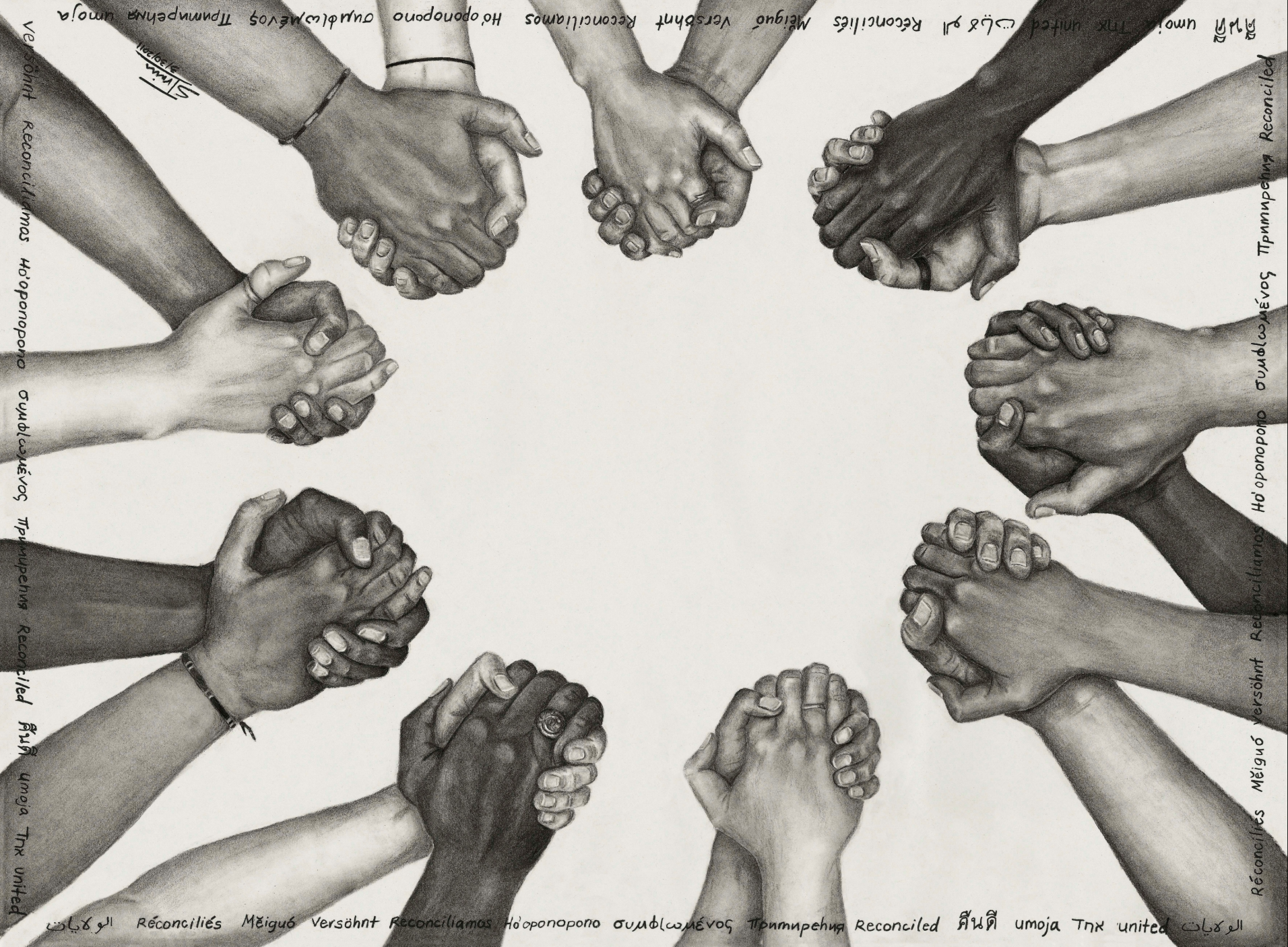
Beloved Community

The final piece brings the project and everyone together. The hands depicted in this piece are the hands of real people, including the artist’s, who choose to join with people of all color to stand for racial reconciliation and live in multicultural and multigenerational community. Bordering the hands are the words “united” and “reconciled” in twelve different languages to emphasize the beauty of diversity. The intention of incorporating these languages is to allow anyone to feel as if that they are a part of this piece. The piece is titled Beloved Community in order to portray racial reconciliation as specifically centered around love that is fostered through a community. Additionally, it references the song “Beloved Community” developed by Dr. Martin Luther King Jr., which reflects the vision of all four pieces cumulatively. You are invited to join this beloved community with those building it around you.


Discussion Questions

  1. Describe your initial thoughts or reactions to the scripture passage, quotes by Dr. Martin Luther King, Jr., or Stephanie’s art pieces.
  2. Where have you personally seen racial justice or inequity taking place? What most breaks your heart about this?
  3. Where do you see people sharing in the prophetic mission of Jesus as described in Luke 4? Where is there evidence of the healing, liberating, redeeming power of God in your life or neighborhood? Share a story that comes to mind.
  4. The Bible has continually been a source of inspiration for the Christian community to address conditions that are unjust or undermine human dignity. Where do you see an opportunity for the Church to come together for the cause of racial justice in this neighborhood or community?

Additional Resources:

-Read the Christian Churches Together response to Martin Luther King’s Letter from a Birmingham Jail here (2013)

-Check out the Emmanuel Gospel Center’s Race & Christian Community Initiative 

Written by uniteboston · Categorized: Blog · Tagged: christian, christianity, diversity, jesus, martin luther king, racial justice, racial reconciliation, reconciliation, unity

  • « Previous Page
  • 1
  • 2
  • 3


Give to Further Christian Unity

DONATE!

  • Email
  • Facebook
  • Instagram
  • YouTube

Copyright © 2026 · UniteBoston · Built on WordPress