Bridging Divides Across Christians for the Flourishing of the City
The Presidential election is right around the corner! We encourage all Christians to pray for the leaders of our country, and prayerfully consider how your faith in Christ informs your vote.
Samuel Adams said, “Let each citizen remember at the moment he is offering his vote … he is executing one of the most solemn trusts in human society for which he is accountable to God and his country.”
Additionally, 1 Timothy 2 states “Therefore I exhort first of all that supplications, prayers, intercessions, and giving of thanks be made for all men, for kings and all who are in authority, that we may lead a quiet and peaceable life in all godliness and reverence.”
The MyFaithVotes.org website is a great resource for information about party platforms.
Whatever your emotions are leading up to the election, I’d encourage you to read author Max Lucado’s blog about his prediction for November 9th. He encourages us to remember God’s sovereignty and that, regardless of the outcome, “Our good God rules the world.”
The Emmanuel Gospel Center suggests that we pray for the Church in Boston during this election season; and that there will be a display of love and unity among Christians even in the midst of disagreement. Pray that we can promote peace, compassion, and justice that transcends political parties. Pray for healthy dialogue that concerns kingdom values, and not just American values.
The Archdiocese of Boston encourages everyone to vote NO on #4. The Archdiocese is particularly concerned about the serious risks to youth that would follow enactment of this proposed law. We feel an obligation to do all that we can to prevent this from occurring. Click here for more resources, including a statement from Mass Medical Society, Massachusetts Chiefs of Police, and other organizations, who strongly oppose #4.
Additionally, the Massachusetts Council of Churches have provided a few some resources to help Massachusetts voters:
Ecumenical Ballot Question Guide

The Massachusetts Council of Churches have created this guide to be honest, specific, and to present the best in each side.
Prayer Services for Election Eve and Election Day –
Resource from the Massachusetts Council of Churches
As November 8 approaches, consider holding a prayer service in your community. The Disciples of Christ Council on Christian Unity has developed this beautiful Liturgy for an Ecumenical Prayer Service for Election Day or Eve. This communion liturgy might be useful to you in planning worship for November 6 or 13 as well.
Here are prayer services taking place in the Greater Boston area; check back with the Massachusetts Council of Churches’ Facebook page for an updated list, or email info@uniteboston.com to add your service here!
Boston
Tuesday, 11/8 Taizé Services 8:30 AM, 12:10 PM and 5:30 PM Trinity Church in the City of Boston
Brookline
Cambridge
Monday 11/7, at Christ Church:
-8am: Morning Prayer Service of Trust
-12pm: Midday Prayer Service of Silence and Intercession
-5:15pm: Evening Prayer Service of Repentance and Deliverance
-6pm: Contemplative Prayer Service of Silence and Intercession 6pm
Tuesday 11/8 at Christ Church:
8am: Morning Prayer Service of Unity and Reconciliation
Tuesday 11/8 – 9am to 8pm at Reservoir Church – Day of Prayer
Lexington
Monday, 11/7 7:00 PM Church of Our Redeemer
Medford
Monday, 11/7 7:00 PM Grace Episcopal Church
Waltham
Monday, 11/7 6:30 PM (communion) Christ Church
Watertown
Monday, 11/7 7:00 PM (interfaith service) Church of the Good Shepherd, Watertown
Finally, the Episcopal bishops in the Commonwealth of Massachusetts call for a vigil period of intense prayer from noon on All Saints Sunday, Nov. 6 through noon on Election Day, Tuesday, Nov. 8.
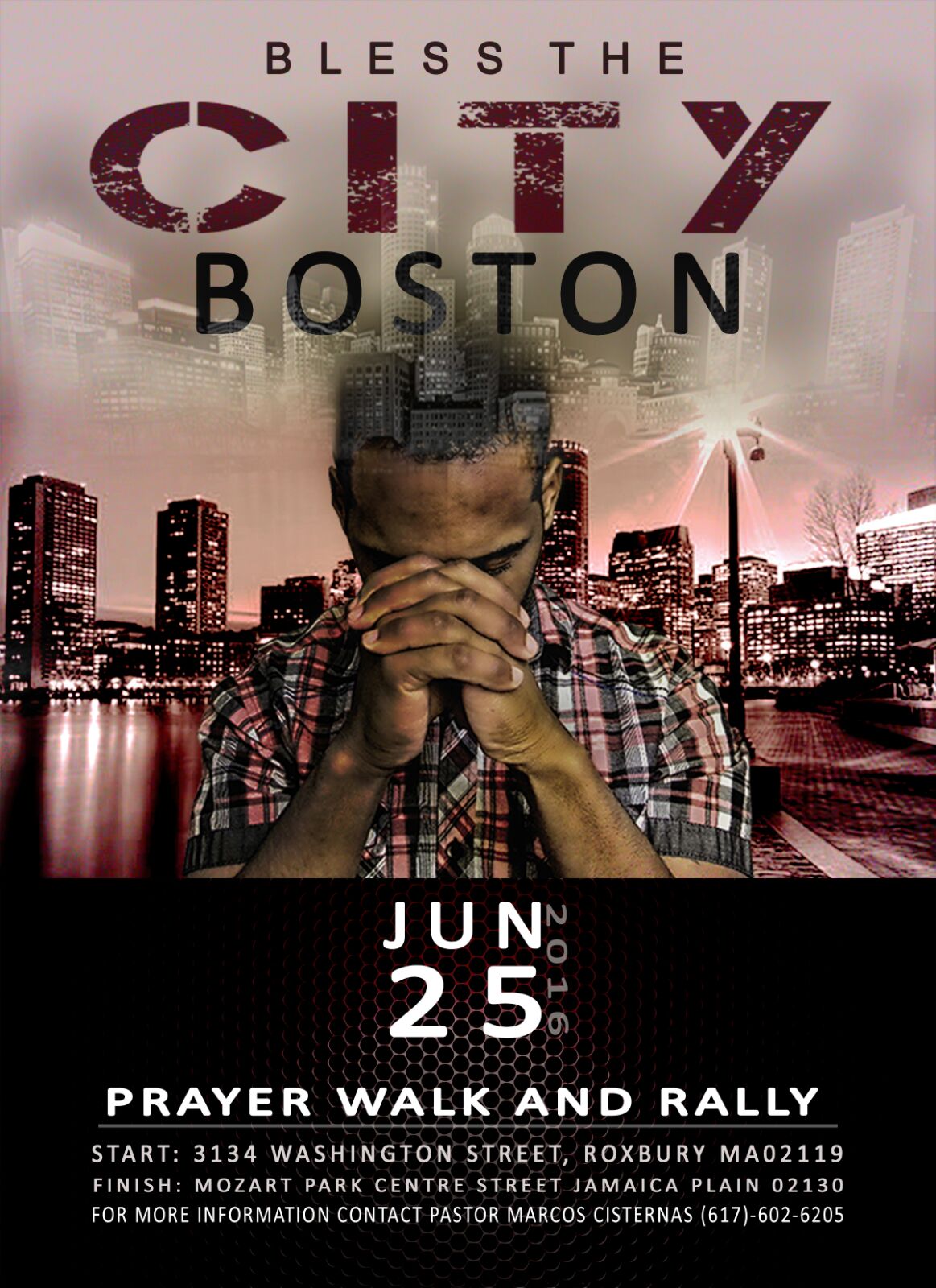
There is an exciting gathering that is taking place this Saturday, June 25! The “Bless the City Prayer Walk and Rally for Community Peace” will begin at 10:00am at 3134 Washington Street, Roxbury, and end with a celebration at Mozart Park in Jamaica Plain.
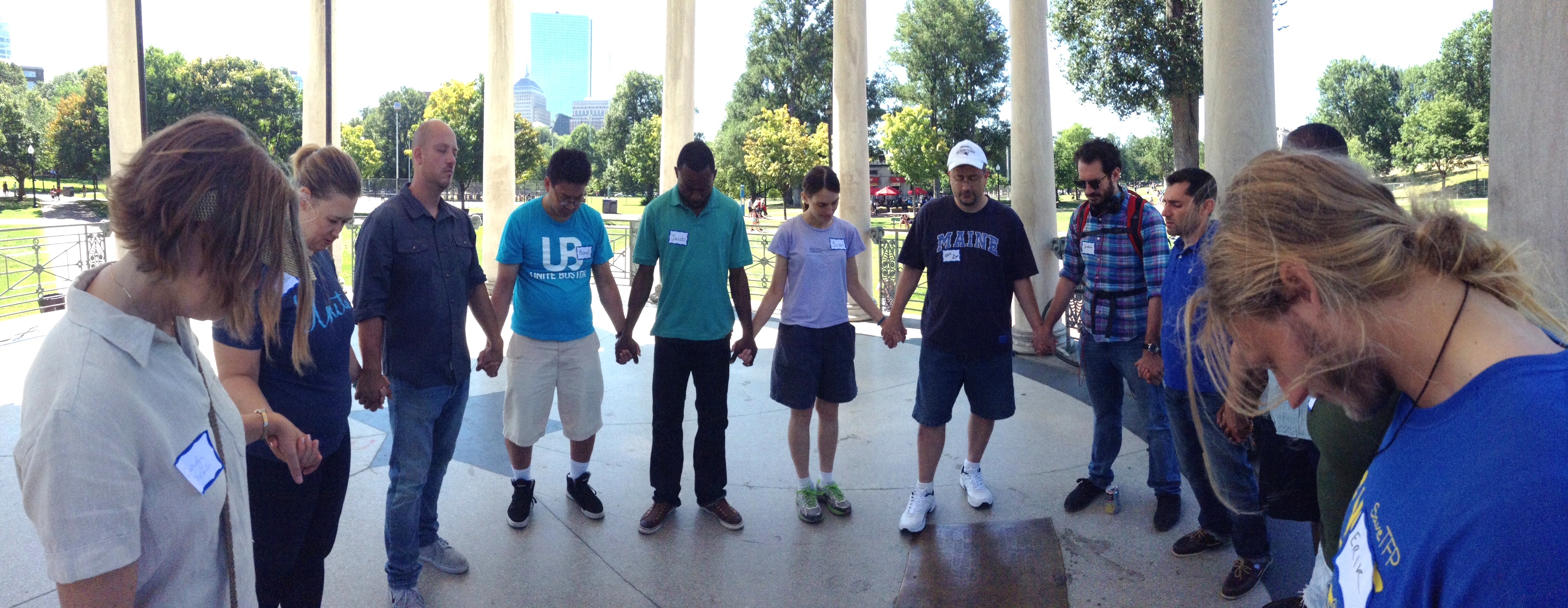
So, come and join us! We’re having a UniteBoston Meetup at the event. Email me back if you’re planning to come so you can find our group.
——–
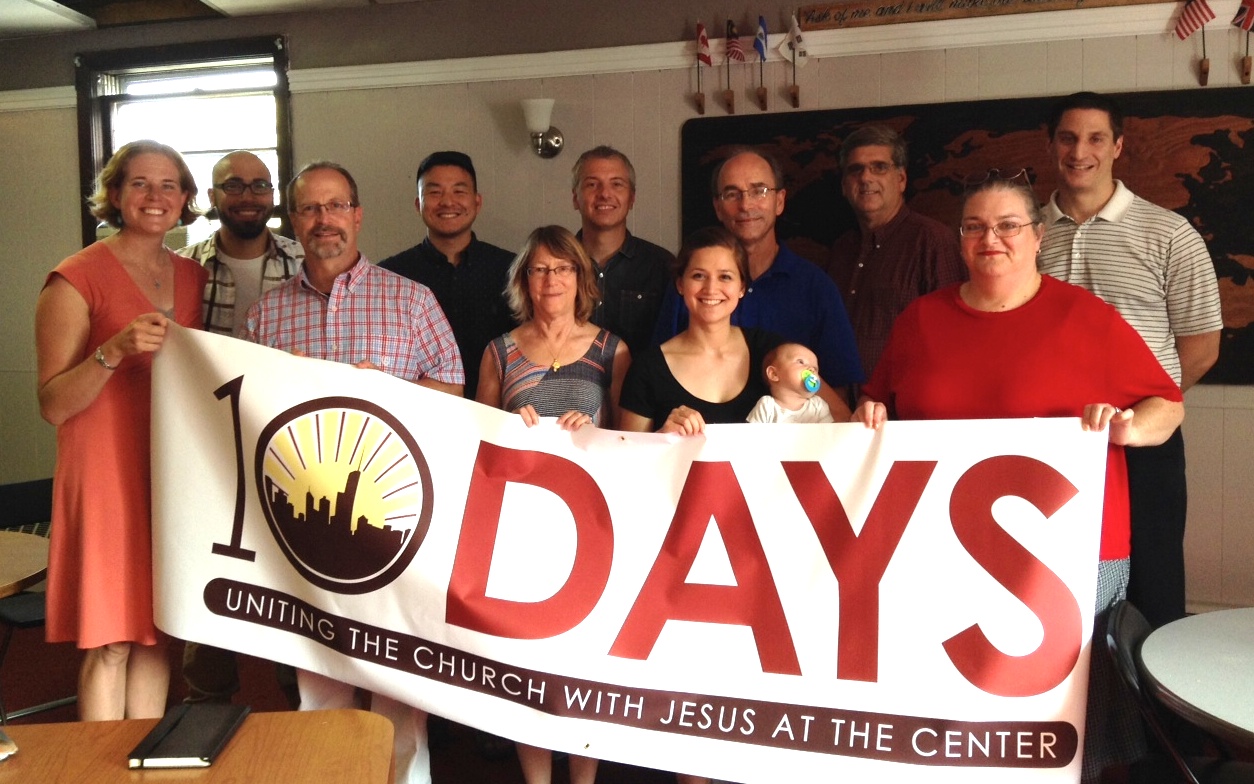
This week, we hear from UniteBoston’s own Kelly Steinhaus, as she shares how the upcoming 10 Days of Prayer provides Boston’s diverse Christian community an opportunity to reconcile differences by remembering Christ as our Peace.
For He himself is our peace, who has made the two groups one and has destroyed the barrier, the dividing wall of hostility… His purpose was to create in himself one new humanity out of the two, thus making peace, and in one body to reconcile both of them to God through the cross, by which he put to death their hostility. (Ephesians 2:14-16)
What a radical concept Christian unity is! The fact that in Christ, we are one!
This heavenly reality certainly does not appear to be true when we look around the world. We all come from various backgrounds and cultures, life experiences, and we have our own denominational distinctions. Each person sees the world very differently, and because of this, we are inherently prone to disagree with and distance ourselves from those who are culturally, denominationally, and ethnically distinct from us.
Yes, it is easier to worship with people who look like us, act like us, and have the same theological beliefs as us. But as Christians we are called to go beyond this place of comfort to see and value Christ in our neighbor.
Paul acknowledges the difficulty of extending Christian fellowship by exhorting us to “earnestly endeavor to keep the unity of the Spirit through the bond of peace” (Ephesians 4:3). According to Karl Barth, the Greek word here implies a “full effort of the whole man, involving his will, sentiment, reason, strength, and total attitude”. “Earnestly endeavor” is not simply an outward action of embracing the other, but is first and foremost an inward examination of our hearts.
When you look at your brother or sister, do you see Jesus? What might be hindering your view?
From my experience, one of the chief hindrances to Christian unity is my need to be right. This places walls between me and my brothers and sisters, resulting in a self-righteous attitude. At the end of the day, only God knows those who are His, and so the “right” answer is Jesus’ work and righteousness, extended to all.
During 10 Days Boston, we have the opportunity to step outside our comfort zones to get to know our brothers and sisters from various denominations and backgrounds. As we do this, we learn to respect those that disagree with us. We learn to be confident in the fact that the fellowship of the saints goes beyond a uniform doctrine to involve a unity of Spirit (Eph 4:3) based on the inward spiritual rebirth of those who confess faith in Jesus as Lord. We also learn to value the breadth of Christian traditions rather than promoting a particular expression as having greater spiritual authority over another. Indeed, the deep, difficult work of Christian unity is to respect and honor those with whom we may have significant disagreements.
When we step back, we realize that the one and only thing that makes us one is our revelation of Jesus Christ. It is what Jesus did in his incarnation, sacrifice, and resurrection that has reconciled us to God and to one another, thus forming an inseverable and eternal peace. It’s as we all gaze at Christ’s sacrificial work on the cross that we are one.
Jesus, we confess our tendency to exclude rather than to include, to judge rather than to honor, and to assert our position rather than to love unconditionally. Lord, have mercy.
*Note: This devotional is a part of the 2015 daily devotional published by the national 10 Days team.
For the past five months, the UniteBoston Reps have been engaging in various activities to listen and learn from their communities. These past four weeks, each rep will be writing a brief blog to share their findings with the Greater Boston Christian community. This week, Andrew Walker, UB Rep in the Back Bay, shares his insights.
We dream of having every community in Boston connected with a UB Rep! UB Rep Cohorts begin in October and finish in May. If you’re interested in being a UB Rep in your community, email Kelly Steinhaus, kelly@uniteboston.com
————
When I think of Back Bay, two symbols come to mind that help me capture the character of this neighborhood: a pen and a wagon wheel. The pen represents learning and the pursuits that require a high level of literacy. Most of the activities that are evident in the Back Bay, from commerce to the various trades and occupations require learning and literacy as basic preconditions.
The wagon wheel brings to mind travel; and the Back Bay is certainly a hub of travel with Back Bay Station serving as a major gateway bringing people into the city and sending them to destinations within the region and beyond. Numerous hotels and restaurants provide hospitality for these travelers as well as those calling this home. And a healthy selection of shops along Boylston and Newbury Street attract shoppers from near and far.

For the most part, the resident population in Back Bay are those who can afford the high real estate prices, which consists of people with professional or highly technical training who hold jobs in the near vicinity. Among them are many families, as well as many with no close family ties.
The churches in the Back Bay are mostly examples of “traditional mainstream” denominations. Their congregations draw from the immediate neighborhoods, but also among them are some who come from surrounding schools as well some who commute to church, just as they commute to work sites in the Back Bay. But there are also a few more recent church planting efforts. The CityLife Presbyterian Church and Renewal Church are two examples of growing fellowships whose leaders speak with great excitement about praying and working for renewal in the city guided by the Spirit of Christ. They seem to be reaching mostly students and young working folks.
So one might gain an impression of the Back Bay being a crossroads offering comfortable domesticity as well as lively commercial and entertainment activity. But there is also in the Back Bay a confrontation with a less comfortable contrast: In 2013 the celebration of cosmopolitan expansiveness that is so much a part of the Boston Marathon and so appropriate to the character of the Back Bay was shattered by the explosion of two bombs. We witnessed and marveled at heroic interventions by so many first responders. In the following weeks admirable efforts were launched in aid of the casualties and their families. All of Boston’s citizens rightly drew encouragement from these acts and efforts. And then, four months later a young man was shot to death on Boylston Str., just across from Trinity Church. This event was not completely over looked by local media, but it got nowhere near the attention of the Marathon Bombing. That young man’s mother has asked us to consider, was the loss of her son any less tragic? Similarly, leaders in other Boston neighborhoods have asked us to consider, of the more than 300 shootings in other parts of the city, over the past ten years, are they any less tragic that they are deserving of so much less attention?
As I consider the question that we are all addressing, what’s God doing among us, this contrast weighs heavily on my heart. But I am not without encouragement.
At First Lutheran Church in Boston, my home congregation on Berkeley Street, I was invited this spring to present 3 sessions of instruction in Biblical Peacemaking during Sunday Morning Adult Bible study. I was pleasantly surprised at how well received it was. Three sessions grew into five sessions and there were more participants at the last session than at the first. I was especially delighted to observe that the sessions included allot of discussion and many thoughtful and penetrative questions were raised and debated. Perhaps most encouraging was the readiness of participants to consider the consequences of avoidance of difficult questions; how the patterns of avoidance hinder discussion when important issues like budget need to be addressed.
Participants in the congregation at First Lutheran are in many ways similar to the folks in the immediate neighborhood. Some are families, some are single, many are students. And we are blessed by much cultural diversity. Career interests are similar. Economic goals are similar. So I don’t consider it too much of a stretch of imagination to suppose that the thoughtful interest in Biblical Peacemaking I was surprised by at First Lutheran might imply that a similar interest exists in the larger community.
God is working among us and we’ll see the benefits when we listen to Him and to one another.