UniteBoston

Bridging Divides Across Christians for the Flourishing of the City

  • Home
  • Events
    • Submit Event
  • Join In
    • Beloved Community Lab
    • Migrant Care and Solidarity
    • The Church and Civic Engagement
    • The ATTIC
    • Kingdom Conversations
    • Worship & Pray
    • Boston Flourish
  • About
    • UB Board, Staff & Volunteers
    • Cohorts
    • Missional Letter
    • Annual Reports
    • History
    • Christian Unity
  • Forums
  • Blog
  • Give to UniteBoston
  • Contact
  • Search

Oct 21 2019

Greening Your Parish: Answering the Cry of the Earth, the Cry of the Poor

Find out how to promote the principles of Pope Francis’ encyclical, Laudato Si’ in the your parish.

Keynote: Words Matter: Communicating Climate Change to Save Our Common Home.(John Anderson, Former Director of Education at New England Aquarium)

Breakout sessions on:  forming Creation Care Teams, praying in the spirit of Laudato Si’, energy efficiency and solar for parish and home, politics and policy for clean energy and environmental justice.

Learn about the Faith Science Alliance (started by Cardinal O’Malley), and the Global Catholic Climate Movement , which mobilizes Catholics around the world

Sponsored by the Boston Catholic Climate Movement.  For more information and for free registration: https://tinyurl.com/greening-19-register

Written by Andrew Walker · Tagged: archdiocese of boston, boston, catholic, christian witness, community, ecumenical, faith, godinthebrokenness, jesusatwork, Life Together, pope francis

Apr 18 2018

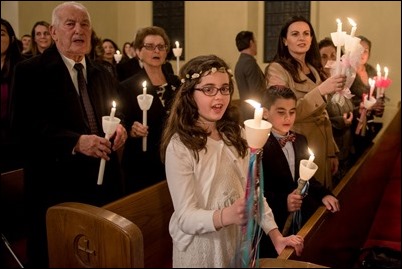
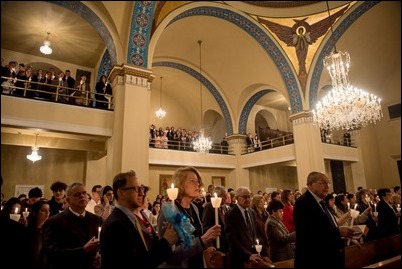
Christos Anesti: Catholic and Orthodox Christians Celebrating Easter

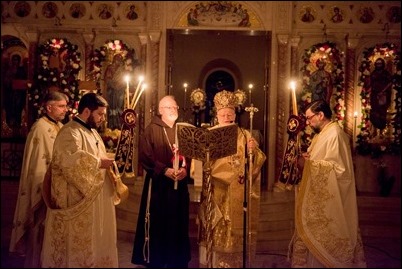
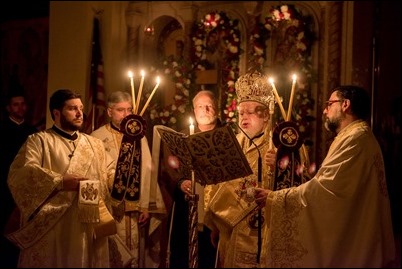
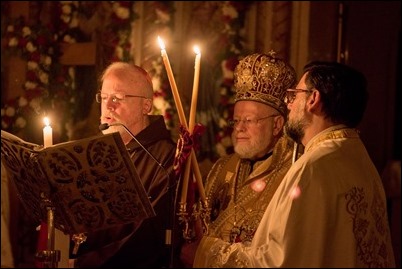
Cardinal Sean O’Malley and Metropolitan Methodios light Paschal candles. Photo Credit: Alex Mavradis

Christians around the world have recently celebrated the resurrection of Christ. The Paschal greeting to people in the Coptic or Greek Orthodox Church is: “Christos Anesti!” which means “Christ is risen!” and the response is: “Truly He is Risen!” or “He Has Risen Indeed!”

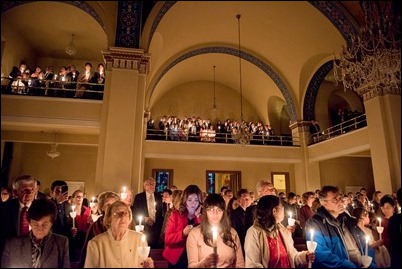
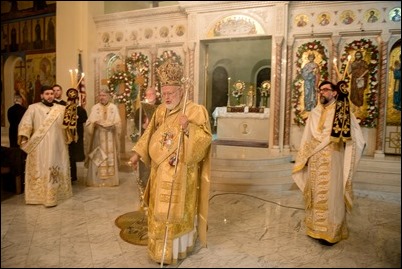
Did you know that here in Boston, the Catholic Cardinal Sean O’Malley and the Greek Orthodox Metropolitan Methodios often attend parts of each others’ Easter Week services to celebrate Easter together? The Orthodox Easter Vigil service begins at 10pm and often lasts until 3am, and Metropolitan Methodios welcomes Cardinal Sean at the proclamation of Christ’s resurrection. Cardinal Sean always says what a joy it is to share this with brothers and sisters within the Orthodox Church. This is a testament to the strength of their ecumenical relationship across Christian traditions.

Read below to see Cardinal Sean’s reflections from this Easter Celebration, which has been reprinted with permission from from Cardinal Sean’s blog.


While this weekend we marked Divine Mercy Sunday, it was also the time when the Eastern Churches celebrated Easter this year. So, that evening I had an opportunity to take part in two different Easter Vigils.

First, I went to the Greek Orthodox Cathedral to join in their celebration.

OrthodoxVig18_AL77843

OrthodoxVig18_AL77858

OrthodoxVig18_AL77862

OrthodoxVig18_AL77904

OrthodoxVig18_AL77938

OrthodoxVig18_AL77953

Metropolitan Methodios always very graciously invites me to read a passage from the Gospel and to address the congregation.

OrthodoxVig18_AL77849

We are so grateful that the Metropolitan comes to our Chrism Mass each year. As he often says in his remarks at the Chrism Mass, it’s a great joy to be able to celebrate Easter twice, once with us and once with his own community.

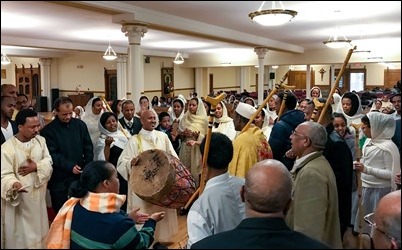
Well, I may have one up on him, because I returned from the Orthodox Vigil in time to greet the Ethiopian and Eritrean Ge’ez Rite Catholic community at the cathedral, who were celebrating their Easter Vigil that night, as well. So, it was my third Easter Vigil of the year.

IMG_8347

Their liturgy ends with very joyful singing, dancing and playing the drums, and it’s always a very lively celebration.


Below is Pope Francis’ prayer from World Communications Day, May 13, 2018. Communication is central to relationship; Pope Francis reminds us how we can be communicating across our Christian traditions to build greater unity:

Lord, make us instruments of your peace.

Help us to recognize the evil latent in a communication that does not build communion.

Help us to remove the venom from our judgements.

Help us to speak about others as our brothers and sisters.

You are faithful and trustworthy; may our words be seeds of goodness for the world:

Where there is shouting, let us practice listening;

Where there is confusion, let us inspire harmony;

Where there is ambiguity, let us bring clarity;

Where there is exclusion, let us offer solidarity;

Where there is sensationalism, let us use sobriety;

Where there is superficiality, let us raise real questions;

Where there is prejudice, let us awaken trust;

Where there is hostility, let us bring respect;

Where there is falsehood, let us bring truth.

Written by uniteboston · Categorized: Blog · Tagged: boston, community, ecumenical, peace, unity

Jun 30 2017

Unity Through Diversity

Lena Denis is our guest blogger this week. She is a local librarian and information professional. Lena inspired young people at her parish to come out to BostonServe with us on May 6th. Read the story below to hear more about Lena’s heart for Christian unity!


When people ask me why I care so much about Christian unity, I often give a personal answer: because over the course of my faith journey, I’ve been in and out of many different kinds of churches. I’m Catholic, but I have ties to Evangelical ministries and I’ve been affiliated with mainline Protestant churches. For as long as I can remember, there hasn’t been only one Christian tradition for me to get to Jesus; it was always a multitude of Christian voices united in my life. For example, I could tap into the ancient traditions of Cappadocian church fathers’ meditation, similar to what we now consider Eastern meditative practices. I could also go to the contemporary worship service down the street and tap into praise music with beats that sounded like they came straight out of the club. Either way, Jesus was present, because according to His words in Matthew 18:20, Jesus is wherever two or more gather in His name. The adventure of finding Christ again and again, sometimes in a completely unfamiliar place, is the joy of the Christian life for me. Unity through diversity is key to my understanding of who I am as a Christian, and how I live the Gospel.

That’s the personal answer to why I care about Christian unity, but there’s a much shorter cut-and-dry answer: because the Bible says to. Scripture says that unity in diversity is what God’s people should aim for because it glorifies God and we accomplish more than when we work independently.

Take, for example, BostonServe on May 6, where churches came together to serve the city. Previous blog posts about that wonderful day show how our Boston-area churches, through their many spiritual gifts, had the opportunity to help a variety of populations ranging from refugees to the unhoused. Attention to all of God’s creation also meant that we cleaned streets and planted gardens. I handed out hot lunches to our brothers and sisters who spent their days on the street, and that alone required a variety of gifts: attention to detail in supply-gathering, packing lunch bags full of essentials like clean socks as well as food, cooking a meal for a large number of people, striking up a conversation and showing a stranger that you care, and the ability to listen deeply when someone wants to tell you their story.

St. Cecilia and Old South Church preparing lunches for our friends on the street for BostonServe

Paul knew that this diverse functioning is us at our best. He wrote in 1 Corinthians 12 that, “There are different kinds of gifts, but the same Spirit distributes them. There are different kinds of service, but the same Lord. There are different kinds of working, but in all of them and in everyone it is the same God at work…Just as a body, though one, has many parts, but all its many parts form one body, so it is with Christ.” We are good at so many different things, both individually and corporately. We’re not supposed to be robots who all do the same task at the same time, because that would be sad and boring and not particularly effective, and it would erase all the beautiful diversity that God made us to be. If we take our diverse gifts and put them together, we are limitless in how we serve the world, which glorifies God.

Participating in BostonServe inspired me to help coordinate a “Reformation 500 Theology on Tapas” event at my church, St. Cecilia Parish. I invited Vito Nicastro (Catholic) and Scott Brill (Lutheran) from the Institute for Christian Unity to speak about their faith experiences and how are honoring ecumenical work and unity in this 500th year since Luther’s Reformation began. I was hopeful that the event would be fun and well-attended, and I couldn’t believe my eyes as the parish hall filled and filled and filled, until we ran out of chairs and had to start bringing them in from neighboring classrooms! People ate and had a great evening of thoughtful questions and some good laughs with our brilliant speakers. This was a tangible demonstration of our unity through diversity.

“Theology on Tapas” Gathering at St Cecilia Parish, June 2017

Long before the institutional church was born, King David knew that this kind of unity is what God desires. In the short and sweet Psalm 133, he sang,

How good and pleasant it is
    when God’s people live together in unity!
It is like precious oil poured on the head,
    running down on the beard,
running down on Aaron’s beard,
    down on the collar of his robe.
It is as if the dew of Hermon
    were falling on Mount Zion.
For there the Lord bestows his blessing,
    even life forevermore.

These days, most of us wouldn’t be too happy with people pouring oil on our clothes, but when we remember the context of priestly consecration in the books of Exodus and Leviticus, it makes sense that this would be a happy image for David. When Aaron and his sons were consecrated with oil and the blood of sacrifice, service to God through these priests could begin.

Though the traditions have changed, our message is the same. When we all band together from our many traditions with our many strengths to live in unity, we are consecrated, and our service is holy. And for me, I can’t think of anything better to strive for.

Written by uniteboston · Categorized: Blog · Tagged: boston, christian unity, ecumenical, jesus, unity

Mar 24 2017

Coming More Alive This Lent

This week, we feature a guest blogger, Fr. Tom Ryan, CSP, who directs the Paulist North American Office for Ecumenical and Interfaith Relations in Boston.

Father Tom recently held a day of reflection entitled “What Will Bring Me More Fully to Life This Lent?” His words are important for us in this period where we are reflecting and considering our relationship with Christ.


CC-BY-2.0/ Susanne Nilsson Via Flickr

If you were to take that approach to Lent this year, you might ask: “What would bring me more alive?”

Keep your eye on the sun in this season. It will give you the primary cue as to what this period we call Lent is all about. In our northern hemisphere, Lent coincides with the turning of the earth towards the sun, the springing forth of life from the apparent death of winter’s frigid grasp.

The very word “Lent” comes from the Anglo-saxon “lencthen,” originally referring to the lengthening of the light. From this original meaning, confirmed in the movement from winter’s darkness to spring’s increasing vitality, we are invited to move out of our own personal lethargy to vitality, from ashes to the paschal feast. Lent, in short, is about coming to life in new ways. It is about growth.

Its spirit is better captured by the pouring of water at Easter baptisms than by the burning of palms on Ash Wednesday. The history of Christian worship reminds us that Lent exists as a time to prepare candidates for baptism and to invite all the baptized to renew their baptismal consecration at Easter. Once again, the emphasis is on new life.

If you were to take that approach to Lent this year, you might ask: “What would bring me more alive?” The practices of physical and spiritual disciplines you choose would be in light of Jesus’ words, “I came that you might have life and have it to the full!” (John 10:10). Yes, you might settle on a practice or two that has some “bite” in it, but it would be undertaken in the spirit of pruning a rose bush, of cutting back the branches that have grown too wild, in order to cultivate more blossoms that give glory to God.

If you approached your life in terms of a holistic spirituality, looking at your physical, mental, emotional and spiritual well-being to see where things have fallen out of balance, have grown wild, and need some pruning or fertilizer or watering, you might ask yourself some questions like these:

How is the balance between my active and contemplative life? Do I spend much more time “conjugating” the verbs doing, wanting, having than the verb being? What forms of prayer might help me restore some contemplative space to my living to allow my soul to breathe?

What is the balance between mind and body in my day? If the scale tips heavily towards major engagement of the mind but minor involvement for the body, what kind of physical exercise might I enjoy that would have the benefit of renewing my energy, enabling me to sleep better, and bring a more relaxed presence to those with whom I live and work?

Is there rough equilibrium between time invested in taking care of myself and time dedicated to taking care of others? If I cannot identify a clear service dimension somewhere in the deployment of my time and energy, what opportunities are there in my locale to assist the homeless, the hungry, the sick or the aged?

Is my relational life blossoming, or dying on the vine? Maybe laying in an evening a week to spend with spouse or friends would be like watering dry soil and bring alive your affectivity with laughter and tears.

What’s the balance between passive watching (as in television) and active reading (as in a good book that nourishes the soul)? Could Lenten fasting take the form of fewer sitcoms watched but more chapters read?

And what’s the ratio between the time my functional activities get and the time made available to nurture my creative energies? Maybe a good Lenten resolution would be to get out at least once a week to an art gallery or a museum, or to an inspiring play or movie.

Whatever you settle on in this season of a springtime for the spirit, keep your eye on the sun and imitate the earth in turning more fully towards the light. Do what will bring you and others more fully to life. There could be no better preparation for the Easter feast of water and light, no better offering to make at the altar, than a heart and spirit renewed and grateful to God for the gift of life both human and divine.


Note: This article was originally published in the Boston Pilot; republished with permission.

Written by uniteboston · Categorized: Blog · Tagged: boston, ecumenical, home, jesus, lent

Jun 29 2016

Why Christian Unity?

What is ecumenism? Why is UniteBoston’s work to bring together churches so important?
UniteBoston Rep Burke Rea has been working to compile a resource list about the value of Christian unity.
Check out our new “About Christian Unity” page here!

Written by uniteboston · Categorized: Blog · Tagged: christian unity, ecumenical, ecumenism, resources

  • « Previous Page
  • 1
  • …
  • 3
  • 4
  • 5
  • 6
  • Next Page »


Give to Further Christian Unity

DONATE!

  • Email
  • Facebook
  • Instagram
  • YouTube

Copyright © 2026 · UniteBoston · Built on WordPress