UniteBoston

Bridging Divides Across Christians for the Flourishing of the City

  • Home
  • Events
    • Submit Event
  • Join In
    • Beloved Community Lab
    • Migrant Care and Solidarity
    • The Church and Civic Engagement
    • The ATTIC
    • Kingdom Conversations
    • Worship & Pray
    • Boston Flourish
  • About
    • UB Board, Staff & Volunteers
    • Cohorts
    • Missional Letter
    • Annual Reports
    • History
    • Christian Unity
  • Forums
  • Blog
  • Give
  • Contact
  • Search

Nov 22 2025

Performing Shalom: A Choir Project

A Cross-Denominational and Cultural Choral Project

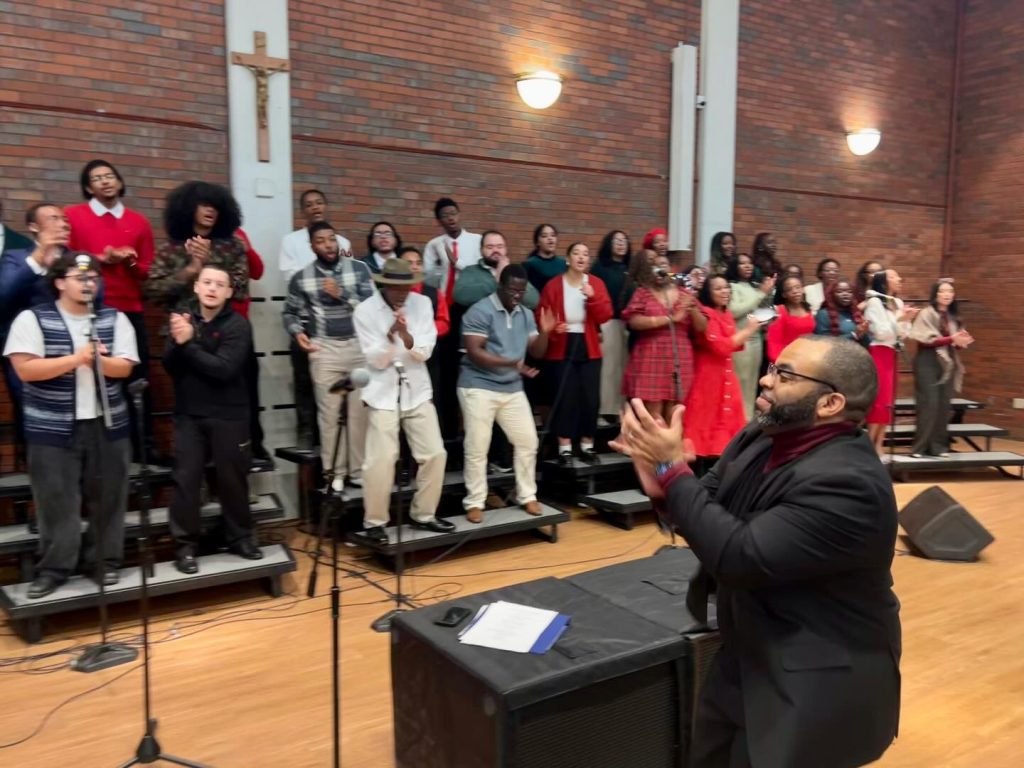
God’s purpose in Christ is “to bring unity to all things in heaven and on earth under Christ.” (Eph 1:10) Join us for an experience of Christian unity through choral singing that is cross-denominational and cross-cultural.

Through choral music, we experience unity in diversity. From Greek Orthodox liturgy music to African-American spirituals and Gospel music, church music of South Korea, Hispanic sacred choral music, and African folk hymns, we explore the richness and diverse unity of global Christian worship. Singing together teaches us empathy, connection, and a deeper understanding of God’s image in all people.

Who Can Join:
All Christians welcome, regardless of musical experience. Whether you’ve never sung in public or have decades of experience, we provide resources to help you learn and participate with joy.

Rehearsals & Concert:

  • Rehearsals:2/9 (Wenham location only), 2/16 (Boston location only), 2/23, 3/2, 3/16, 3/23, 3/30, 4/6, and 4/13, Mondays in Spring 2026 from 7-9 PM (It is okay if you cannot make
    it to all rehearsals!)
  • Dress Rehearsal: Sunday, 4/19, 3–5:30 PM
  • Concert: Sunday, 4/19, 7 PM at Gordon College, Wenham, MA
  • Two rehearsal locations: we offer two rehearsal locations so you can choose to attend  whichever is easier for you
    • Northshore Location: Phillips Recital Hall, Gordon College (Address: 255 Grapevine Rd, Wenham, MA 01984)
      • Parking is available around the campus
    • City Location: Second Church Meeting House in Dorchester (Address: 44 Moultrie St, Dorchester Center, MA 02124)
      • A few parking spaces are available
      • 7-8 min walk from the Shawmut Station on MBTA Red Line or the Talbot Ave Commuter Rail Station

Join Us:
Experience the joy of singing, the beauty of diverse cultures, and the power of unity in Christ.

If you have any questions, please email to minji.kim@gordon.edu and/or debrah.hernandez@gordon.edu

For More Information or to register, please scan the QR code or follow this link.

Written by uniteboston · Tagged: boston, christian, christian unity, shalom, unity

Oct 27 2025

New Book Release! For the Love of Women

At UniteBoston, we are committed to building bridges across divides and strengthening the Church’s witness by reckoning with the deeper causes of division. This week, we’re excited to highlight a new resource that speaks to this mission: For the Love of Women: Uprooting and Healing Misogyny in America — a brand-new book released this week by local author and longtime Boston ministry leader, Dorothy Greco.

Dorothy and her husband, Christopher, have faithfully served the church in Boston for decades. In her latest work, Dorothy explores how misogyny continues to show up in subtle and harmful ways across everyday life — from healthcare and the workplace to media, government, relationships, and even within the Church itself.

Below, you’ll find a snapshot of Dorothy’s heart for this work and her invitation for all of us to recognize these patterns and pursue healing, equity, and justice — so that the Church can more faithfully follow Jesus and embody beloved community.

P.S. If you’re looking to re-imagine and re-form gender relations that move toward forgiveness, healing and the restoration of relationships, consider attending the upcoming Gender Equity & Reconciliation International training taking place in the Boston area.


Dorothy, can you share more about yourself and what led you to writing this book?

I’m in my mid sixties, a wife and a mother of three grown sons. I’ve spent the past forty years working as a photographer, writer, and serving in various capacities in church settings. At core, I’m a journalist with a pastoral heart. I’ve written two other books, Making Marriage Beautiful, and Marriage in the Middle, with the most recent focuses on misogyny. 

The inspiration for writing For the Love of Women emerged out of personal experiences, being proximate to ongoing sexual abuse in church settings, and the current political moment where women and children are routinely being mistreated. As I read and listen to women, so many are choosing to leave the church in part because some vocal church leaders are using their positions of authority to control and demean women. This breaks my heart and I think God wants more for his church and our culture.

How would you define misogyny?

It’s super important how we define this term. Though the literal definition is “the hatred of women,” that’s not the definitive or even the most helpful definition because many people who engage in misogynistic behaviors or hold misogynistic beliefs don’t hate women. Linguist Ben Zimmer notes that misogyny “has more to do with ingrained prejudices against women than a pathological hatred of them.”

Misogyny is a persistent, insidious belief that men’s ideas, wants, needs, and experiences are more important than women’s and that legal, religious, and social systems, as well as intimate relationships, should uphold this principle. This belief system subsequently influences the laws, policies, practices, and ethos of a given culture.

As I write in the first chapter of the book, “if we define misogyny too narrowly, we may be tempted to disregard or deny it. Misogyny encompasses more than specific, tangible acts committed by individuals who admittedly despise women. If we interpret violence or prejudice against women as random and label the Andrew Tates of the world as anomalies, we will fail to see the patterns. If we constrain the definition to include only violent, hateful acts, some men will distance themselves from the conversation and from having any responsibility to change it. We must understand the scope of the issue and expand the definition to fully encompass it.” 

What’s the thesis of the book? 

For the Love of Women examines six spaces in culture where misogyny has influenced laws, policies, structures, expectations, and behaviors: healthcare, the workplace, the government, entertainment and media, sexual relationships, and the church. The final two chapters explore how women and men can heal from the effects of misogyny and partner together to diminish it.

Because it’s easy to dismiss misogyny as a problem “over there,” I’ve focused on North America, primarily the United States, though the examples transcend geographic boundaries.

I wrote this book primarily for women who’ve had first-person experiences of misogyny. Because misogyny harms, shames, and tries to silence us, I wanted to give voice to and validate our experiences. But this offering isn’t only for women. Despite women’s courage, resilience, and strength, we won’t succeed in eradicating misogyny without men’s partnership, which is why I long for men to read this book with curiosity and humility.

Why does the Church need to address this topic?

I’ve been reading and studying Scripture for more than forty-four years. There’s still much I don’t understand, but I do think it’s clear that God loves women. Scripture tells so many stories about Jesus overturning prevailing cultural norms to care for and love women well. I think of the woman caught in adultery whom Jesus spared a certain death by helping the men to see their hypocrisy. Or when the woman who had been suffering from chronic health issues reached for him in the crowd, he blessed her faith and healed her. Further, as we read about the early church, women were released and blessed to lead alongside men in many different capacities, from deacons (Pheobe), to teachers (Priscilla), and patrons (Lydia). 

It didn’t take long for the church to revert back to pre-Pentecost ways. Since Constantine’s rule and decision to make Christianity the state church, women have been excluded from key leadership roles and have been vulnerable to abuse within hierarchical church structures. The church should be the safest place for women and the best place for them to flourish. Tragically, that’s not consistently been true. I think it’s long past time that we addressed these wrongs. 

How can this understanding benefit both individuals and the Church as a whole?

According to Jesus, the most important commandment is to love the Lord with all of who we are and then to love our neighbor as ourselves. Therefore, we need to be loving women as defined by 1 Corinthians 13. This is a radical mandate and one that requires us to regularly confess our sin, repent, and work to repair and reconcile. If the church could consistently love like this, Sunday services would be packed. 

Furthermore, men need to realize that protecting, advocating for, and supporting women is not simply a gospel mandate: their lives will be significantly better when they prioritize mutual flourishing. 

How can we interrupt and heal from misogyny?

The final two chapters of the book focus on what healing and repair from misogyny might look like. Everyone’s journey will be unique, but there are common practices that need to be in place. This includes men confessing any of the ways that they have contributed to misogyny, facing and healing from the trauma misogyny causes, grieving and lamenting in community, and ultimately, forgiveness. In spaces where there has been systemic abuse or injustice, we must not rush the survivors to forgive. It must be on their timetable. 

The goal is not simply to interrupt misogyny, but to stop it. This is no small thing, and women cannot do this alone. Men have to be willing to use their power and authority to benefit everyone, not simply themselves. This requires them to interrogate their stories, face any fears connected to losing power, and learn how to trust others. One practical way to frame male engagement is for men to become allies, advocates, and interrupters. Chapter nine has lots of practical ideas connected to this.

It will require all of us to image what it could look like to end misogyny in relationships, the workplace, the government, and the church. God has blessed each one of us with imaginations and given us access to the Holy Spirit. That’s a lot of potential. Let’s put it to good use.   


P.S. At UniteBoston, we respect the variety of convictions on the role of women in church leadership and we encourage individuals to have honest, courageous conversations of listening, learning and story-sharing with those they may disagree with to grow in our embodiment of Christian unity. We believe Dorothy’s book is an important message today for all of us to consider how we can honor women as image bearers; we encourage everyone to pick up a copy of her powerful message for the Church and society. Byron Borger’s bookstore, Hearts and Minds, is offering 20% off. Dorothy also regularly shares thoughtful reflections on her Substack, “What’s Faith Got to Do With It”

Written by uniteboston · Categorized: Blog · Tagged: christian unity, lent, reconciliation, uniteboston, unity

Oct 09 2025

National Council of Churches’ 75th Anniversary – In Boston!!

The National Council of Churches (NCC) invites Boston-area Christians to attend its upcoming 75th anniversary gathering from October 13-16, 2025.

Info and registration is here. Boston area attendees can use discount code NCCBoston to receive a discounted rate of $75.

  • Monday, Oct 13 at Boston Marriott Newton: Evening plenary and prayer service launching their 75th anniversary celebration featuring Dr. Melanie Hill and Dr. Stephanie Paulsell from Harvard Divinity School

  • Tuesday, Oct 14 at Holy Cross Hellenic College: Panels with global and regional partners including Rev. Dr. John Chryssavgis E.D. of the Huffington Ecumenical Institute, Dr. Demetrios Katos President of Hellenic College-Holy Cross, His Eminence Archbishop Elpidophoros of America,  and His Grace Bishop Anthony of Synoda as well as a Panel Discussion on the Challenges and Opportunities of Ecumenism in a Polarized Society; Book Launch for “Nicaea: The Council and Creed that Defined Christianity;” concert, and installation of the new NCC Governing Board chair during vespers.

  • Wednesday, Oct 15 at the Cathedral Church of St Paul: Morning prayer at The Embrace with Rev. Jeffrey Brown, Our Global Christian Family: Trends in World Christianity for 21st Century Ecumenism with Dr. Gina Zurlo; National Ecumenical Affirmation of the Museum of African American History – Boston; ecumenical walking tour, and site visits to the African Meeting House and Holy Trinity Armenian Church, ending with vespers.

  • Thursday, Oct 16 at Holy Trinity Armenian Church: Closing worship, session on Theology & Technology: Theological Imagination in a Digital Age; Intergenerational Panel; plenary reflections, and a gala awards luncheon celebrating 75 years of Christian unity and witness.

More info and registration is here.

Please share with all those who might be interested.

And everyone is welcome  (no registration, no fee!) to attend their worship service on Wednesday, Oct. 15th, at 7 pm, at the Cathedral Church of St. Paul. The service will combine Episcopal evening prayer and tremendous praise songs offered by the Bethel AME Praise Choir. Sermon by Rev. Dr. Elijah Brown, General Secretary, Baptist World Alliance.
Why This Gathering Matters for Boston Christians 
As Christians locally committed to bridging divides and working together for gospel impact, this is a unique opportunity for us to connect with a broader ecumenical movement. It’s a chance to hear and share wisdom, build relational networks across traditions, and strengthen our shared voice for justice, compassion, and unity.
UniteBoston’s mission—to foster Christian collaboration, unity, and faithful witness in the city—resonates deeply with the goals of this gathering. Attending enriches our local efforts by linking us into the national tapestry of ecumenical work, deepening our theological reflection, and inspiring action in Greater Boston.

Written by uniteboston · Tagged: boston, christian unity, collaboration, uniteboston, unity

Aug 02 2025

There Are No Walls in Heaven: What Peacemakers in Belfast Taught Me

Rev. Kelly Fassett shares reflections from her recent trip to Northern Ireland, where she saw the quiet courage of reconciliation in a land torn by religious and political violence. From walking the Peace Walls, to meeting faith leaders who have given their lives to forge friendships across enemy lines, Kelly explores what these lessons mean for the American Church today.


“A divided Church has little or nothing to offer towards leading a divided people into the way of peace.” —Fr. Gerry Reynolds, Priest at Clonard Monastery in West Belfast

Last month, I had the incredible privilege of traveling to Northern Ireland with a group of fellow Americans in a cohort with Global Immersion. We had traveled there to study peacebuilding efforts in a country marked by decades of violent conflict. It was there where I learned a new word: “themens”— Irish slang for “them.” It’s a word of suspicion and othering, and a posture of inner hostility towards “those people.”

We first heard it in Divis, from Steven Hughes, pastor of St. Peter’s Youth Center. We had spent the morning walking along the Peace Walls—some of them up to 21 miles long and 20 feet high—originally built to reduce violence between Irish nationalists and British unionists.

We learned that between 1968 and 1998, in a period that came to be known as The Troubles, there were more than 3,700 people killed and 50,000 injured in a series of bombings and shootings throughout Northern Ireland. This particular stretch of the walls was known as “Murder Mile,” where much of the violence was concentrated between two groups of people divided by their religious and nationalist identities: mainly Catholics on one side and Protestants on the other. While the physical violence has dissipated, as you walk along these walls, mural after mural stand like tall scars declaring, “you must never forget.”

In the youth center, Pastor Steven began to share his story. He had grown up in the worst of it—seeing bombs explode and friends killed, even as a six-year-old. “Bombs and shells were as common as bird songs,” he told us.

Yet witnessing that violence is what drew him to youth ministry. Even after the 1998 Good Friday Agreement, which ended decades of violence by establishing a power-sharing government and recognizing both British and Irish identities, the walls had to be made taller because people kept throwing objects over them.

But Steven believed reconciliation was possible: “It’s hard to throw stones at someone you know,” he said. His mission? To create space for young people from both sides of the wall to meet and grow up together.

Building Friendships Across the Wall

Steven partnered with a Presbyterian pastor named Tracy that he had met from the Shankle community on the other side of the wall. It took them eight years to build enough trust to start a joint youth group, where youth from both communities began meeting weekly, alternating between centers. They taught a holistic curriculum, including Christian values, trauma healing, leadership principles, and upholding human dignity. 

Pastor Steven leads the Ambassadors for Peace Programme, which has 33 young people from the two communities. 

This joint effort began to change the local community. Steven described that formerly, twenty five to thirty youth per year from this neighborhood were ending up in jail. Now, that number has dropped to just one every four years. Where only 3% of the community had a degree, that number has risen to 10%.

“There Are No Walls in Heaven”

Over ten days, I heard this theme repeated: reconciliation happens through relationships. At Clonard Monastery, a red-brick Catholic church just steps from the peace walls, we heard about “Unity Pilgrims,” an intentional initiative pioneered by Fr. Gerry Reynolds for Catholics to regularly visit other Christian denominations’ services to build friendships and cross-denominational understanding.

Fr. Gerry believed, “A divided Church has little or nothing to offer towards leading a divided people into the way of peace. In the Northern Ireland conflict, divided churches have cost lives.” He often repeated the phrase, “the walls of separation do not reach to heaven.” 

Prayer cards about the Unity Pilgrims from Clonard Monastery

At Black Mountain Shared Space, a community center built on the fault line between divided neighborhoods in West Belfast, we met Shamus (Catholic) and Mark (Protestant), who decades ago were literally shooting at one another, yet had a reckoning when they realized they wanted their children to grow up in a different type of world. Shamus described that what changed him is “trust, and relationship with someone on the other side.” 

We then traveled to Corymeela, a retreat center on the beautiful northern coast of Ireland, which was founded as a safe place for encounter, meeting and dialogue. Here, we engaged in a four-day Dialogue for Peaceful Change training and met another peacebuilder, Rev. Harold Good. Harold had played an influential role in convening opposing parties during the Troubles towards the decommissioning of weapons. He gave us simple but profound advice: “Activate your kitchen table. Talk, truth, trust, and tea—these are the ingredients of peace. Build trust one person at a time, then bring them together over a cup of tea.” Listen to his humble wisdom below.

I felt so honored to meet some of Ireland’s most renowned peacebuilders. From left to right: Rev. Harold Good, Colin Craig, Rev. Shona Bell.

What About Us?

As I reflect on the experience, I am holding a lot. I confess that what I saw in this conflict in Northern Ireland feels like it could be a window into America’s future, just as much as it is a mirror of America’s painful legacy of exclusion and violence. I see us early on in the conflict cycle we learned about, with widening ideological siloes and growing vitriol, marginalized groups being scapegoated, governmental power being used to intimidate and coerce, and underlying tensions that at times are erupting into violence.

I’m learning that reconciliation isn’t just about physical walls—it’s about the walls we build inside. Pastor Steven reminded us: “When you talk about ‘themens,’ remember you’ve got three fingers pointing back at yourself. It’s not something that happens out there, but ‘in here,’” and he pointed right to his heart.

He’s right: the real work lies in removing “themens” not just from our language, but from our hearts—because once we label someone as “other,” it becomes all too easy to dehumanize them, mistreat them, demonize them, and ultimately justify violence against them. UniteBoston is calling this inward posture of hostility “righteous hubris,” and has identified it as one of the main barriers to Christian unity and the oneness Jesus calls us Christians to embody.

Many leaders we met went from perpetrating violence to building peace because they had lost loved ones and didn’t want the conflict to endure into perpetuity, especially for the sake of future generations. I kept wondering – What will it take to turn America around? How might we learn to love – or at least respect – the person on the other side of the wall? 

A Revolutionary Teaching: Enemy Love

What if we took seriously one of Jesus’ most radical teachings—not just to love those who are like us, but to love even our enemies (Matthew 5:43–44)? As Dan White Jr. puts it, “Enemy-love is not peripheral to the way of Jesus—it is the very center. If your version of Christianity does not compel you to move toward your enemy with empathy and curiosity, it may not be Christianity at all.” 

In Christ, hostility is torn down. Righteous hubris removed. Republican and Democrat, Jew and Gentile—there are no “themens” in the kingdom of God. When we root our belief and actions in the imago Dei—that every person is made in the image of God and carries inherent dignity and worth—we’re invited to see others not as adversaries, but as beloved siblings. 

What if we truly saw each person that way? I am beloved. You are beloved. We are beloved. How might the world change if we recognized God’s image in those we fear or oppose, and understood that ultimately what affects them also affects us? (1 Corinthians 12:25–26). That’s the kind of church the world is longing to see.

The peace walls are lined with graffiti, but this woman is working with the St. Peter’s Youth Centre to create this 3D mural with Scripture on it, a visible witness of the transformative power of the gospel to turn ashes into beauty (Is. 61:3).

A Final Word from Pastor Steven

Before we left, I asked Pastor Steven what advice he’d give us as Americans. He paused, then said:
“Get rid of your guns. Fight for relationship with the person who is ‘the other.’ Because you don’t want to have decades to clean up the mess.”

His words were simple, yet profound—a challenge not just to disarm physically, but spiritually. In a world so quick to divide, label, and defend, Pastor Steven reminded us that the path of peace begins with relationship. It begins with choosing to see the humanity in those we’ve called “the other.” Who might that person be for you?

In these tenuous times, we don’t have decades to wait. Let us walk with Jesus and one another to pursue reconciliation and forging friendships across lines of difference, in our neighborhoods, our churches, and our own hearts.

And so, we pray:

Lord Jesus, 
who on the eve of your death,
prayed that all your disciples may be one
as you in the Father and the Father in you,
make us feel intense sorrow over the infidelity of our disunity.
Give us the honesty to recognise, 
and the courage to reject,
whatever indifference towards one another, 
or mutual distrust,
or even enmity, 
lie hidden within us.  
Enable us to meet one another in you.
And let your prayer for the unity of Christians,
be ever in our hearts and on our lips,
unity such as you desire and by the means that you will.
Make us find the way that leads to unity in you, 
who are perfect charity
through being obedient to the Spirit of love and truth.
Amen. 

— Fr Gerry Reynolds, who wrote this prayer for the Unity Pilgrims, inspired by the work of Fr Paul Couturier (1881-1953), a strong believer in the power of praying for Christian unity; and Brother Charles of Jesus (Blessed Charles de Foucauld, 1858-1916), who was martyred when living as a hermit in the Algerian Sahara. 


Practical Next Steps

  1. If the Church has been part of the problem, then it must be part of the solution. This is the heart of our work at UniteBoston—we seek to stand as a public witness to our churches and city, demonstrating that the Way of Jesus is to cross divides and seek out the Imago Dei of all our neighbors across typical lines of difference. We’re launching the Beloved Community Lab this fall—an experiential pilot cohort for Boston-based Christian leaders to learn and grow together as ambassadors of reconciliation. If this stirs up something in you, please prayerfully consider this opportunity and/or share it with a pastoral leader you know. Click here to learn more about the Beloved Community Lab.
  2. I highly recommend listening to this powerful sermon where my colleague Megan Lietz from Abundant Life Church preached last month from Acts 11 on the uniting work of God to bridge cultural and religious boundaries. 
  3. In our polarized climate, violence in thought and action can show up in surprising places – It is vital that we pastor the instincts in our own hearts in order to follow Jesus as the Prince of Peace. I want to offer this blog as a transparent reflection and spiritual practice inviting us as followers of Jesus to do the hard work of examining what lies beneath.
  4. Last, I recommend this blog about turning enemies into friends by my friend and colleague Lexi Carver, who shares incredible wisdom from her time in Northern Ireland and Clonard Monestary about how the Church can be a force for peacebuilding rather than violence.

Written by uniteboston · Categorized: Blog · Tagged: christian unity, lent, reconciliation, uniteboston, unity

Jul 14 2025

Join the Pilot Cohort of the Beloved Community Lab

Monthly on Tuesdays, 11:00AM–2:00PM | Starts September 16 | $750 Stipend | Application Due August 15

 – Do you long to be in a community of Boston-based leaders from a variety of Christian traditions and backgrounds?

 – How do we follow Jesus’ call to love our neighbors – and our enemies – without losing our convictions?

 – Do you want to explore how conflict can strengthen our connections to one another instead of fracturing us apart? 

 – Do you long for the Church to be known for what we are for, rather than what we are against? 

 – Do you desire to be an ambassador of reconciliation (2 Cor 5:20) and want to grow in learning how to lead your community in the peacemaking, reconciling Way of Jesus?   – 

If these questions stir up something inside you, then the Beloved Community Lab might be for you!


A New Kind of Leadership for our Divided Time

Despite Jesus’ clear mandate for unity and welcoming all to the table, churches remain some of the most divided institutions in our society. With over 45,000 Christian denominations and countless divides over race, gender, theology, and politics, the Church’s fractured witness stands in stark contrast to Jesus’ prayer that we would be one (John 17).

A team of diverse Christian leaders in Boston recognized this gap and came together to ask:

What kind of discipleship is needed to form leaders who uphold God’s call for unity and oneness in today’s world?

Through prayer, study, and listening, UniteBoston has been on a two-year journey of developing the Beloved Community Lab, a unique opportunity for Boston-area Christian leaders to come together across lines of difference to learn and practice unity, justice, and reconciliation in their leadership contexts.

We call this a “lab” because it combines core theological concepts with real-world application through case studies, interactive exercises, and spiritual practices. This cohort is a space for spiritual formation—shaping leaders into peacemakers and reconcilers, growing into the life and way of Jesus. 

The things that are keeping us part are deep-rooted: we need a vision of togetherness that doesn’t only lean into our differences but also brings about holistic gospel transformation. If we want to see a different kind of world and a more embodied Christian witness, we must become different kinds of people. Our pilot Beloved Community Lab cohort is an experiment in Christian unity that seeks to change not just what we know, but how we live.


Details 

WHEN: Tuesdays from 11:00AM–2:00PM
FORMAT: Monthly gatherings in-person (Greater Boston Area) or Zoom
STIPEND: $750 for full participation
APPLICATION DEADLINE: August 15, 2025
WHO SHOULD APPLY:
Christian leaders in Greater Boston who value unity, reconciliation, and justice—and want to grow in living these out. We are seeking to convene a cohort community of stakeholders that come from a wide range of denominational, theological, racial/ethnic, and generational backgrounds to shape the curriculum during its pilot stage.

Click here to see the Beloved Community Lab Cohort PDF to learn more about the vision, dates, core competencies, and more. We will be choosing 15 pastoral leaders from diverse backgrounds and we do have $750 stipends to honor leaders for their time and participation.

We believe there’s no better time than now for Christ followers to prioritize the ministry of reconciliation by engaging well across our deep differences – serving as peacemakers in our fractured world. Today’s algorithms and silos will seek to keep us fractured and divided, but God calls us to a different way. 

Apply by August 15 to join the Pilot Cohort! 

We look forward to learning with you! 

Written by uniteboston · Tagged: christian unity, peace, reconciliation, uniteboston, unity

  • « Previous Page
  • 1
  • 2
  • 3
  • 4
  • 5
  • …
  • 30
  • Next Page »


Give to Further Christian Unity

DONATE!

  • Email
  • Facebook
  • Instagram
  • YouTube

Copyright © 2026 · UniteBoston · Built on WordPress