UniteBoston

Bridging Divides Across Christians for the Flourishing of the City

  • Home
  • Events
    • Submit Event
  • Join In
    • Beloved Community Lab
    • Migrant Care and Solidarity
    • The Church and Civic Engagement
    • The ATTIC
    • Kingdom Conversations
    • Worship & Pray
    • Boston Flourish
  • About
    • UB Board, Staff & Volunteers
    • Cohorts
    • Missional Letter
    • Annual Reports
    • History
    • Christian Unity
  • Forums
  • Blog
  • Give to UniteBoston
  • Contact
  • Search

Apr 11 2014

Syrian Bishop Finds Ecumenical Solidarity in Boston

Today, Dr. Vito Nicastro, the associate director of the archdiocese’s Office for Ecumenical and Interreligious Affairs, shares about the rich ecumenical gathering initiated by a visit from His Grace Bishop Elias Toumeh, Antiochian Orthodox bishop of Pyrgou in Syria.

Originally published in the 4/4/14 edition of the the Boston Pilot. Reprinted with permission.
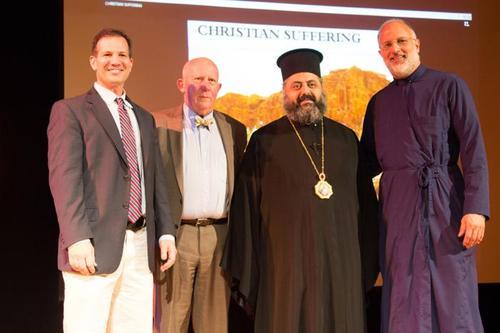

Above, Vito Nicastro, associate director of the archdiocese’s Office for Ecumenical and Interreligious Affairs; Rev. Dr. Rodney Petersen, executive director of the Boston Theological Institute; Bishop Elias Toumeh, Antiochian Orthodox Bishop of Pyrgou; and Rev. Luke Veronis, Director of the Missions Institute of Orthodox Christianity at Holy Cross Greek Orthodox School of Theology are pictured at Costas Consultation of the Boston Theological Institute, March 28. Courtesy photo.

“Hello, Bishop? Would you mind picking up two prisoners, driving them alone behind enemy lines into a war zone, and completing a prisoner exchange for two kidnapped Christians?” This paraphrases part of the experience related by His Grace Bishop Elias Toumeh, Antiochian Orthodox bishop of Pyrgou in Syria, to an academic convocation March 28 in Brookline which was also an ecumenical gathering of Christians united in listening to his peoples’ plight.

Hostage exchange is not even the most heartbreaking part of his ministry as a Syrian bishop. When his phone rings, he does not know if it is another request to come and collect the body of one of his flock. “In the last three years, I learned what it means to be a bishop. It is about being ready to be sacrificed at any moment for the people.”

And his people were the centerpiece of the message, in my impression. The message Bishop Elias brought was Jesus, as witnessed in the life of the Christians of Syria. “We have no enemies. We carry no weapons.” His church instead has become a relief center trying to cope with needs ranging from traumatic stress among children to hygiene supplies. They have built a Peace Center for Children – children of many Christian and non-Christian backgrounds. “We teach them to care for each other.”

A glance at the crowd listening to Bishop Elias told of the bond between Christians. “If one part of the body suffers…” (I Cor. 12:26) The gathering was the Costas Consultation of the Boston Theological Institute, a consortium of 10 theological schools and seminaries of Greater Boston. This year’s host was Hellenic College/Holy Cross Greek Orthodox School of Theology. There was a large crowd, perhaps over 150, of Orthodox, Catholics, and Protestants. There were professors and students from Andover Newton Theological School, Boston College, Boston University School of Theology, and Gordon Conwell Theological Seminary. There were Evangelicals from Unite Boston and Emmanuel Gospel Center; there were mainline Protestants including the head of the Massachusetts Council of Churches; there were Catholics of several stripes including representatives of the lay ecclesial movement The Community of Sant’Egidio; and there were Orthodox of many Churches: Antiochian, Greek, and Romanian. Bishop Elias himself, like many Middle Eastern Christians, has a deep ecumenical background – and a doctorate from Rome.

This diverse group came together in Christian solidarity around the suffering of the Syrian churches. We came first of all to listen and learn. When we Americans hear about Syria on the news it can seem an enigma to us. Most of us think it is a Muslim nation; few know it is historically composite, with a strong Christian presence. Even fewer of us realize how deep the Christian presence runs. Paul was converted to Christ in Syria. Christians were first called Christians in Syria. St. Peter was bishop of Antioch in Syria for seven years before he went to Rome. This is our family in the Triune God. They are precious members, giving witness at great cost. We were there to support them. Once again, as in the Christian Unity Martyrs’ Prayer service of Jan. 25, one of the themes was “you are not forgotten.”

Two bishops have already been kidnapped in Syria and are still missing after almost a year. Priests, Religious, and people of many traditions have been abducted. For all these centuries, Christians have kept the faith, literally, in Syria. Except now, Syria has not kept the Christians. Bishop Toumeh described a Syria which held approximately 2 million Christians three years ago. Now he believes approximately one-third have emigrated, one-third are displaced within Syria, and one-third are left in their homes. He compares their situation to that of the Churches in Iraq. And Syria as a country, he says, is losing a generation. Children have put aside toys and have ordinance collections.

It is not a problem for one Church only, but for all Christians. Subsequent to Bishop Toumeh’s address, news came out that Kessab, Syria, the last Armenian town in the Mediterranean region to survive the 1915 genocide, has been the subject of attacks from Islamic rebels. The result of all of this adversity is the need and desire for deeper Christian unity. As the Holy Father has said, we are living in the age of “the ecumenism of blood.”

Bishop Toumeh said the first need is to stop the violence and begin a political process, then bring in humanitarian aid. After that, economic growth is the key to providing jobs to prevent emigration and thereby save the Christian presence in Syria. At that point, he said, Christians can reclaim the confidence of their historic leadership role in concert with the other parts of Syrian society in the land of their ancient heritage.
Written by jasonjclement · Categorized: Blog · Tagged: boston, boston theological institute, christian unity, christians, ecumenical, holy cross, peace, persecution, prayer, syria, uniteboston, unity

Apr 01 2014

Mennonite Church Plant in Boston

By Vicki Sairs
Originally Published on Mennonite World Review, reprinted with permission

Every day, we hear about more and more churches that are being planted in Boston, and Tim and Alice Colegrove are a big part of that. They are planting a church in Jamaica Plain within the Conservative Mennonite Conference and we are excited to share their story today. If you would be interested in getting involved in the church the Colegrove’s are planting, please contact them at timothy.colegrove@gmail.com

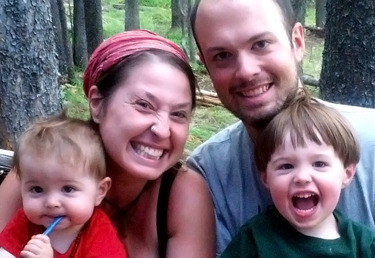
Above, Tim and Alice Colegrove with their sons River and Elias

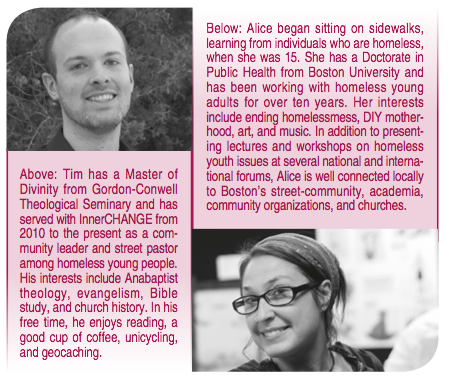
Together, Alice and Tim bring a powerful combination of gifting and experience to the task of church planting. For the last four years, they’ve worked with homeless youth and young adults in Boston through InnerCHANGE, a Christian order among the poor. They’ve acted as advocates and friends for young people on the streets, trying to provide “a healthy community where healing and hope can be found.”

Now they sense a call to step back from their street ministry and focus on building a church in their neighborhood, which they describe as “incredibly diverse” and which they enjoy tremendously.

Here’s how they describe that call: “Our vision is to plant a multi-ethnic evangelical Anabaptist church in the city of Boston committed to discipling new believers, breaking down socio-economic barriers, and gathering an eclectic community around Jesus’ table.”

It will, they say, take “outside-the-box thinking,” but their goal is “to build a church where people from all walks of life can come and experience new life in Christ.”

They see a “great need for church growth and Gospel witness” in Boston and believe that the CMC’s “historic emphasis on peace and simplicity” uniquely position them “to offer a fresh angle on Christian faith… . Boston is rich soil for Kingdom movements towards racial reconciliation, peacemaking, and economic justice.”

“Part of our vision for a church will springboard from the ministry we’ve had with homeless youth and folks on the street. We would love to be able to have a church where they are welcome…where church and non-church people, poor and rich, intellectuals and non-intellectuals come around the table.”


Alice brings over a decade of experience in working on issues of homelessness and public policy to this topic of empowerment. She has worked with young people on the streets, service providers, churches, and academics; at the policy level, she’s worked at the state level in Massachusetts and with the governments of Romania and Peru.
“All those voices need to be heard,” she explained, “to create a bigger picture.” Navigating those worlds takes skill. “God has blessed me with the ability to speak the languages of those various worlds. I have navigated that in the secular world and I can bring that to the church, meeting folks from a variety of backgrounds across the table.”

Tim added, “Secular people are working on this. The church should be even more capable of doing that… .It’s a challenge to the church that secular groups are able to come together. We’d like to see a congregation that meets that challenge.”

Alice said, “At the policy level, it’s not only a good idea [that the poor are included in discussions] … the poor are required to be there. Is that the same in the church?”

Their focus will be on proclaiming the Gospel and making disciples in Jamaica Plain.

Tim explained that there already are “homeless churches and outdoor churches. The drawback is they don’t bring any relational wealth or social capital to the people on the street… It’s hard to overcome the barriers of addiction, poverty, lack of education, unless you have people who can support you in that. We want to build a church that can do that.”

Alice used the parable of the good Samaritan: “Part of our job is being the Samaritan, sitting with the bro- ken, tending to their wounds. But we still need an inn to take them to. An inn is not just filled with the broken, it’s filled with all sorts of people. We want our friends to come from the streets and find healing, and we want folks who are stable to be with them.”


Written by jasonjclement · Categorized: Blog · Tagged: boston, cambridge, church planting, innerchange, jesus, mennonite, poverty, samaritan, testimony

Mar 19 2014

Our Christian Unity Dream Starting to Become a Reality?

Today, we hear from Dick Kiernan, Field Ministry Director for Alpha New England. Dick shares his thoughts on a recent video of Pope Francis and its significance for Catholics and Evangelicals

“May they be brought to complete unity to let the world know that you sent me … “ (John 17:23)

I’m not a gambler, but I bet we all know hundreds of friends of Jesus who are longing for Jesus’ prayer for unity to be answered on this side of heaven. At the end of February, a most extraordinary video of Pope Francis and Kenneth Copeland started going viral. It began when Pope Francis asked his long time Anglican friend, Bishop Tony Palmer, to deliver a video calling for Christian reconciliation to Kenneth Copeland at his annual pastors’ conference in Texas with hundreds of charismatic pastors. Kenneth Copeland reciprocated with prayers and blessings for the pope and said he was “open,” and then he ended by saying that 40 years ago this would have been considered impossible by everyone.

I sent this video link to my Alpha colleagues across the country. Some were in tears or amazed. One simply responded, “breath-taking.” A few other Evangelical friends from my local prayer networks were suspicious. After some discussion I realized that this gesture from Pope Francis and Kenneth Copeland will be misunderstood by some people and it won’t be meaningful if people don’t really live it out. So what is really happening and what is the significance?

Bishop Tony Palmer stated that there are 33,000 Christian denominations and this gesture by Pope Francis is not going to change that. However, the specific challenge that Bishop Palmer gave was for Evangelicals to sign the Joint Declaration on the Doctrine of Justification—also known as JDDJ. He explained that Catholics and Lutherans had resolved Martin Luther’s original protest of “salvation by faith alone,” and this joint declaration about salvation means that Catholics and Lutherans have resolved the main dividing point of the Protestant Reformation. In other words, they came to agree that salvation is by grace alone through faith resulting in good works, but the good works don’t save us–we are only saved by the merits of Christ’s crucifixion. What this means is that we agree on salvation—and we agree that there is one Gospel message. This may not be the end of 33,000 denominations, but it officially states that Catholics and Lutherans agree on this main point of division. Bishop Palmer asked the Evangelicals at this conference (and cyberspace too?) to join with Catholics, Lutherans, and Methodists in signing this joint declaration. Wow—isn’t that something?!

My friends and I started discussing it. Can you imagine Catholics, Main Line Christians, and Evangelicals signing this joint declaration? Can you imagine them changing their thinking? It would mean that Evangelicals would expect to see fruit in someone’s life as an assurance they have trusted Jesus, not “cheap grace.” It would mean that Catholics would stop thinking they get to heaven if they are “good” or perform so many good works. On another level the signing of a joint declaration should involve some dialogue and relationship and increase mutual respect, ultimately leading to authentic fellowship and unity.

Jesus said, “all will know you are my disciples if you love one another,” (John 13:34). Could we even imagine loving each other even if we don’t agree on everything? Pope Francis had recently said that this unity with other Christians must be based on essential teachings we hold in common, otherwise known as the hierarchy of truths. He also said that given the state of society Christians no longer have the option to remain divided. It seems like he really means this.

My friends also came up with a dream. What if all New England pastors and Christians started signing and living this teaching? What if they came together for 10 Days of Prayer and United Nights of Worship? What if they started reaching out to the needed or started doing Alpha together? The 500th anniversary of Luther’s protest, also known as the Protestant Reformation is coming up in three years in October of 2017. What if all New England were to come together to celebrate the end of the Protestant Reformation and the beginning of a new Reformation? Can you imagine international gatherings at Wittenburg and Rome? If this is what Jesus was praying for in John 17, then why wouldn’t we do this? Let’s live the dream—amen.

Written by jasonjclement · Categorized: Blog · Tagged: 10 days boston, boston, christian unity, pope francis, united night of worship

Feb 26 2014

Introducing…the 2014 UniteBoston Reps!

Today, we’re excited to announce the 2014 UniteBoston Reps – Coming to a neighborhood near you!

 How has God been working in UniteBoston?

Great question! Watch this PrayTV Interview with Kelly Steinhaus, UniteBoston Team Leader to learn more.

What are UniteBoston Reps?

UniteBoston Reps facilitate connection between church and community. Through interviews and church visits, UniteBoston reps establish a presence in the community, conveying the attitude that “we care about what God is doing in your midst and are here to serve you.” UniteBoston Reps are also intentional about researching history and demographics to form a comprehensive understanding of the community. By becoming a learner of neighborhoods, UniteBoston reps find out where God is working and how churches/ministries can collaborate together to further that work.

What do UniteBoston Reps do?

Each month has a particular focus around studying the community, such as observation, research, or interviews. UB Reps meet together monthly to share celebrations and challenges of what they see happening in their communities, as well as get trained for the following month. The UB Reps are a tight-knit community of people who prayerfully seek God’s work in Boston together and how churches are a part of the fabric of the city at large.

Why is this initiative important?

While the UniteBoston newsletter and website are helping to spread awareness of what God is doing throughout the city, we realized that it lacked one key component: relationships. Relationships are the heart of unity. Only relationships can instill understanding and help to remove barriers between churches of diverse cultures, denominations, ages and socioeconomic status. UniteBoston Reps devote their time and energy to building relational connections within one specific neighborhood, which makes uniting the city of Boston more manageable.

What are you hoping to accomplish with UB Reps?

Success as a UniteBoston Rep is to connect two independent churches or individuals for a larger purpose. Like a jigsaw puzzle, each piece only makes sense when it is in relationship with the other pieces. A greater sense of awareness will draw on the collective wisdom of the entire body of Christ. This will also improve each church’s aim to make strategic investments with ministry resources, so we fight the right battles and reduce duplication of efforts.

As relationships and trust are fostered, UniteBoston Reps will help to guide the missional activities of the Church within a specific community. This information will be made public to better aid in our efforts to pray for Boston and strategically mobilize the Christian community to meet the needs of the city.

Who are the 2014 UB Reps?

UB Rep: Coolidge Corner – Lex Carroll

UB Rep: UMass Boston – Amanda Green

UB Rep: Jamaica Plain – Bond Hsu

UB Rep: South End – Ralph Kee

UB Rep: Mattapan – Deneen Levy

UB Rep: Fenway – Betsy Slate

UB Rep: Harvard Square – Kelly Steinhaus

UB Rep: Back Bay – Andrew Walker

UniteBoston Reps Informational meeting, January 2014 UniteBoston Reps Informational meeting, January 2014

The current communities that are covered by the 2014 UB Reps - Could your neighborhood be next? The current communities that are covered by the 2014 UB Reps – Could your neighborhood be next?

How can I get involved?

Email Kelly Steinhaus, UniteBoston Team Leader at kelly@uniteboston.com to learn more!

From him the whole body, joined and held together by every supporting ligament, grows and builds itself up in love, as each part does its work (Ephesians 4:16)

If you want to go quickly, go alone; if you want to go far, go together – African Proverb

Long interview with Pray TV:
)

Written by jasonjclement · Categorized: Blog · Tagged: boston, cambridge, christian, christian unity, community, community exegesis, jesus, presence, synergy, uniteboston, unity

Feb 20 2014

City-Wide Martin Luther King Service

Today, Ruth Nkemontoh from Abundant Life Church shares her reflections from last month’s city-wide service to honor Dr. Martin Luther King, Jr.
——-

Rev. Dr. Martin Luther King Jr. was a man who practiced his faith
wholeheartedly. I look to his life as an example of putting faith into action, or as I recently equated it, being comfortable with uncertainty. Each year, around January 20th, people across the US pay homage to this man by hosting a day of community service or holding memorial dinners, film viewings, or other events.

On Sunday, January 19th, 2014, the Black Ministerial Alliance (BMA) and the Cambridge Black Pastors Alliance (CBPA) came together to honor this well known dreamer with a worship service. The service included both Boston and Cambridge-based churches of various denominations. The program created a space for a multitude of pastoral voices to be heard. Even worship followed suit as we were graced with the presence of a gospel choir made up of individuals representing choirs throughout the Boston area. The unity of the entire evening was a beautiful sight to see, an image I am still now left with, two weeks later.

Having moved to Boston over a year ago, I’ve noticed many things – one in particular being how segregated and territorial the city can be. When I found my current church home, Abundant Life, it was through an advertisement in the program of United Night of Worship. That evening spoke volumes as I witnessed people from all over the Greater Boston Area being brought together for the glory of God. Attending the BMA/CBPA worship service was a similar experience. It isn’t that ingenious of an idea to come together as a church, made of multiple denominations, with multiple pastors, and yet how often do we do it? In today’s society, it can be easy to get caught up in the individualistic tendencies our world values so highly, yet God calls us to community. Community is not only the community we make for ourselves, but the wider community that God has made for us. This includes our brothers and sisters across the street, across the Charles River, and across denominations. If we can’t model that as believers, as churches who claim to believe in the Church being one body, then how can we expect the rest of the world to?

The MLK service was a joint effort communicating hope: a statement that
churches are united and banding together for a stronger impact. Gathering to remember a man who helped pave the way for us to be there
that night also served as a reminder of why this unity is still so desperately needed today. In the gospel of Matthew, chapter 18 verse 20, the Lord promises that where two or more are gathered in His name, there He will be also. From the life of MLK Jr. and others like him, we’ve learned that making change requires the effort, gifts, and commitment of many. We can’t go it alone and, once we surrender to the promise that we don’t have to do it on our own, we’re able to step into the fullness of community God has called us into. It is then that we will truly begin to live as brothers and sisters, when we have learned to “rise above the narrow confines of individualistic concerns to the broader concerns of humanity.” -MLK Jr.

Note: This article was first published in Abundant Life Church’s monthly e-newsletter

Written by jasonjclement · Categorized: Blog · Tagged: boston, cambridge, martin luther king, pastors, uniteboston, unity

  • « Previous Page
  • 1
  • …
  • 10
  • 11
  • 12
  • 13
  • 14
  • …
  • 21
  • Next Page »


Give to Further Christian Unity

DONATE!

  • Email
  • Facebook
  • Instagram
  • YouTube

Copyright © 2026 · UniteBoston · Built on WordPress