UniteBoston

Bridging Divides Across Christians for the Flourishing of the City

  • Home
  • Events
    • Submit Event
  • Join In
    • Beloved Community Lab
    • Migrant Care and Solidarity
    • The Church and Civic Engagement
    • The ATTIC
    • Kingdom Conversations
    • Worship & Pray
    • Boston Flourish
  • About
    • UB Board, Staff & Volunteers
    • Cohorts
    • Missional Letter
    • Annual Reports
    • History
    • Christian Unity
  • Forums
  • Blog
  • Give to UniteBoston
  • Contact
  • Search

Sep 11 2016

Preparing for the Reformation Commemoration: Conversation Groups

image credit: http://www.empowermissions.org/
Photo and Graphics: Empower MissionsDigna Reklambyrå

Last fall, Bishop Jim Hazelwood and Cardinal Sean O’Malley announced preparations for a mutual observance of the 500th anniversary of the Reformation. This participates in the worldwide observance, to be initiated October 31, 2016 by Pope Francis and Bishop Munib Younan, President of the Lutheran World Federation. Locally, along with worship and service projects, Cardinal Sean and Bishop Jim encouraged us to participate in ecumenical discussion groups, saying:

…We seek to witness together to the world. One aspect of this witness is in caring for God’s good creation. Pope Francis’ encyclical On Care for Our Common Home provides a timely opportunity for Lutherans, Roman Catholics, and all our ecumenical partners to gather in small groups to read and discuss it together in an atmosphere of prayer and common faith. We encourage all to do so. Such a time of study, prayer, and ecumenical fellowship will serve as a worthy preparation for our mutual observance of the 500th anniversary of the Reformation in 2017.

Over the next year and a half, the commemoration planning team would like to encourage and support congregations in forming such groups not only in the Boston Archdiocese but all across New England. Some congregations, such as St. John Lutheran in Sudbury, MA, have already studied the Pope’s encyclical. Others are beginning to plan for next year’s programs and may choose a different document to study. Whatever approach is chosen, these discussion groups can be a starting point for joint activities including shared acts of service and, in the fall of 2017, a culminating worship experience.

If you would like to join the conversation, here are some ways to get started:

  • Contact leaders of nearby congregations, share the bishops’ letter, and invite them to co-lead a study group with you.
  • Choose the location. Will one congregation host? Or is there a public setting available, such as a coffee shop, library or pub? Perhaps a non-church setting will make the group feel more balanced and welcoming even to people not from our congregations.
  • Set dates. Joint study such as this could make for a wonderful Lenten activity for 2017!
  • Select a text to read together. Suggested options include:

On Care for our Common Home. Pope Francis’ encyclical will certainly be an engaging option with which Christians of all kinds will find common ground.

The Joint Declaration of the Doctrine of Justification (JDDJ). This document from 1999 presents a shared consensus between Lutherans and Roman Catholics on the central issue of the reformation.

From Conflict to Communion. This book explores the themes and history of the reformation and explores the work of recent decades in reconciling our two churches.

(All three resources are available for free online and for purchase at Amazon.com and other retailers. Additional resources are listed below.)

  • Invite and advertise! Depending on your setting and the text you choose, don’t forget to include other ecumenical partners and the non-church neighbors in your community!
  • Share what you are doing! Besides using social media, please also share your plans and stories with our planning team so that we can celebrate this as a region-wide, mutual observance. (You can share your plans by sending them to Pastor Andrew Heisen at pastor_mtolivet@townisp.com. He will be compiling a list of all congregations taking part.)

Hopefully, this cross-congregational opportunity will enrich all of our churches, help us discover common ground, and lead us into other aspects of our mutual observance including joint service projects and liturgical observances – so as to demonstrate our unity through baptism in Christ.

For example, please save the date for New England CityServe, which will take place on May 6, 2017. This initiative will be hosted by UniteBoston, where churches all across the region will be coming together to identify shared missional goals to serve their neighborhoods. The committee is also planning a joint liturgical gathering in Boston for Fall 2017 along with materials for use in local gathering with your local neighbors.

For more information:

More information regarding this and other reformation observances in New England can be found at the website of the Institute for Christian Unity at http://www.instituteforchristianunity.org.

The Commemoration Planning Team would love to hear from you to listen to your ideas and answer questions. We can be reached through Pastor Andrew Heisen of the ELCA at pastor_mtolivet@townisp.com and Dr. Vito Nicastro, Associate Director, Office of Ecumenical and Interreligious Affairs, Archdiocese of Boston, at vito_nicastro@rcab.org.

Additional Resources for Discussion:

ELCA social statement on environment: http://www.elca.org/Faith/Faith-and-Society/Social-Statements/Caring-for-Creation?_ga=1.195392044.149268272.1454101160

ELCA Bishop’s response to encyclical: http://www.elca.org/Resources/Presiding-Bishop-Messages?_ga=1.259436810.149268272.1454101160

Declaration on the Way, From Conflict to Communion Study Guide, JDDJ and other resources: http://www.elca500.org/articles-and-publications/

“Lutherans Restoring Creation Study Guide” http://www.lutheransrestoringcreation.org/Home/highlights/laudato-si—lutheran-study-guide

Study Guide from Archdiocese of Washington: http://adw.org/wp-content/uploads/2015/06/Laudato-Si-Study-Guide.pdf


Written by uniteboston · Categorized: Blog · Tagged: christian unity, christianunity, lent, uniteboston, unity

Sep 09 2016

Praise God in Times Square

Christian unity–the unity of the Church–comes in more than one stripe. Most often, when Christian unity is discussed, the conversation regards the unity, or desired unity, of the great church communities, traditions, denominations.

But there is another Christian unity–another unity of the Church–equal to or greater than the unity of church communities, and that is the Christian unity of colors, races and ethnicities.

Last summer, in New York City, an evangelistic outreach was held, and, as part of the outreach, there was a concert in Times Square. Matt Redman and his band performed (see below link) and you’ll be hard-pressed to find a color, race or ethnicity not represented in this moving and inspiring moment on behalf of the living Christ.

Enjoy!

Re-posted with permission from Matt Crane, Institute for Christian Unity, http://www.instituteforchristianunity.org/?p=466

Written by uniteboston · Categorized: Blog · Tagged: christian, christian unity, christianunity, city, unity

Aug 16 2016

Boston – A City Radical in the Best Way

Our friends at the Emmanuel Gospel Center were featured on an article on Movement Day! Movement Day is a catalytic event designed to transform the world’s cities by focusing on impacting today’s urban issues through the Gospel, and collaborative leadership.

The article mentions how committed ministry leaders in Boston are to Christian unity: “Many of Boston’s denominational and church leaders are passionate about unity and are sharing life and discipleship across orthodox, pentecostal, catholic and evangelical congregations. In fact, many churches blend the best from various church traditions. This is a trend that is taking traction in other cities, and Boston will surely provide fascinating models for unity.”

Praise God! Click on the graphic below to read the full article.

http://movementday.com/boston-a-city-radical-in-the-best-way/

Written by uniteboston · Categorized: Blog · Tagged: boston, catholic, christian, christian unity, unity

Aug 10 2016

UniteBoston was featured in the Koinonia Newsletter!

We have big news – we were just featured on the Paulist Fathers “Koinonia” newsletter! The text is posted below, or you can check it out by clicking on the link here


UniteBoston: Recognizing the Family of God

UniteBoston Reps Team

By Kelly Steinhaus

August 2, 2016
Kelly Steinhaus
Kelly Steinhaus

“These are my brothers and sisters!”

I hear this sentiment expressed repeatedly from individuals attending events affiliated with our up-and-coming ecumenical organization in Boston called UniteBoston. UniteBoston’s mission is to build relational connections throughout the diversity of Boston’s Christian community. There are many differences separating Christians, but with UniteBoston we focus on the shared faith practices that bring us together: worship, prayer, and missional service to the city.

While we are a large network now, with strong relationships in the Catholic, Evangelical, Mainline Protestant, and Orthodox communities, starting a non-profit organization was never our intent. Rather, a group of young people and I noticed that there were so many great things happening around churches in the city, but little infrastructure to connect the events that were taking place with the people that might be interested in attending.

To address this, in September 2010, we started sending out weekly “UniteBoston” email newsletters with information about the various Christian events taking place in the city. Within a couple of months, over 1,000 people had added themselves to the newsletter! Additionally, a lot of local interest was emerging, and a leadership team began to form. Soon, the newsletter became overloaded with information submitted from the community, so we raised funds and built a website.

UniteBoston Fall meeting on Boston Common

UniteBoston Fall meeting on Boston Common

Over the next few years, UniteBoston continued to grow, eventually becoming a 501c3 non-profit in July 2012. In addition to our weekly Christian events newsletter, UniteBoston hosts monthly “meetup” events to build community and encourage people to go beyond their denominational walls to discover all that God is doing in Boston. During Lent last year, we coordinated a “Holy Week Pilgrimage,” which highlighted various worship services that were already taking place in the city. Two young men attended an Orthodox service for the first time on Good Friday, and were astounded by how they resonated with the liturgy.

Additionally, UniteBoston loves to see Christians come together to serve the city. We have a team of “UniteBoston Reps” who are working to build relationships with pastors and city leaders within specific neighborhoods in Boston. The UB Reps meet monthly as a collaborative “think tank” of God’s work in the city, and they mobilize churches together to discern a collaborative shared missional project for their neighborhood communities. We had our first BostonServe day last October, and we’re gearing up for a CityServe day on May 6, 2017 in conjunction with Catholics and Lutherans throughout New England who are coming together to commemorate the 500thanniversary of the Reformation. Truly, God is up to great things in Boston!

Throughout these initial years of our ministry, I have begun to discover something significant about ecumenism: While the Internet can be a powerful tool to bring Christians together, the real work of Christian unity comes down to relationships, which cultivate agape love between brothers and sisters in Christ. It was not until I sat down with brothers and sisters from other denominations and ethnic groups that God began to reveal my underlying biases and partiality towards my own tradition’s worship practices. Through my new friendships, God began to break down my boxes of how I understood Christ’s Church and God’s work in the world. This continues to be true for our leaders and participants in UniteBoston’s events – we’re discovering that Christ’s family is much bigger than we initially imagined!

In coming together across our differences, God does an incredible work in our hearts. We begin to identify ourselves primarily not as Catholic or Lutheran, for example, but as pilgrims on a journey following Jesus Christ. Our denominational distinctions matter, and they matter profoundly – but our differences come to be understood not as barriers for others to enter into my one “right” understanding of God, but rather as beautiful displays of the multifaceted heart of God. I am beginning to see that unity is a process by which the church is brought to maturity (Eph 4:13).

In light of the recent racially-charged events plaguing our nation, I lament with the families that have been affected with this violence and the reality of racial discrimination and injustice within our communities. Jesus models loving those who are difficult to love, and Jesus’ call to love our neighbor must be stronger than our innate tendency to fear and hate those who are different than us.

People in the world are searching for a vision of hope and transcendence beyond what they see. What they are looking for is found in the Church, as Christ’s work on the cross has fully destroyed the dividing walls of hostility (Eph 2:14.) Indeed, we are called to embody this ministry of reconciliation (2 Cor 5:19). However, if people look at the Church and only see us in tension with one another, then how can they believe that our message is about love? Ultimately, it’s as we embody Christ’s message of reconciliation that we will regain our ability to act in healing ways in situations that the world is wrestling with.

In addition to directing UniteBoston, Kelly Steinhaus is also studying urban ministry at Boston’s campus of Gordon-Conwell Theological Seminary. She lives in Brookline and enjoys outdoor activities such as hiking and bicycling.

Written by uniteboston · Categorized: Blog · Tagged: christian unity, lent, reconciliation, uniteboston, unity

Jul 10 2016

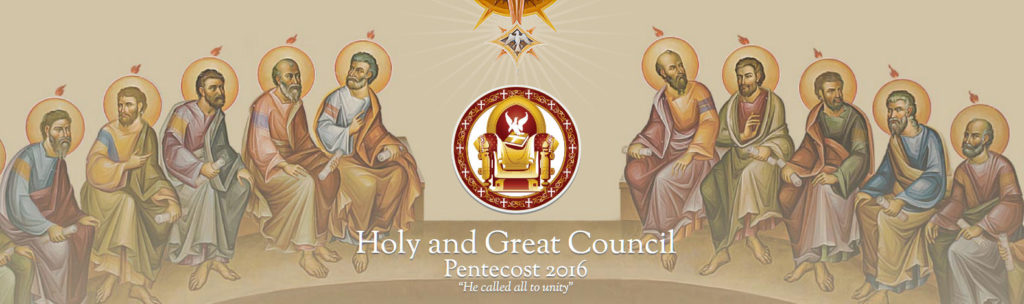
“He Called All to Unity” – The Holy and Great Council of 2016

From June 19th to the 26th, bishops from Orthodox Christian Churches around the world gathered together on a scale that has not been matched for over 1,000 years. This week, our blog is written by UniteBoston Rep Jason Oneida, who updates us on the decisions made at the Pan-Orthodox Great and Holy Council and its worldwide witness towards Christian unity.
————

Image1
Image credit: https://www.holycouncil.org/

From June 19th to the 26th, bishops from Orthodox Christian Churches around the world gathered together on a scale that has not been matched for over 1,000 years. Ecumenical Patriarch Bartholomew of Constantinople issued the invitation for Orthodox bishops everywhere to come together for a great, holy council. The goal of the united body of hierarchs was to advance work their predecessors began generations ago. Over 340 bishops responded to the call and met His All-Holiness at the Orthodox Academy on the island of Crete in Greece. These bishops accompanied their Primate, or leader, in delegations representing their respective local church. Of the fourteen autonomous Orthodox Churches in the world, united by God through common faith and sacramental grace, ten were represented at the council.

The work of organizing the council began in 1930 with a preparatory council that drafted a list of 17 topics for discussion. The 17 topics were combined and reduced down to six through additional pre-conciliar conferences between 1961 and 2015. Unanimity—the ability for all Churches to come to a common mind and witness—was the primary criteria for selecting the topics covered at the Great and Holy Council of 2016. The capability of coming to unanimous decisions was carefully crafted through years of dialog before the council began. Such careful planning allowed the Church to issue resolutions with an authoritative voice backed by all the participating bishops. As a result, one of the primary outputs from the Holy and Great Council was six joint statements on the following topics: the importance of fasting and its practice, the relation of the Orthodox Church to the rest of the Christian world, the mission of the Orthodox Church in today’s world, the sacrament of marriage, and organization of multinational councils of bishops throughout the world.

A gathering so long in the making surely begs a simple, powerful question: what does the council’s work mean for us? In particular, how does it speak to Christian ministry in the greater Boston area? The Great and Holy Council provides reinforcement to Unite Boston’s mission for unity and a guide for future ministry endeavors.

The Great and Holy Council embodied Jesus’ call for unity among all people in its mission statement, organization, and very nature. It is no coincidence that the council was chosen to begin during the Orthodox Christian celebration of Pentecost. And it is also no accident that the council took its slogan, “He called all to unity,” from a hymn sung in honor of this feast day. Furthermore, the council’s method of coming to consensus through dialog and the search for unanimity also bear the mark of desire for unity. All these aspects of the council indicate the overriding truth that unity is essential for humanity. We are not strong alone, but rather when we are gathered together in Christ’s name so that He is among us. Therefore, work toward Christian unity is of the utmost importance to the future of mankind. Following the council’s example, we must strive to understand each other and come to a common mind. We must continue to create opportunities for dialogue that removes the various barriers that separate people.

Image credit: https://www.holycouncil.org/

The wisdom of the Great and Holy Council also provides a guide for future ministerial endeavors. One of the greatest concerns for humankind discussed by the bishops at the council was the ecological crisis. Exploitation of the natural environment to suit human desires has resulted in serious problems with climate change, extinction of a large number of our planet’s diverse lifeforms, and poisoning of our environment. The members of the Holy Council called on Christians to view the attitude of indifference toward creation as a sin fully warranting our repentance. In order to truly be the Church, we must seek to right this situation through prayer, education, and organized action. Let us Christians respond to this call, taking it as an opportunity to be leaders in new environmental ministries that help us fulfill our vocation as caretakers of creation. Here we have an opportunity to be prophetic voices that remind the world of the truth that God made humanity to live in harmony with His good creation.

There is much more to say about the Great and Holy Council than can be presented here. If you would like to learn more, please visit the official website at www.holycouncil.org. There you can see the press releases, read the statements issued, and see videos of the proceedings.

Written by uniteboston · Categorized: Blog · Tagged: boston, christian unity, jesus, uniteboston, unity

  • « Previous Page
  • 1
  • …
  • 74
  • 75
  • 76
  • 77
  • 78
  • …
  • 81
  • Next Page »


Give to Further Christian Unity

DONATE!

  • Email
  • Facebook
  • Instagram
  • YouTube

Copyright © 2026 · UniteBoston · Built on WordPress