
What if the people most familiar with darkness have the most to teach us about how to walk through it?
This Disability Pride Month, we’re honored to feature a guest blog from Maggie Austen—attorney, advocate, and member of The Garden Church—who invites us to consider what the disability community has to offer the Church and the world in times of grief, loss, and uncertainty. Drawing from Scripture, personal experience, and the shared wisdom of disabled and marginalized voices, Maggie reminds us that light doesn’t always come in a flash—it’s often found slowly, tenderly, together.
Below, Maggie reflects on the spiritual skills born of navigating a world not built for you, and how we might all learn to survive—and even thrive—when the lights go out.
Content warning: This piece discusses grief, loss, and death.
As someone who is legally blind, I’ve learned that navigating darkness – both literal and metaphorical – is a skill. The disability community has wisdom to offer about surviving difficult times, finding community in grief, and discovering light gradually rather than demanding it immediately. This Disability Pride Month, let marginalized voices guide you through the darkness we’ve been practicing in our whole lives.
July is Disability Pride Month, and as someone who lives with disability, I’ve been reflecting on what our community has to offer the world – especially during dark times.
This past Sunday, our worship leader Caleb McCoy preached on Ephesians 5:8-20 about living as children of light, letting God’s love shape every part of us as we leave behind old ways and walk in what is good, right, and true. One of his analogies resonated with me in an unexpected way: he mentioned how we’ve all stubbed our toe trying to navigate to the bathroom in the middle of the night.
If you’re not into Jesus and have never heard of Ephesians, stay with me – this isn’t really about theology. It’s about what marginalized communities can teach all of us about navigating hard times.
My instinctive reaction was: Actually, no, I don’t.
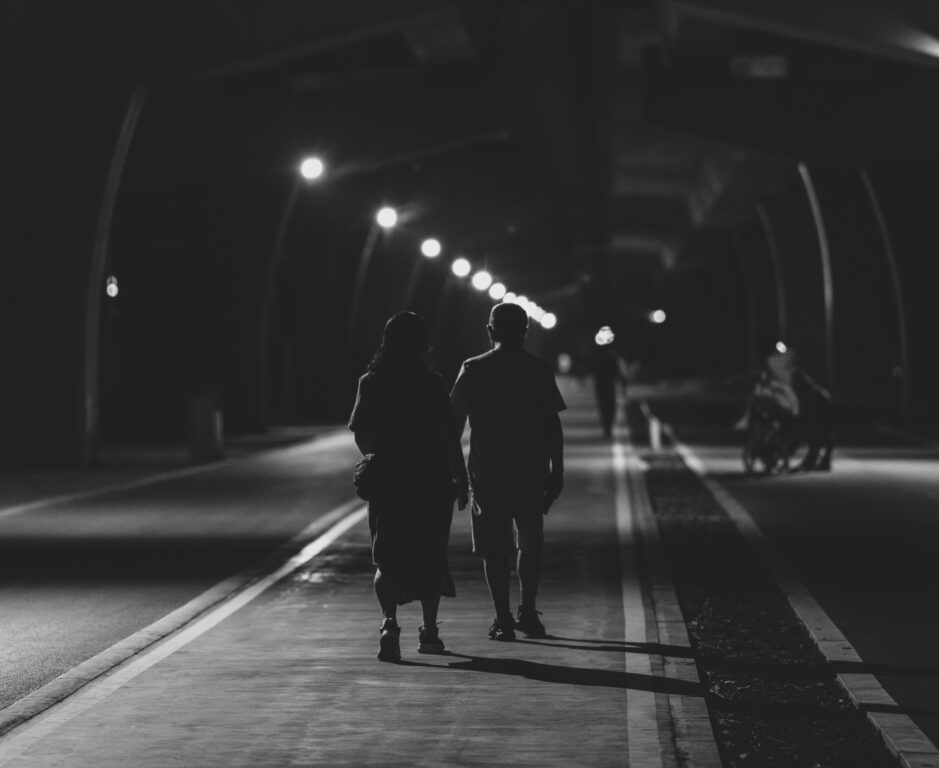
As someone who is legally blind, wandering around in the dark is surprisingly easy for me. The way my eyes work means darkness is sometimes more comfortable than light. My parents and others in my life have often walked into the kitchen to find me elbow-deep in chopped vegetables and immediately started turning lights on. It almost never occurs to me to do so myself.
Of course, this isn’t exclusively true – right after the sermon and my mental celebration of being great at operating in darkness, I did in fact stub my toe going to bed. But the irony got me thinking about something deeper.
Learning to Navigate Darkness
People with disabilities live life with our scars on our sleeves, navigate a world that wasn’t designed for us, and we know intimately what it means to find our way when the path isn’t clear. And I believe this is where the disability community – along with other marginalized and oppressed peoples, whether Black, poor, female, or queer – has something profound to offer: we can be guides in the darkness.
This is a dark season politically, globally, and for me personally. On June 13th, my Nana passed away at 84, after a full and adventurous life and 64 years of marriage to a man who adored her, following a short battle with pancreatic cancer. My retired guide dog, a 13 year old German shepherd named O’Bella, is struggling with numerous health conditions, and I am struggling with anticipatory grief and how to best care for her in this final season of her life.

Living in the disability community for the past five years has made sickness and death all too familiar. COVID-19 brought forward conversations about pre-existing conditions and ventilator priority protocols that meant friends with chronic illnesses and disabilities affecting their respiratory systems became increasingly cautious and afraid. So while much of my healthy, non-disabled community found creative ways to socially distance during peak pandemic, the disability community stayed online and inside – still finding ways to “meet” and be together from afar. In 2020 and ‘21, my Facebook and Instagram feeds became memorial walls of disability activists and community members passing away – whether from COVID, limited access to care, or tragic coincidence.
Content creator Molly Burke recently shared a similar experience of navigating darkness during the California wildfires – the power went out and they were packing to potentially evacuate. She was unphased; navigating darkness is not new to her. While her boyfriend used his cell phone flashlight to try to light a candle, draining the battery they couldn’t charge, she could find and light the candle with no flashlight at all.
So in 2022, when my Aunt Elizabeth, my Pop Pop (Nana’s beloved), and my dear friend Bob all passed away in October, November, and December respectively, I wasn’t prepared, but I was primed. I had a community of people who understood the complexities of grief. Their posts, liturgies, songs, and prayers from the past two years had given me a library of comfort to turn to. I had learned ways to metabolize grief that didn’t leave me stuck under the covers for weeks or neck-deep in a party-sized bag of Cool Ranch Doritos. And I had a faith community with leaders who embraced practices of lament and held grief circles that created spaces to just be in the darkness together. Instead of ignoring the darkness, I learned to walk through it in community.

Perhaps most importantly, I learned the power and importance of telling our stories – not polished, tidy versions like AI-generated TikTok reels, but authentic, complicated moments. The disability community doesn’t shy away from the messy reality of living with chronic illness, navigating grief, or dealing with systems that weren’t built for us. We share the real stuff: the stubbed toes after bragging about navigating darkness, the days when the covers feel safer than the world, the simultaneous grief and relief when a beloved guide dog’s suffering ends.
Rethinking the Light
I think sometimes Christians believe our faith means there’s a glowing sword (yes, I’m imagining a lightsaber now) we can brandish upon invoking the name and power of Jesus. My disabled, broken, bruised, sacrificial Jesus just doesn’t seem to work at my beck and call.
I believe Jesus is a light in the darkness, but I think it’s more like the way rhodopsin in our eyes eventually adjusts to the darkness and starts seeing the light that was there all along. (Thanks to my roommate Elizabeth Bonnice for this rhodopsin reference – after a long chat in our kitchen over a glass of wine, I was able to detangle some of my thoughts for this piece.) The adjustment takes time (like breaking in a new pair of shoes – going back to Caleb’s sermon analogies for a moment). The seeing happens gradually. And sometimes, we need guides who are already comfortable in the dark.
A Challenge for Disability Pride Month
This month, my challenge to my Christian comrades is this: stop weaponizing Jesus’ light. I’m not asking you to stop hoping that darkness will flee or praying for dawn to come (or even police your vocabulary). But while we sit in the darkness of the world today, remember your disabled and marginalized neighbors. This wisdom is especially needed now, as wars around the world continue to be mass disabling events, while rhetoric from leadership continues to scapegoat us, and policies further marginalize and oppress.
And for my friends who don’t share my faith – the invitation is the same. In these dark times, consider what wisdom might be found in the voices of those who’ve been navigating darkness all along.
Maybe we have something to teach you about surviving in the dark. Maybe we’ve developed skills, communities, and spiritual practices that can help you navigate when the lights go out. Maybe our scars aren’t just marks of what we’ve survived, but maps of where we’ve learned to find our way.
I’m not saying that chopping vegetables isn’t easier with the light on, or that darkness isn’t challenging to navigate. The season of grief I am in – and quite frankly have been in – has been exhausting. I am still learning to embrace moments to hide under the covers (rather than sign up for one more well intentioned commitment), indulge in the decadent pastry when I just need a little something sweet in my day (instead of shame myself into another kale salad), to be kind to my body (instead of expecting it to roll with the punches), and to not push community away in favor of independence or isolation. It is not easy, it is messy.
But when we stand next to a mountain with a friend, the mountain does not seem so tall. When we stand in the darkness with someone who can chop veggies with the lights off and who lets guide dogs help them cross chaotic city streets at midnight, the darkness might not seem so dark after all.
We’ve been practicing this our whole lives, learning to navigate when the path isn’t clear. Let us be your guides.
What might that look like practically? Invite people with disabilities to serve on advisory boards and decision-making committees. Ask us how we feel about policies that affect us, rather than deciding for us. Support disability-led organizations and activism financially and through amplifying our voices. Listen to our stories (plug for JustBook-ish and DotOut’s Disability themed Dot Stories event on July 17th) – the real, messy, complicated ones – rather than the inspiration porn versions. And when the lights go out in your own life, remember that some of us have been finding our way in the dark all along.
This Disability Pride Month, I invite you to listen to the voices of disabled people in your communities, to learn from marginalized voices, and to discover what wisdom might be found in the darkness – not as a place to fear, but as a place where we can learn to see differently.

And to read more from Maggie, check out her earlier blog post written during Disability Pride Month last year. Drawing from Luke 14, Maggie asks: Would those Jesus calls us to invite—the poor, the disabled, the overlooked—feel truly welcomed in our churches today? In this reflection, she shares a personal story that challenges us to extend God’s welcome to those society often excludes as well as practical advice for church leaders for how they can DO disability justice.
This was incredibly moving and just what I needed to hear. I agree, Maggie, and I think you for the reminder! I am the lucky parent of a kiddo with a physical disability who is pure joy. The world isn’t built for him, and that worries me now more than ever. But watching him navigate the world–the creativity, the adaptability, the confidence he has in himself and in other people–brings such wonder and hope. He seems to know inherently that he is “fearfully and wonderfully made” in God’s image, and reminds me that I am, too.