By Scott Rice, Kristin T. Lee and Greg Fung

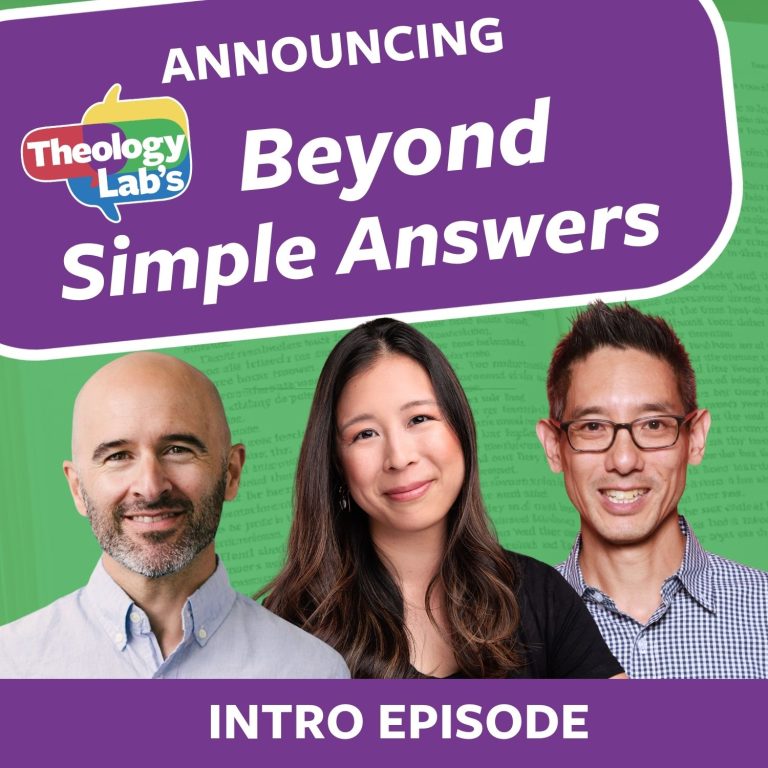
How do we pursue a theological vision when simple answers aren’t enough? This is the core question behind a new podcast series from Theology Lab, called Beyond Simple Answers.
Today, Scott Rice (ThD) from Highrock Church offers two key insights to this central question. Below, he unpacks this exciting new series and how we can uphold God’s vision for unity and diversity by seeking nuance and curiosity in our faith.
Does Theology Matter?
For me, Beyond Simple Answers is more than a new podcast series. The vision behind this series tries to capture the gift I hope theology can be for everyday Christians, how theological conversations can be meaningful tools for discovery and spiritual growth. Personally, this is because theology has been such a necessary and practical thing for me.
College was a challenging period in the thinking life of my faith. I encountered questions that caused me, for example, to reexamine how God speaks to us through the human authors of the Bible, people like you and me. I was also invested in off-campus ministry where I became close friends with people in situations of chronic poverty. The experiences they shared with me led to much grappling, theoretically and personally, with the problems of human suffering that surround us.
Theology wasn’t so much a choice, but something I was compelled to do. It’s not that it wasn’t joyful – to the contrary, I found wonderful companions for reflection in both ancient Christian traditions and conversations with peers that have turned into longstanding friendships. But it did feel like something I had to do for the sake of honesty: I knew that for me to continue to pray, to participate in acts of worship, now required exploring questions about God’s goodness and what it means to trust an invisible God.
God met me in these ventures. What’s more, conversations about faith spurred me into asking new questions, which I’ve found often leads to a more (not less) vibrant way of relating to God. These experiences also gave me new perspectives on my past. I came to appreciate the people in my faith life like Chris Eiesenman, a spiritual mentor of mine from high school, who embodied putting Christ in the center of all things. I didn’t realize it then but, to me, Chris exemplified a faith rooted in Christ that could be expressed in generosity toward others, in both actions and in how we exchange ideas with other people.
This has been my journey. Theology and community have been gifts that have sustained my faith. And I think it’s part of what inspires Beyond Simple Answers, a vision for faith and reflecting on belief today that Kristin, Greg (my co-hosts in this podcast) and I hope to convey in this joint venture.
What’s Beyond Simple Answers about?
The motto of Beyond Simple Answers is this: seeking a theological vision when simple answers fall short. There’s two parts to this:
Beyond Simple Answers isn’t about going beyond the beautiful simplicity of faith. The beyond is more like what the Psalmist means in the line, the law of God “is sure, making wise the simple” (Psalm 19:7 NRSUVE). It’s the yearning that many have expressed – and which you could probably see in my story above – for a faith characterized by nuance and subtle reflection. For many, that comes through in words like deconstruction. In the story I shared above, it meant a deep desire for curiosity to play a more basic role in what it means for me to be Christian.
The second part has to do with holding onto a theological vision, or continuing to think through such a vision. For some, facing doubts or a process like deconstructing (which admittedly means different things to different people) means belief moves to the margins of one’s life, or ceases to exist at all. But, often, it doesn’t. For many, the issue isn’t unbelief – rather, it’s about a variety of things that prompt us to seek out a way of navigating faith, doubts, and questions in community.
I have shared how new questions both led to difficulties but also a new sense of rigor in my faith life. Questions like Who is God? or How do we grapple with the reality of suffering in the world? or How do we interpret the Bible? haven’t lost their urgency, although we might find ourselves thinking about them in deeper ways. For many, a theological vision still matters; it may even be the key to a revitalized faith.
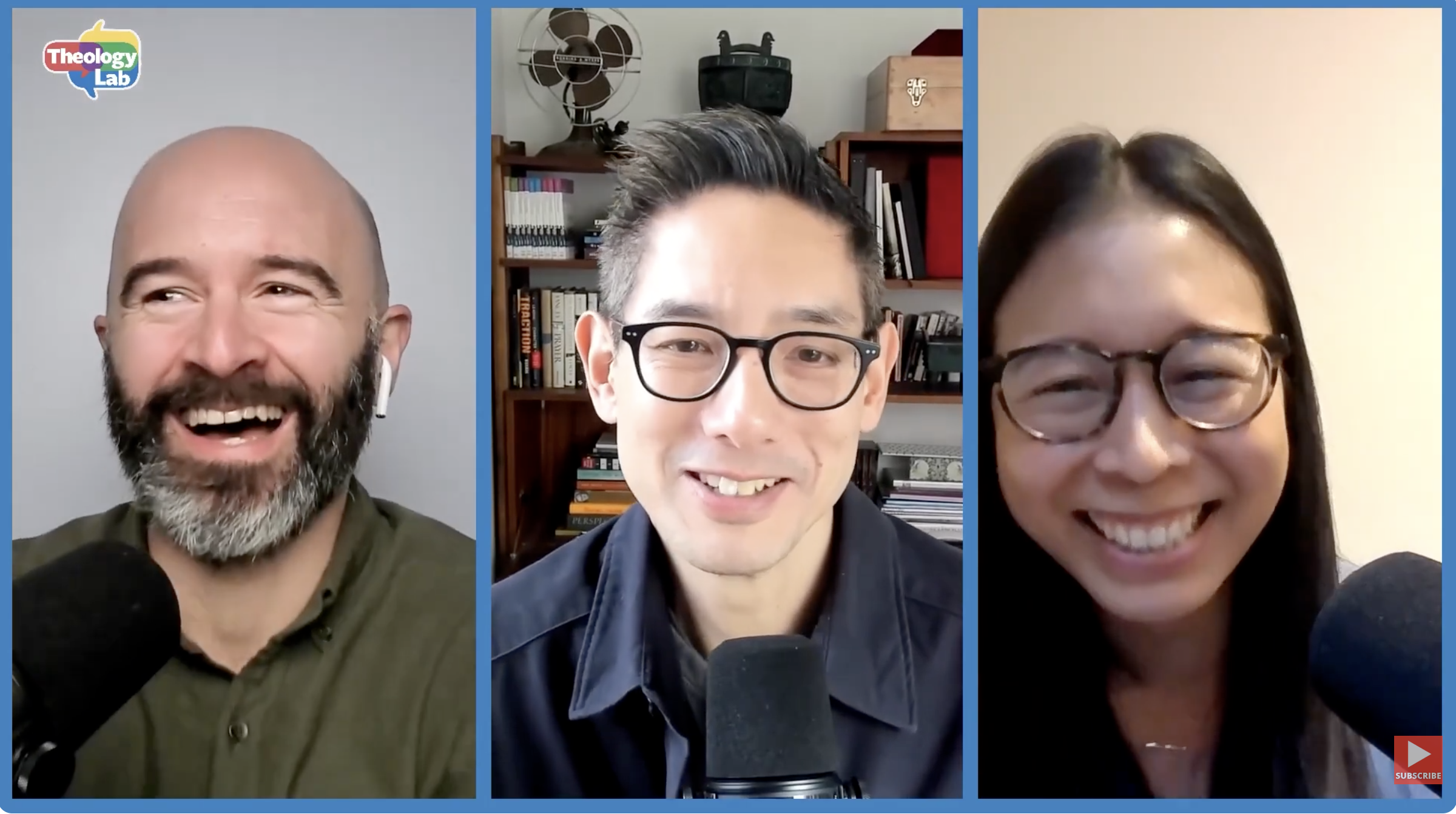
My co-hosts in this series are Kristin T. Lee and Greg Fung. We are part of Highrock Church, and in many ways, Beyond Simple Answers is our attempt to do in public something we’ve been doing in everyday conversations for years. When there are several, seemingly disconnected lines of thought in a given conversation, Greg is adept at identifying the signal among the noise. Kristin has a knack for naming the felt-need behind luminous theological concepts, and forging links between theological ideas and solidarity with people on the margins.
Each of us cares about pursuing a theological vision within a faith community. We know that we won’t end up in the same place on every topic. Uniformity isn’t the goal. (For a lighthearted example of this, see Greg’s growing affinity for process theology in episode 3.) Rather, it’s to learn what Christ means for a vibrant, thinking faith – together.
These last lines point to the importance of a lived notion of unity-in-difference in Beyond Simple Answers. This is, of course, also central to the mission of UniteBoston. In this spirit, I thought it would be appropriate to ask Greg and Kristin what unity-across-differences means to them as we begin this joint venture at Theology Lab.
What Does Unity-In-Difference Mean to You?

Kristin: When I come up against thorny theological questions that stump me (and that have frankly stumped the entire world, unless someone has solved the predestination vs. free will conundrum), I find myself craving a multitude of viewpoints rather than a singular but unsatisfying ‘answer.’
For example, I was raised on the idea of penal substitutionary atonement as the one and only understanding of the cross—so normalized that it didn’t even have a name or label. It was the only explanation I was ever given for how and why Jesus had to die for our sins. As an adult, when I found myself troubled by aspects of this teaching, it was a relief to discover that there are actually a multitude of lenses through which we can understand the cross and its centrality to our faith, none of which likely encapsulates the entire glory of Christ but all of which can contribute to our understanding of God’s love. This pattern repeated itself over and over. At multiple points where my faith felt ready to break, it was listening to voices on the margins of the church that kept me hopeful and believing.
Thus, to me, unity is essential, because unity means embracing our diversity and not casting anyone out. It means keeping the table of theological discussions open to all who approach it out of love, especially bringing those to the table whose voices haven’t yet been platformed, who can nuance or trouble our too-easy explanations of God. Unity is an acknowledgement that we need every single one of us to be the living, breathing body and to better see the multifaceted brilliance of the God we worship.
Greg: There was a time in my life when “unity across differences” meant gathering large groups of different people into one big event. I was in a para-church ministry and remember the vibrant energy of being a part of something larger. These large-scale events provided energizing visions of unity, but (understandly) were less adept in helping us reckon with differences that might enable us to go beyond ourselves.
I would return home, inspired, but without ministry tools for navigating complex situations. I needed a broader vision that could hold competing values in tension, but doing so would have required me to venture past my safe theological comfort zone, something I was not able or willing to do at the time.
Being open to change is hard for me. I’m especially resistant to frontal assaults on my worldview, and I respond poorly to coercive or manipulative efforts to make me change my mind. Yet, there have been unpredictable moments where I’ve grown. Most often, they are when I’m with people I trust, who have similar goals and values, but who don’t see the world exactly as I do. Something magical happens for me when there’s just a bit of grist in the midst of a safe place.
Which is why I’m excited about Beyond Simple Answers. It aims to make these random moments of growth more commonplace. One of our hopes is to foster, or perhaps better, try to embody the kind of growth that comes from bumping up against one another in relationship — not in spite of our differences but because of them. I’m not sure what the outcome will be, but I know it will involve growth, be a little messy, and be a whole lot of fun.

Here at UniteBoston, we celebrate Scott, Kristin, and Greg’s efforts to cultivate conversations to take people deeper and grow in Christ “beyond simple answers.”
The Introduction episode is available on Apple Podcasts, Spotify and YouTube.
Episodes 1-5, addressing the question Why does God create a world with so much suffering? will be released during the months of March and April 2026. Subscribe or follow Theology Lab’s podcast or YouTube channel to receive the latest episodes!

I’m so excited to dive deep into these podcasts and to explore the ways in which faith can be shown and demonstrated in so many different ways. Every person’s journey gives them a unique perspective on God’s kingdom and our place in it and I look forward to listening and learning from 3 individuals who are deeply interested in living their faith not through words, but through actions: living and asking authentic questions while seeking out answers that have no easy answers about faith, God, and our place in this infinite universe.